
Employee Provident Fund (EPF) in India: How Section 80C Deductions Save You Tax
 Feb, 11 2026
Every month, a portion of your salary disappears into the Employee Provident Fund (EPF). You might not even notice it - but that money isn’t gone. It’s growing. And if you’re smart about it, it can also cut your income tax bill. That’s where Section 80C comes in.
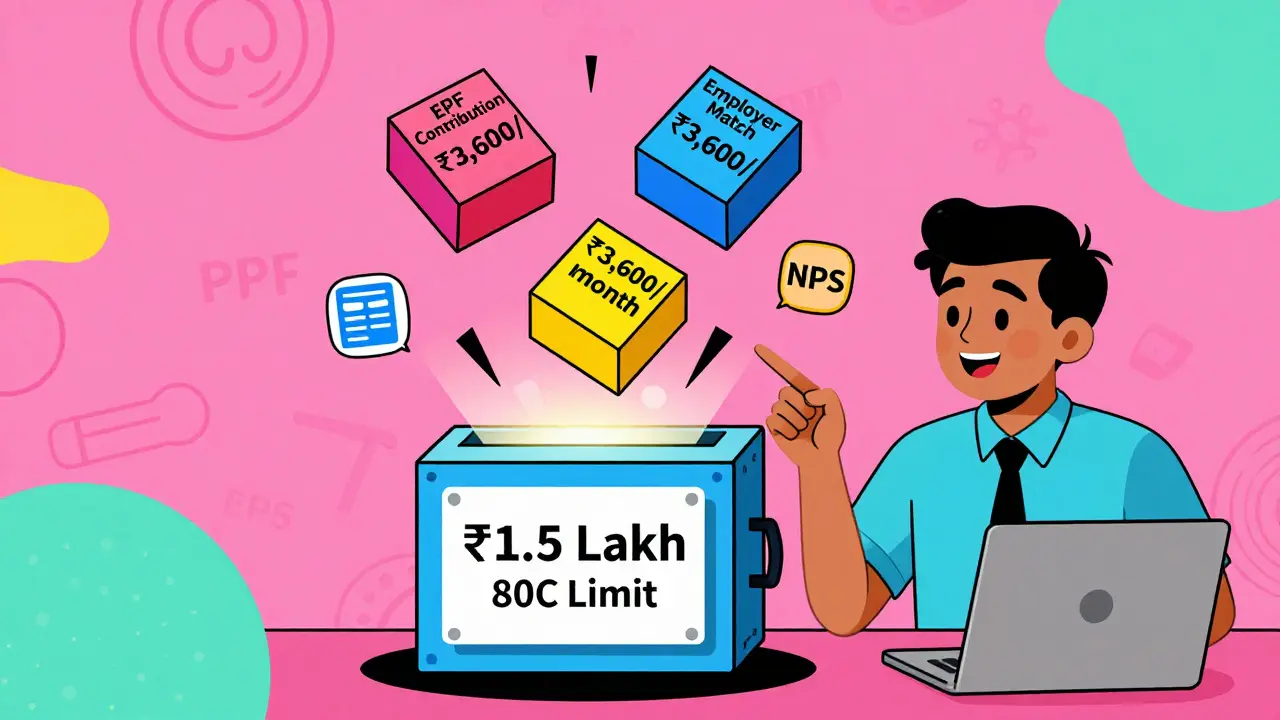
Section 80C of the Income Tax Act lets you claim a deduction of up to ₹1.5 lakh every year for certain investments and savings. Your EPF contribution is one of the most powerful tools under this section. But not everyone knows how it works, or how much they can really save. Let’s clear the confusion.
What Exactly Is the Employee Provident Fund?
The EPF is a mandatory retirement savings scheme for salaried employees in India. If you work for a company with 20 or more employees, your employer must enroll you in it. Every month, you contribute 12% of your basic salary plus dearness allowance (DA). Your employer matches that with another 12%. That’s 24% of your basic pay going into your EPF account.
Here’s the catch: only 3.67% of your employer’s contribution goes into your EPF account. The rest (8.33%) goes into the Employee Pension Scheme (EPS), and a tiny fraction (0.5%) goes to the Employee Deposit Linked Insurance (EDLI). But for tax purposes, you only care about the total amount you personally contribute - because that’s what qualifies under Section 80C.
How Section 80C Works With EPF
Section 80C allows you to deduct up to ₹1.5 lakh per financial year from your taxable income for specific investments. Your EPF contribution is one of them - and it’s automatic. If you earn ₹50,000 a month, your basic salary is likely around ₹30,000. That means you contribute ₹3,600 every month to EPF. Over a year, that’s ₹43,200. That entire amount counts toward your ₹1.5 lakh limit.
But here’s what most people miss: you can still invest more under Section 80C. Maybe you’ve got a PPF account, paid life insurance premiums, or invested in ELSS mutual funds. All of those add up. Your EPF contribution is just one piece of the puzzle. If you’ve already maxed out your ₹1.5 lakh limit with other investments, your EPF contribution won’t give you extra tax savings - but it still grows tax-free and gives you a retirement corpus.
Why EPF Is Better Than Other 80C Options
Not all Section 80C investments are created equal. Let’s compare EPF with two common alternatives: fixed deposits and tax-saving mutual funds.
| Feature | EPF | PPF | ELSS Mutual Funds |
|---|---|---|---|
| Lock-in Period | Until retirement (or job change) | 15 years | 3 years |
| Current Interest Rate (2025-26) | 8.25% | 7.1% | Not applicable (market-linked) |
| Tax Treatment on Withdrawal | Tax-free if held 5+ years | Tax-free | Tax-free after 3 years |
| Employer Contribution | Yes (12% match) | No | No |
| Default Investment Risk | Very low (govt-backed) | Very low | High (market dependent) |
EPF wins on two fronts: guaranteed returns and employer contributions. Even if the interest rate drops next year, it’s still higher than most bank FDs. And the employer’s match is free money - something you can’t get from ELSS funds or NSCs.
What Happens If You Change Jobs?
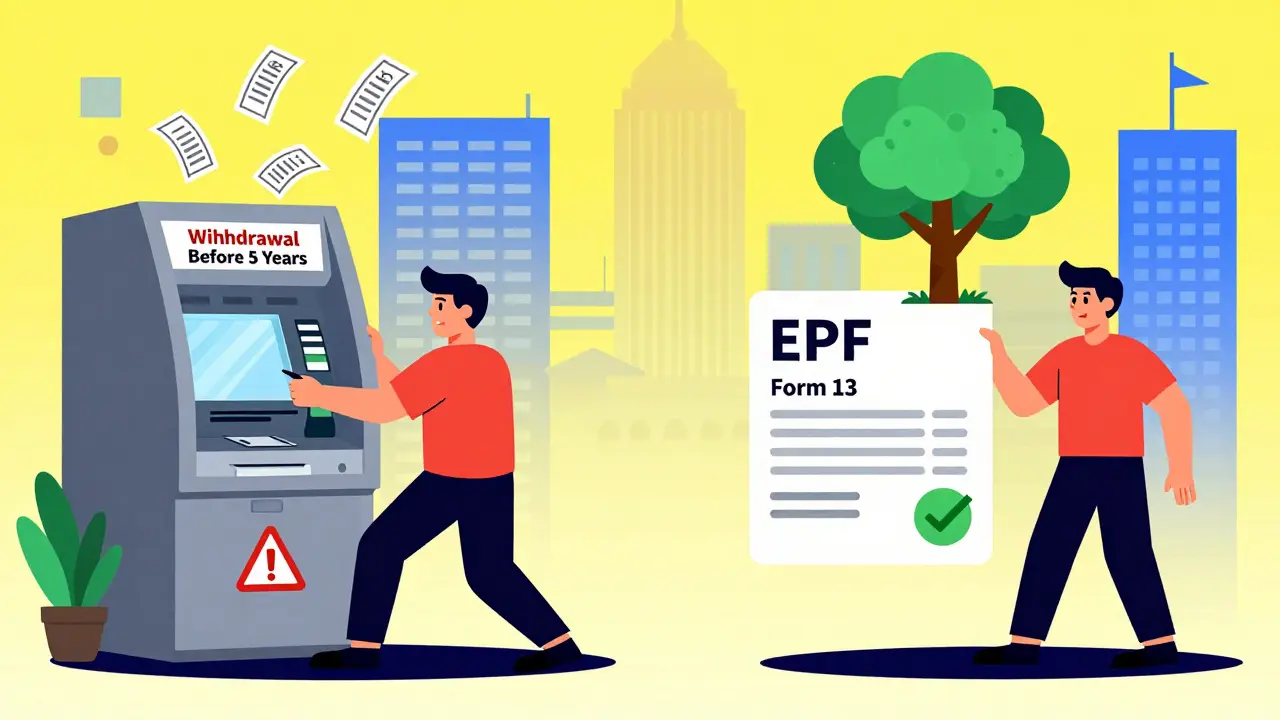
Many people panic when switching jobs. They think their EPF money is locked or lost. It’s not. You can transfer your EPF balance from your old account to your new one using Form 13. This keeps your contributions continuous and ensures your 5-year lock-in period isn’t reset.
Why does that matter? Because if you withdraw EPF before 5 years of continuous service, the amount becomes taxable. Even if you contributed under Section 80C, the tax benefit gets reversed. That’s a nasty surprise if you didn’t know.
Example: You worked for 3 years at Company A, contributed ₹1.2 lakh total, claimed ₹1.2 lakh under Section 80C. You left and withdrew your EPF. The entire ₹1.2 lakh gets added back to your taxable income for that year. You’ll owe tax on it - plus interest and penalties if you didn’t report it. Don’t do this.
Can Self-Employed People Use EPF?
No. EPF is only for salaried employees under the Employees’ Provident Fund Organization (EPFO). If you’re self-employed, you can’t contribute to EPF. But you can still use Section 80C with other options:
- Public Provident Fund (PPF): Open a PPF account at any post office or bank. You can deposit up to ₹1.5 lakh per year. Interest is 7.1% (2025-26), and withdrawals are tax-free after 15 years.
- NPS Tier I: National Pension System lets you invest up to ₹50,000 extra under Section 80CCD(1B), on top of your ₹1.5 lakh limit. It’s a good option for long-term retirement planning.
- ELSS Funds: Equity-linked savings schemes offer higher returns over time. They have a 3-year lock-in and are ideal if you’re comfortable with market risk.
If you’re self-employed, PPF is your closest equivalent to EPF. It’s government-backed, tax-free, and gives you a steady return.
How to Maximize Your Section 80C Benefits
Here’s how to get the most out of Section 80C without overcomplicating things:
- Check your EPF contribution each month. Multiply it by 12. That’s your first ₹43,200 (or whatever your number is) toward the ₹1.5 lakh limit.
- Use the rest of your limit for investments that give you better growth. If you’re young and can handle risk, put more into ELSS funds. If you’re risk-averse, use PPF.
- Don’t forget about employer contributions. They don’t count toward your 80C limit, but they’re still free money. Keep your EPF account active.
- Transfer your EPF when you switch jobs. Never withdraw unless absolutely necessary.
- Track all your 80C investments. Use a simple spreadsheet or your employer’s payroll portal to see how close you are to ₹1.5 lakh.
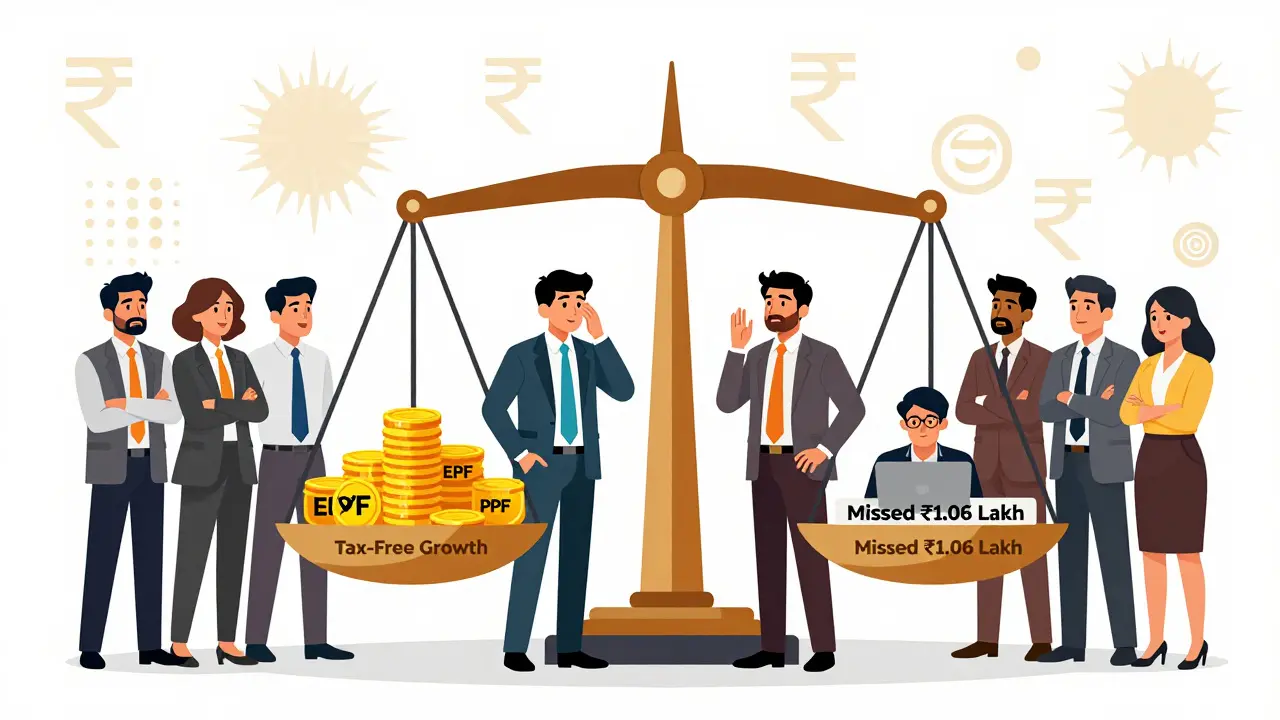
Most people don’t even hit the ₹1.5 lakh limit. If you’re contributing ₹43,200 to EPF and nothing else, you’re leaving ₹1.06 lakh in tax savings on the table. That’s a potential ₹17,700 in tax savings (at 20% slab) - just sitting there.
Common Mistakes to Avoid
- Withdrawing EPF early: If you leave a job and withdraw before 5 years, you lose the tax benefit. You’ll owe tax on the entire amount you claimed under Section 80C in previous years.
- Double-dipping: You can’t claim EPF contributions twice - once by you and once by your employer. Only your contribution counts. The employer’s part is not deductible.
- Ignoring Form 12BB: Your employer needs this form to know how much you’re investing under Section 80C. If you don’t submit it, they won’t reduce your TDS. You’ll end up paying more tax upfront and get a refund later - tying up your money.
- Assuming EPF is the only option: If you’re in a high tax bracket, mixing EPF with ELSS or PPF can give you better long-term returns while staying within the limit.
What About Tax on EPF Interest?
Good news: EPF interest is completely tax-free. Even after retirement, when you withdraw your entire balance, you don’t pay any tax - as long as you’ve been contributing for at least 5 years. That’s a huge advantage over taxable fixed deposits or savings accounts.
There’s one exception: if you contribute more than ₹2.5 lakh per year to EPF (which is rare), the interest on the excess amount becomes taxable. But for 99% of employees, this doesn’t apply.
Final Takeaway
Your EPF isn’t just a forced savings account. It’s a tax-saving machine, a retirement safety net, and a free money generator rolled into one. You’re already paying into it. The question isn’t whether to use it - it’s whether you’re using it to its full potential.
Check your payslip. See how much you’re putting in. Add up your other 80C investments. Make sure you’re hitting that ₹1.5 lakh limit. Don’t leave tax savings on the table. And whatever you do - don’t touch your EPF money until retirement. That’s the real power of Section 80C: it doesn’t just reduce your tax today. It builds your future.
Is EPF contribution mandatory for all employees?
Yes, for employees working in organizations with 20 or more staff. Both the employee and employer contribute 12% of basic salary plus DA. Smaller companies may offer voluntary EPF enrollment.
Can I claim EPF deduction if I’m self-employed?
No. EPF is only available to salaried employees. Self-employed individuals can use PPF, NPS, or ELSS mutual funds to claim Section 80C deductions instead.
What happens if I withdraw EPF before 5 years?
The entire amount withdrawn becomes taxable. You’ll also lose the tax benefit you claimed in previous years under Section 80C. The income tax department may add it back to your income for the year of withdrawal, and you could owe interest and penalties.
Does employer contribution count toward Section 80C?
No. Only your own contribution to EPF qualifies for Section 80C deduction. The employer’s matching contribution is not deductible by you, though it still grows tax-free in your account.
Is EPF interest taxable?
No. Interest earned on EPF is completely tax-free, even at the time of withdrawal, as long as you’ve contributed for at least 5 years. The only exception is if you contribute more than ₹2.5 lakh annually - then interest on the excess becomes taxable.