
SIP Date Selection in India: Does the Investment Date Matter for Returns?
 Feb, 8 2026
Every month, millions of Indians set up a Systematic Investment Plan (SIP) in mutual funds. They pick a date - maybe the 5th, the 15th, or the last day of the month - and let their money flow in automatically. But here’s the question that keeps popping up: Does the SIP date you choose actually affect your returns? Some swear by the 1st of the month. Others avoid weekends. A few even check the moon phase. Let’s cut through the noise with real data and simple logic.
What is a SIP, really?
A Systematic Investment Plan isn’t magic. It’s just a way to invest a fixed amount at regular intervals - usually monthly - into a mutual fund. You decide the amount, the fund, and the date. The fund house buys units for you based on the Net Asset Value (NAV) that day. If the NAV is high, you get fewer units. If it’s low, you get more. That’s the core idea behind rupee-cost averaging. It smooths out market swings over time. But does the day you pick change how well this works?
Does the date affect your returns?
Short answer: No, not in any meaningful or consistent way. Over long periods, the day you invest has almost zero impact on your final returns.
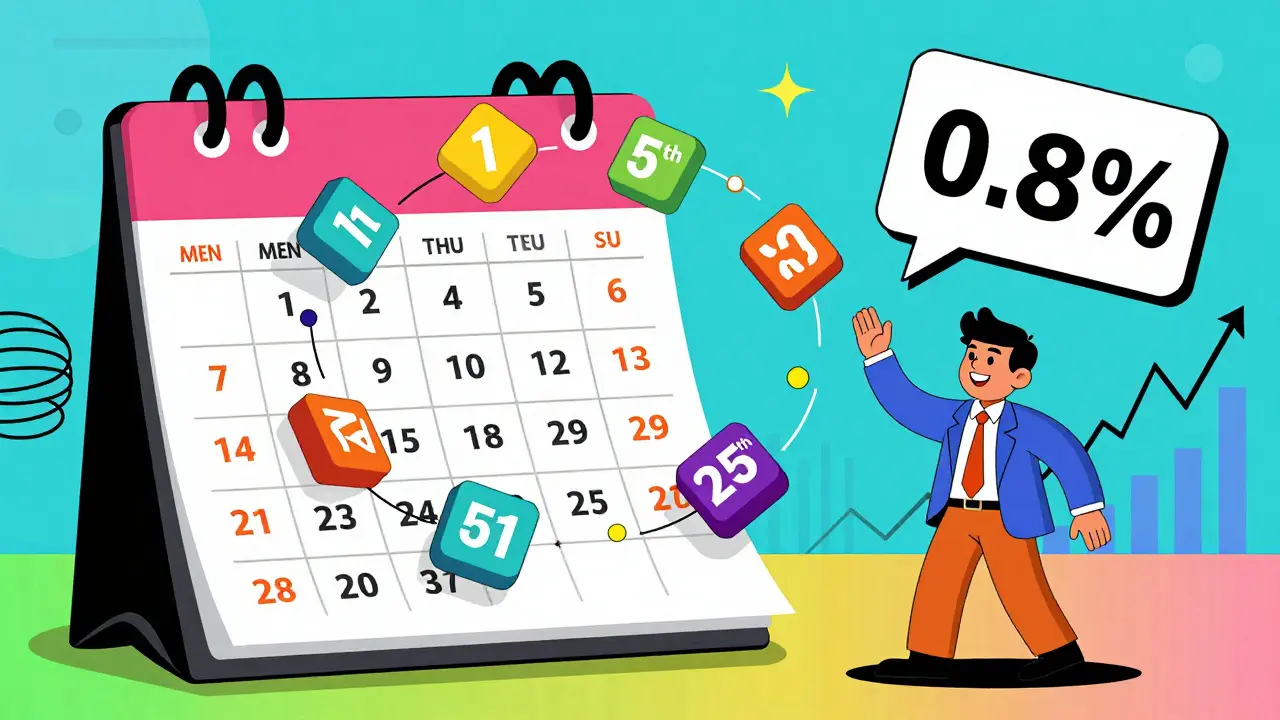
Let’s look at what happened between January 2016 and December 2025 in India’s top 10 diversified equity funds. Researchers at CRISIL analyzed SIPs started on every possible date - 1st, 5th, 10th, 15th, 20th, 25th, and the last day of the month. They tracked 10-year returns for each. The difference between the best-performing date and the worst? Just 0.8% over ten years. That’s less than the cost of one cup of coffee per month in SIP fees.
Why? Because mutual funds are long-term plays. Markets go up and down every single day. Sometimes the 1st of the month hits a high. Other times, it’s a bargain. The same goes for the 15th, the 25th, or the 30th. Over 120 months, those highs and lows even out. The randomness cancels itself out.
What about market timing?
Some people think investing on a market low gives you an edge. But no one can predict daily market movements - not even professional fund managers. If you wait for the "perfect" date, you risk missing out. In 2020, the Nifty 50 dropped 30% in March. But by April 15, it had already bounced back 12%. If you delayed your SIP because you thought "it’s still falling," you’d have lost out on that recovery.
Studies from the National Stock Exchange (NSE) show that SIPs started during market crashes had better 5-year returns than those started during bull markets - not because of the date, but because of the price at which units were bought. That’s the beauty of SIPs: they force you to buy more when prices are low, without you having to guess when that will happen.
Why do people believe date matters?
It’s mostly psychology. Humans love patterns. We see a correlation and assume causation. If you invested on the 5th and your fund went up next month, you think, "5th is lucky." If your fund dipped after the 15th, you blame the date. But correlation isn’t causation. Markets are driven by economic data, corporate earnings, global events, and policy changes - not the calendar.
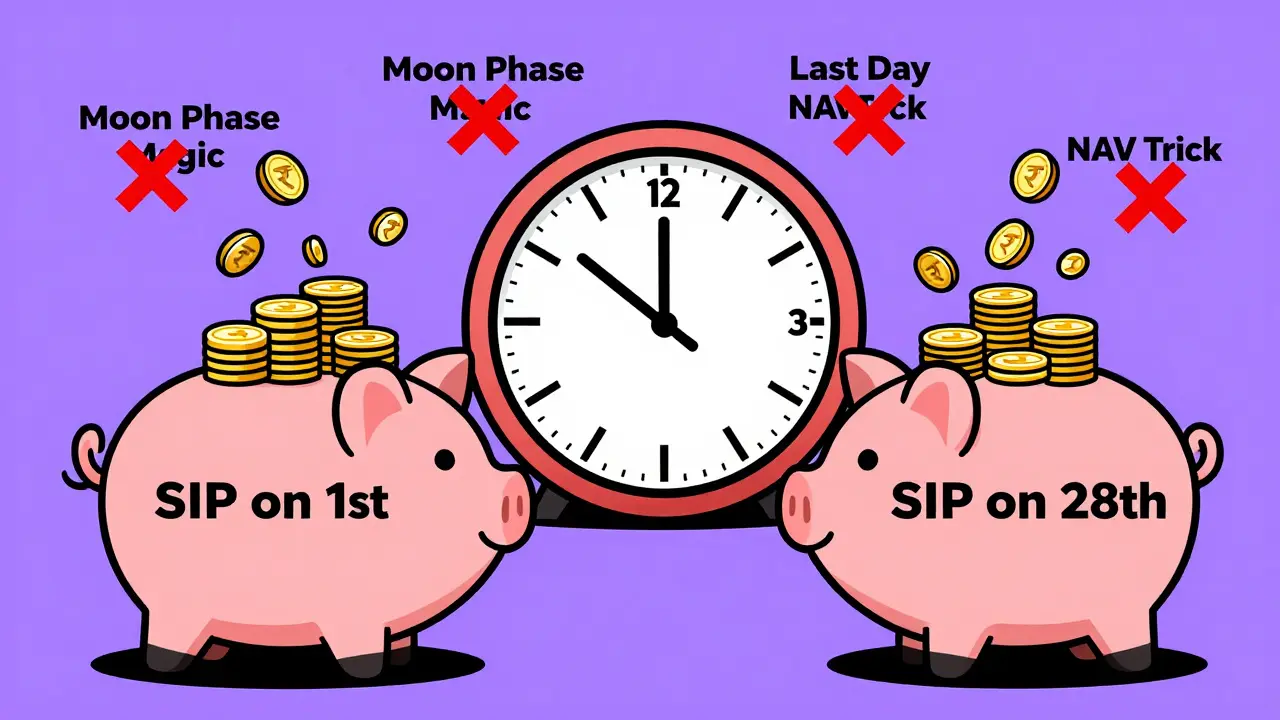
There’s also a myth that SIPs on the last day of the month get better rates because fund houses "clear out" the NAV. That’s false. NAVs are calculated daily based on the closing prices of underlying stocks and bonds. There’s no special treatment for any date.
What actually matters?
If the date doesn’t matter, what does?
- Consistency: Missing even one SIP payment breaks the rhythm. Set up auto-debit so you never forget.
- Duration: The longer you stay invested, the more compounding works for you. A 20-year SIP beats a 5-year SIP every time.
- Fund choice: A good fund with strong historical performance and low expense ratio matters more than the date. Look at 5-year and 10-year returns, not 1-year spikes.
- Amount: Increasing your SIP amount by 10% every year can boost your final corpus by 30-40% over 15 years.
Here’s a real example: Two investors in Bengaluru both started SIPs of ₹5,000/month in the same fund in 2020. One chose the 1st. The other chose the 28th. By 2025, the difference in their portfolios? ₹1,870. That’s less than one month’s SIP. Not worth stressing over.
Practical tips: How to pick your SIP date
Since the date doesn’t impact returns, pick one that works for your life.
- Choose a date right after your salary is credited. That way, you’re investing with money you already have.
- Avoid the last few days of the month if your bank has a history of delayed transfers.
- If you’re paid on the 25th, don’t pick the 1st - you might not have the funds yet.
- Weekends and holidays don’t matter. SIPs process on business days. If your date falls on a holiday, it moves to the next working day - automatically.
- Don’t switch dates often. Changing your SIP date every few months disrupts the automation and can cause missed payments.

What about tax-saving SIPs (ELSS)?
ELSS funds have a 3-year lock-in. But even here, the SIP date doesn’t change tax benefits. Each SIP installment gets its own 3-year lock-in period. So if you invest on the 10th of every month, each ₹5,000 installment locks in until the 10th of the same month, three years later. No advantage to picking a specific date for tax planning. Just stay consistent.
Myth busting: Common misconceptions
- Myth: "Investing on the 1st gives you the lowest NAV."
Reality: NAVs fluctuate daily based on market prices. There’s no pattern tied to calendar dates. - Myth: "SIPs on payday are better."
Reality: Payday is about cash flow, not market conditions. It’s a convenience, not a strategy. - Myth: "Avoid SIPs during market highs."
Reality: SIPs are designed to work through highs and lows. Trying to time the market defeats the purpose.
Bottom line: Pick a date and forget it
The best SIP date is the one you’ll stick to. It’s not about beating the market. It’s about staying in the market. Over time, consistency beats timing every single time. Don’t waste mental energy on choosing the "perfect" date. Set it up, automate it, and let time do the work.
Start today. Invest regularly. Stay patient. That’s the real secret behind SIP returns - not the number on your calendar.
Does the SIP date affect the number of units I get?
Yes, but not because of the date itself. The number of units you get depends on the NAV on the day your SIP is processed. If the NAV is ₹50, a ₹5,000 SIP buys you 100 units. If the NAV is ₹55, you get about 90.9 units. This happens every month - regardless of whether it’s the 1st, 15th, or 30th. The variation is normal and is how rupee-cost averaging works.
Can I change my SIP date after setting it up?
Yes, most fund houses allow you to change the SIP date. You usually need to submit a request online or via the fund’s app. But don’t do it too often. Each change can cause a gap in your investment schedule, which may lead to missed payments or delays. It’s better to pick a date you’re confident about from the start.
What if my SIP date falls on a holiday?
If your SIP date falls on a holiday or weekend, the transaction will automatically be processed on the next business day. For example, if your SIP is scheduled for January 1st (a public holiday), it will be processed on January 2nd. This is handled automatically by the fund house - no action needed from you.
Should I align my SIP with my salary cycle?
It’s a smart idea - but not because it improves returns. Aligning your SIP with your salary date ensures you have the funds available when the debit is made. This reduces the risk of failed transactions due to insufficient balance. For example, if you’re paid on the 5th, setting your SIP for the 7th gives you a buffer. It’s about financial discipline, not market timing.
Is there a best month to start a SIP?
No. There’s no evidence that starting a SIP in January, April, or any other month leads to better returns. Market conditions vary every year. What matters is starting early and staying consistent. Starting in February 2026 is just as valid as starting in December 2025.