
Advertising Rules for Crypto: Disclosures and Jurisdictions
 Dec, 7 2025
Running a crypto ad in 2025 isn’t like running an ad for sneakers or coffee. One wrong phrase, one missing warning, and your entire campaign gets shut down-maybe even your account. The rules aren’t just different across countries; they’re often contradictory. What’s legal in Germany could land you in jail in Algeria. What Google allows, Meta bans. And if you’re targeting the U.S., you’re not just fighting one regulator-you’re fighting 47 different state regulators, each with their own forms, fees, and deadlines.
Platform Rules Are Not the Same
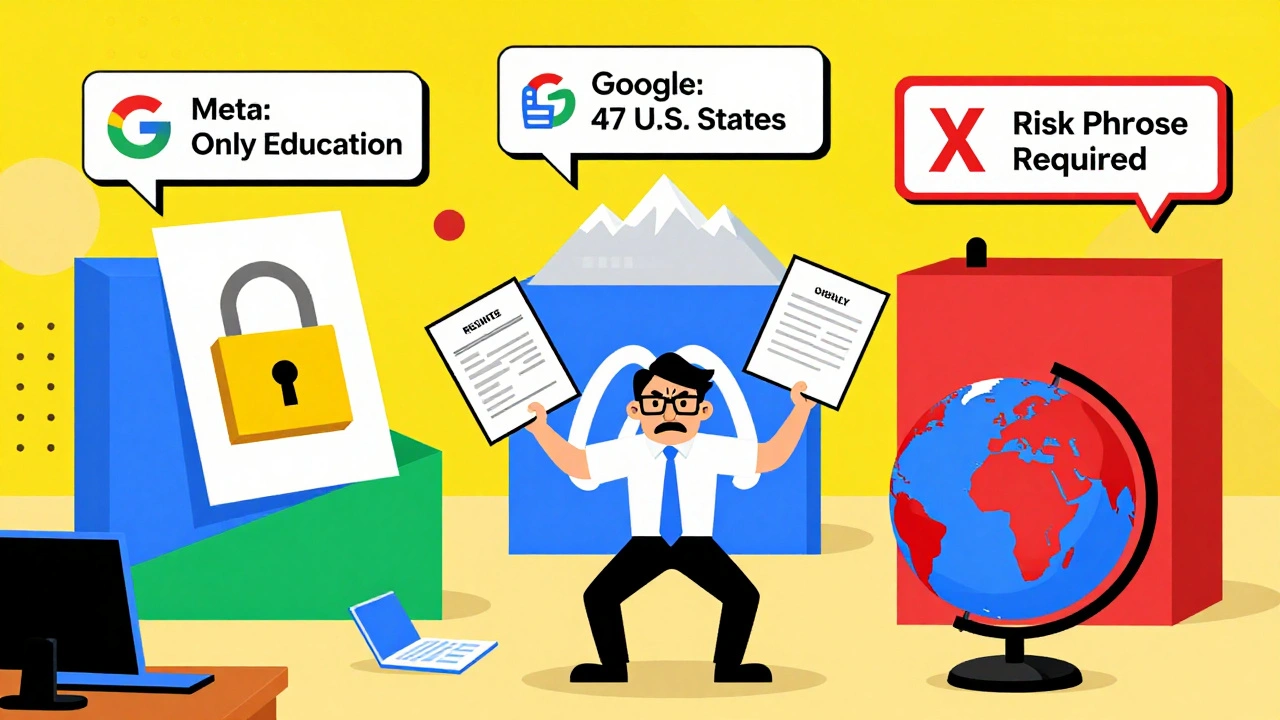
Google, Meta, and X (formerly Twitter) all say they allow crypto ads-but only if you jump through their unique hoops. Google’s system is the most bureaucratic. To run ads, you need a separate certification for every country you want to target. That means if you’re selling a wallet in the U.S., Germany, and Japan, you need three separate applications. Each costs $500 and takes 3 to 5 weeks to process. You’ll need to prove you’re licensed with FinCEN, hold state money transmitter licenses in all 47 U.S. states that require them, and have AML systems that meet FinCEN’s 2025 standards. And don’t forget: your ad must include the exact phrase, “Cryptocurrency investments are volatile and unregulated in some countries,” in 10-point font or higher. Miss it? Your ads get pulled. Repeat offenses? Your account gets suspended.Meta’s stance is simpler but harsher. They don’t allow ads for trading platforms, staking services, or any product that lets users earn, swap, or resell crypto. Period. The only crypto ads they accept are educational-like explainers on blockchain basics or how to set up a wallet. Even then, only in 42 countries. If you’re a DeFi startup trying to promote your yield aggregator, Meta is off-limits. That’s why an estimated $4.2 billion in annual crypto ad spend moved to other platforms after Meta tightened its rules in September 2025.
X is the wildcard. They allow ads for exchanges, wallets, ATMs, crypto debit cards, staking, tax tools, NFT marketplaces, and even blockchain games where you can earn tokens. That’s the broadest scope of any platform. Their certification process is faster too-78% of applications clear in under two weeks. But they demand one thing: every single ad must include the phrase, “Trading crypto carries significant risk.” No exceptions. In Q3 2025 alone, X suspended 2,147 accounts for missing this warning. It’s not a suggestion. It’s a legal requirement enforced by automated systems.
U.S. States Make It a Nightmare
The U.S. doesn’t have one federal rule for crypto advertising. It has 47 different state money transmitter licenses. Wyoming, Texas, and New York each have their own forms, fees, and compliance requirements. The average cost to get licensed in one state? $18,500. The average processing time? 6 to 12 months. To operate nationwide, you’re looking at a minimum of $1.2 million in licensing fees and 1,850 hours of staff time just to get approved. And that’s before you even start designing ads.Some states added new rules in 2025. California’s AB-1955 requires ads from crypto exchanges to include “proof of reserves” disclosures-meaning you must show real-time data proving you hold enough assets to cover all customer balances. Other states require disclosures about custody arrangements, insurance coverage, or even the specific blockchain the asset runs on. If your ad says “buy Bitcoin” without the right fine print in California, you’re violating state law-even if it’s perfectly fine under federal guidelines.
There’s a bill in Congress-the CLARITY Act of 2025-that could fix this. It would give the CFTC jurisdiction over spot crypto markets and let federal rules override state ones. But it’s still stuck in committee. Until then, crypto companies must treat each state like a separate country. Many now run jurisdiction-specific landing pages with localized disclosures. Bitstamp did this and cut their certification time by 60%. It’s not elegant, but it works.

Global Differences Are Extreme
Outside the U.S., the rules get even wilder. In the European Union, MiCA (Markets in Crypto-Assets Regulation) went live on January 1, 2025. Now, every crypto ad must be pre-approved by a national regulator before it runs. And the risk disclosure? It must be translated into 24 languages. By June 30, 2026, every single ad in the EU must comply-or face fines up to 5% of global revenue.Then there’s Algeria. Their Law No. 25-10, passed in July 2025, makes advertising crypto a criminal offense. Same in Egypt, Morocco, and Nepal. In Singapore, you can run ads-but only if you’re licensed by the Monetary Authority of Singapore (MAS). In Japan, you need approval from the Financial Services Agency. In Brazil, you must include a 15-second video disclaimer before any ad plays.
Platforms like Google and X track which countries allow crypto ads. As of December 2025, Google permits ads in 87 countries, X in 104. But that doesn’t mean you’re safe. Just because a platform allows ads in a country doesn’t mean local laws do. Many companies have been fined for running ads in countries where the platform says it’s okay-but the government says it’s not. The safest approach? Only advertise where you have a physical license or legal entity registered.
Disclosures Are Non-Negotiable
No matter where you are or which platform you use, risk disclosures are mandatory. But they’re not the same. Google requires: “Cryptocurrency investments are volatile and unregulated in some countries.” X requires: “Trading crypto carries significant risk.” The EU requires a full paragraph in local language explaining price volatility, lack of consumer protection, and potential for total loss.Here’s what happens if you skip this: your ads get blocked. Your account gets suspended. Your payment method gets revoked. And if you’re caught advertising in a country where crypto is illegal, you could face criminal charges. In 2025, three crypto marketers in Nigeria were arrested for running ads promoting staking rewards. They didn’t know it was banned.
Most rejections come from missing disclosures. Legal Nodes analyzed 500 failed Google Ads applications in 2025. Forty-three percent were denied because the risk warning was too small, poorly placed, or missing entirely. Another 29% failed because they didn’t have state licenses. Eighteen% didn’t have proper transaction monitoring tools in place.

What You Need to Do Right Now
If you’re running crypto ads in 2025, here’s your checklist:- Map your target markets. List every country and U.S. state where you want to advertise. Don’t assume a platform’s approval means local legality.
- Apply for certifications. Start with Google and X. Apply for each jurisdiction separately. Budget $500 per country and 3-5 weeks per application.
- Get state licenses in the U.S. If you’re targeting more than one state, hire a compliance firm. The cost is high, but the penalty for skipping this is higher.
- Write disclosures into every ad. Use the exact wording required by each platform and jurisdiction. Don’t paraphrase. Don’t shorten. Copy and paste.
- Use jurisdiction-specific landing pages. If you’re targeting California, send users to a page with AB-1955 disclosures. If you’re targeting Germany, use the MiCA-approved risk text.
- Track regulatory changes weekly. New rules drop all the time. Use tools like CryptoCompare’s Compliance Navigator or join the Digital Chamber of Commerce’s Advertising Compliance Working Group.
Most companies spend 30% of their marketing budget just on compliance. That’s not waste-that’s insurance. One lawsuit or account suspension can cost more than a year’s ad spend.
What’s Coming in 2026
The future of crypto advertising is automation. Gartner predicts that by 2027, 75% of platforms will require real-time compliance checks before an ad even loads. Imagine: your ad gets blocked automatically if your license expired, or your disclosure is outdated. That’s not science fiction-it’s already being tested by Chainalysis and TRM Labs.The SEC is also working on new rules for token sales. Their “purpose-fit disclosures” proposal, announced in November 2025, would force ads for new tokens to include technical details about consensus mechanisms, governance, and tokenomics. No more vague claims like “the next big thing.” You’ll have to prove it.
Meanwhile, the EU’s MiCA rollout continues. By mid-2026, every crypto ad in Europe must be pre-approved, translated, and archived for five years. Non-compliance could mean fines up to €10 million.
The message is clear: if you’re advertising crypto, you’re no longer just a marketer. You’re a compliance officer. The rules are complex, changing fast, and vary by every border. But if you get it right-your ads will run. Your account will stay active. And your business will survive.
Can I run crypto ads on Meta if I’m not selling trading services?
Yes-but only if your ad is purely educational. Meta allows content that explains how blockchain works, how to set up a wallet, or what crypto is. You cannot promote exchanges, staking, yield farming, NFT trading, or any service that enables buying, selling, or earning crypto. Even if your intent is educational, if the landing page leads to a trading platform, your ad will be rejected.
Do I need a separate Google Ads certification for each U.S. state?
Yes. Google requires certification per country, and in the U.S., that means separate applications for each state that requires a money transmitter license. Even if your business operates the same way in New York and Wyoming, you need two separate certifications. There’s no federal override. This is why many companies choose to advertise only in states where they’re already licensed.
What happens if I run a crypto ad without the required disclosure?
Your ad will be immediately blocked. Your account may be suspended. If you’re in a country where crypto advertising is illegal, you could face fines or criminal charges. In Q3 2025, X suspended over 2,000 accounts for missing the required risk warning. Google also auto-rejects ads without proper disclosures during the certification process. Don’t risk it-use the exact wording required by each platform and jurisdiction.
Is it legal to advertise crypto in the EU?
Yes-but only if you’re licensed under MiCA and your ad includes the approved risk disclosure in the local language. All crypto asset service providers must get pre-approval from their national regulator before running any ad. The disclosure must be clear, prominent, and include information about volatility, lack of consumer protection, and potential for total loss. Failure to comply can result in fines up to 5% of global revenue.
How much does crypto advertising compliance cost?
For a U.S.-based company targeting all 47 states, expect to spend at least $1.2 million in licensing fees alone. Add certification fees for Google and X ($500 per country), legal fees for compliance setup ($75,000-$120,000), and ongoing monitoring tools, and you’re looking at $1.5 million to $2 million annually. Most successful crypto firms spend 30% of their marketing budget on compliance-not creative work.