
Best Performing Mutual Funds in India: Top Schemes Across Categories (2026)
 May, 20 2026
You have a goal. Maybe it's buying a home in five years, funding your child's education, or simply building a safety net that outpaces inflation. The problem isn't the goal; it's the vehicle you use to get there. In India, where market volatility can be sharp and tax laws shift with every budget, picking the right mutual fund feels like navigating a maze blindfolded.
We often chase the highest return from last year. That’s a trap. A fund that topped the charts in 2024 might struggle in 2026 if its strategy doesn't fit the current economic cycle. What you need is consistency, low costs, and managers who stick to their guns when markets panic. This guide breaks down the best-performing mutual funds in India across major categories as of mid-2026, helping you move beyond noise and find schemes that actually work for your specific financial timeline.
Why "Best" Changes Every Year
Before we look at names, let's talk about how performance works. Mutual Fund Performance is a measure of how well a fund has grown its assets over a specific period compared to its benchmark and peers. If you look at a one-year chart, you're looking at luck. If you look at three to five years, you're looking at skill.
In the Indian context, the SEBI is the Securities and Exchange Board of India, the regulatory body that oversees securities markets enforces strict categorization norms. This means a "Large Cap" fund must invest at least 80% of its money in large-cap companies. This standardization helps us compare apples to apples. However, past returns do not guarantee future results. The best performing fund in 2023 was likely a small-cap fund riding a bull run. In a correction phase, those same funds drop hardest. Your job is to pick the right category for your risk appetite, then pick the manager who handles that category best.
Top Equity Mutual Funds: Growth Engines
Equity funds are for investors with a horizon of five years or more. They offer the highest potential returns but come with significant volatility. Here is how the landscape looks in 2026.
Large Cap Funds: Stability First
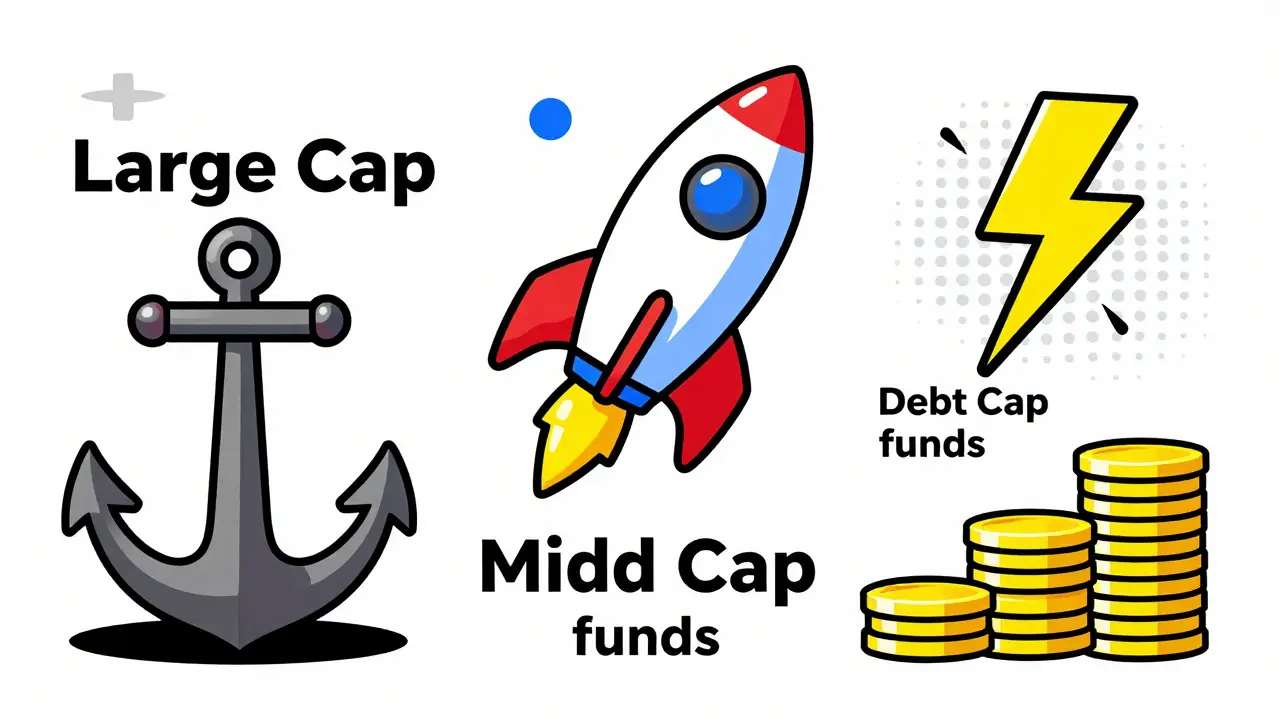
These funds invest in the top 100 companies by market capitalization. Think of them as the anchors of your portfolio. You don't expect them to double overnight, but you expect them to grow steadily with the economy.
- HDFC Top 100 Fund: Consistently ranks high due to its disciplined approach to quality stocks. It focuses on companies with strong cash flows and manageable debt levels.
- ICICI Prudential Bluechip Fund: Known for lower volatility within the large-cap space. It tends to hold fewer stocks but manages them actively, avoiding passive index-like behavior.
- Nippon India Large Cap Fund: Offers a balanced mix of value and growth stocks, making it suitable for investors who want steady compounding without extreme swings.
Mid Cap Funds: The Sweet Spot
Mid-cap companies are established but still growing fast. They offer higher returns than large caps but carry more risk. In 2026, this category remains popular for long-term wealth creation.
- Motilal Oswal Midcap Fund: Has delivered exceptional returns over the last three years by focusing on structural growth stories in manufacturing and technology.
- SBI Magnum Midcap Fund: A veteran scheme with a track record of surviving multiple market cycles. It avoids chasing trends, which protects downside during corrections.
- Kotak Emerging Equity Fund: Focuses on companies transitioning from mid-cap to large-cap status, capturing growth early while managing risk through diversification.
Small Cap Funds: High Risk, High Reward
Only allocate here if you can stomach 20-30% drops in a bad year. Small caps have outperformed all other categories in India over the last decade, but they require patience.
- Nippon India Small Cap Fund: One of the largest small-cap funds, offering deep diversification. Its size allows it to access smaller opportunities that other funds miss.
- Quant Small Cap Fund: Uses a quantitative model to identify undervalued stocks. It churns its portfolio frequently, which can lead to high short-term volatility but impressive long-term gains.
- HDFC Small Cap Fund: Takes a conservative approach within the small-cap space, focusing on fundamentally strong companies with good governance records.
Debt Mutual Funds: Safety and Income
If your goal is capital preservation or regular income, debt funds are your friend. With interest rates stabilizing in 2026, these funds offer predictable returns.
Corporate Bond Funds
These funds invest in bonds issued by companies with high credit ratings. They are safer than equity but less volatile.
- HDFC Corporate Bond Fund: Holds bonds until maturity, reducing interest rate risk. Ideal for investors looking for returns slightly above fixed deposits.
- ICICI Prudential Corporate Bond Fund: Offers a diversified portfolio across various sectors, ensuring no single company's default impacts the entire fund significantly.
Dynamic Bond Funds
These funds adjust their duration based on interest rate expectations. When rates fall, they extend duration to capture higher yields; when rates rise, they shorten duration to protect capital.
- Kotak Dynamic Bond Fund: Actively managed to navigate changing interest rate environments. Suitable for investors with a medium-term horizon of 3-5 years.
- SBI Dynamic Bond Fund: Provides flexibility to switch between government securities and corporate bonds depending on market conditions.
Hybrid Funds: Balanced Portfolios
Hybrid funds invest in both equity and debt. They are perfect for investors who want growth but cannot handle pure equity volatility.
- ICICI Prudential Balanced Advantage Fund: Dynamically shifts between equity and debt based on market valuations. It buys equity when cheap and sells when expensive, smoothing out returns.
- HDFC Balanced Advantage Fund: Uses a strategic asset allocation model to reduce downside risk while participating in upside movements.
- Parag Parikh Flexi Cap Fund: Though technically a flexi-cap equity fund, its global diversification and value-oriented approach make it behave like a stable hybrid option for many investors.
| Category | Risk Level | Ideal Holding Period | Expected Annual Return* | Best For |
|---|---|---|---|---|
| Large Cap Equity | Medium | 5+ Years | 12-14% | Stability & Core Portfolio |
| Mid Cap Equity | High | 7+ Years | 15-18% | Growth-Oriented Investors |
| Small Cap Equity | Very High | 7+ Years | 18-22% | Aggressive Wealth Creation |
| Corporate Bond | Low | 3-5 Years | 7-9% | Cash Preservation & Income |
| Balanced Advantage | Medium-Low | 3+ Years | 10-12% | Conservative Growth |
*Returns are historical averages and not guaranteed. Actual returns may vary based on market conditions.
How to Choose the Right Scheme for You
Picking a fund isn't just about looking at a list. It's about matching the fund's personality with your own. Here is a simple framework to follow.
- Define Your Goal: Is this money for retirement (20 years away) or a vacation (2 years away)? Long-term goals suit equity; short-term goals suit debt.
- Check Expense Ratios: A 1% difference in expense ratio can cost you lakhs over time. Look for funds with lower costs, especially in index funds.
- Evaluate Consistency: Don't just look at the top ranker. Look for funds that stay in the top quartile over 3, 5, and 7 years. Consistency beats peak performance.
- Understand the Manager: Read the fund manager's commentary. Do they explain losses? Do they stick to their stated strategy? Transparency is key.
- Avoid Chasing Past Returns: A fund that returned 50% last year is likely due for a correction. Buy when the category is out of favor, not when it's trendy.

Tax Implications in 2026
Taxation plays a huge role in your net returns. In India, equity funds held for more than one year benefit from Long-Term Capital Gains (LTCG) tax exemptions up to ₹1.25 lakh per year, with gains above that taxed at 12.5%. Short-term gains are taxed at 20%. Debt funds are treated like equity for taxation purposes now, meaning LTCG applies after one year. Always factor in taxes when comparing returns.
Common Mistakes to Avoid
Even smart investors make errors. Here are the most common ones:
- Over-diversification: Having 20 mutual funds doesn't reduce risk; it increases complexity and costs. Stick to 5-7 funds max.
- Stopping SIPs During Volatility: Market dips are buying opportunities. Stopping your Systematic Investment Plan (SIP) during a crash locks in losses.
- Ignoring Asset Allocation: As you near your goal, shift from equity to debt. Don't keep aggressive funds running right before you need the money.
- Panic Selling: Emotional decisions destroy wealth. Stick to your plan unless your fundamental goal changes.
Next Steps for Your Portfolio
Start by assessing your current holdings. Are you overweight in small caps? Underweight in debt? Use the categories above to rebalance. If you're new, start with a Large Cap or Balanced Advantage fund via a monthly SIP. Rebalance once a year to maintain your target asset allocation. Remember, investing is a marathon, not a sprint. The best performing fund is the one you stick with through thick and thin.
What is the safest mutual fund in India?
The safest mutual funds are Liquid Funds and Overnight Funds. They invest in very short-term instruments like treasury bills and commercial paper, offering stability close to bank savings accounts but with slightly better post-tax returns.
Are index funds better than active funds?
For large-cap categories, index funds often perform better due to lower costs and consistent tracking of the market. For mid and small caps, active funds can add value by selecting undervalued stocks that indices might miss.
How much should I invest in mutual funds?
Financial experts recommend investing at least 20% of your monthly income into mutual funds, adjusted for your age and risk tolerance. Start with an amount you can afford to lose without impacting your daily life.
Can I withdraw money from mutual funds anytime?
Yes, open-ended mutual funds allow withdrawals at any time. However, exiting early may result in exit loads (fees) and unfavorable tax treatment. Always check the fund's specific terms before withdrawing.
What is the minimum investment required?
Most mutual funds in India allow you to start with as little as ₹500 or even ₹100 per month through SIPs. There is no high barrier to entry, making them accessible to everyone.