
Blockchain for Environmental Tracking: How Distributed Ledgers Verify Carbon Credits and ESG Data
 May, 16 2026
Greenwashing is the silent killer of climate action. Companies claim they are saving the planet, but without a way to verify their claims, investors and regulators are left guessing. You might have seen headlines about blockchain solving this problem, but the reality is more complex than just "putting data on a chain." Blockchain for environmental tracking is the use of distributed ledger technology to record, verify, and share data on greenhouse gas emissions, carbon credits, and biodiversity in a tamper-resistant manner. It offers a single source of truth that prevents fraud and double-counting, yet it faces significant hurdles in energy consumption and regulatory adoption.
The core promise here is simple: immutability. Once an emission reduction or a waste collection event is recorded on a blockchain, it cannot be altered retroactively without consensus from the network. This creates an audit trail that traditional databases simply cannot match. But does this actually work in practice? Let’s look at how these systems function, where they succeed, and where they fall short.
How Blockchain Solves the Double-Counting Crisis
The biggest failure point in current carbon markets is double-counting. This happens when two different parties claim the same emission reduction. For example, a company buys a carbon credit from a forest project, but the host country also counts that forest’s sequestration toward its national climate targets. Both sides think they are reducing global emissions, but nothing has actually changed.
The Climate Action Data Trust (CAD Trust) is a permissioned blockchain platform launched by the World Bank, IETA, and the Government of Singapore to link national and independent carbon registries. Announced at COP27 in 2022, CAD Trust uses a distributed ledger to assign globally unique identifiers (GUIDs) to every carbon unit. When a unit is transferred or retired, the ledger updates its status instantly. This ensures that at any given moment, there is only one authoritative record of that unit’s location and status. It’s like having a shared bank account statement that everyone can see but no one can fake.
This mechanism is critical for Article 6 of the Paris Agreement, which allows countries to trade emission reductions. Without a system like CAD Trust, trust breaks down. With it, governments and corporations can transact with confidence that their offsets are real and unique.
Enterprise ESG Reporting: From Silos to Single Source of Truth
Corporate Environmental, Social, and Governance (ESG) reporting is notoriously messy. Data lives in spreadsards, ERP systems, and email chains across dozens of subsidiaries. Consolidating this for annual reports takes months and is prone to error.
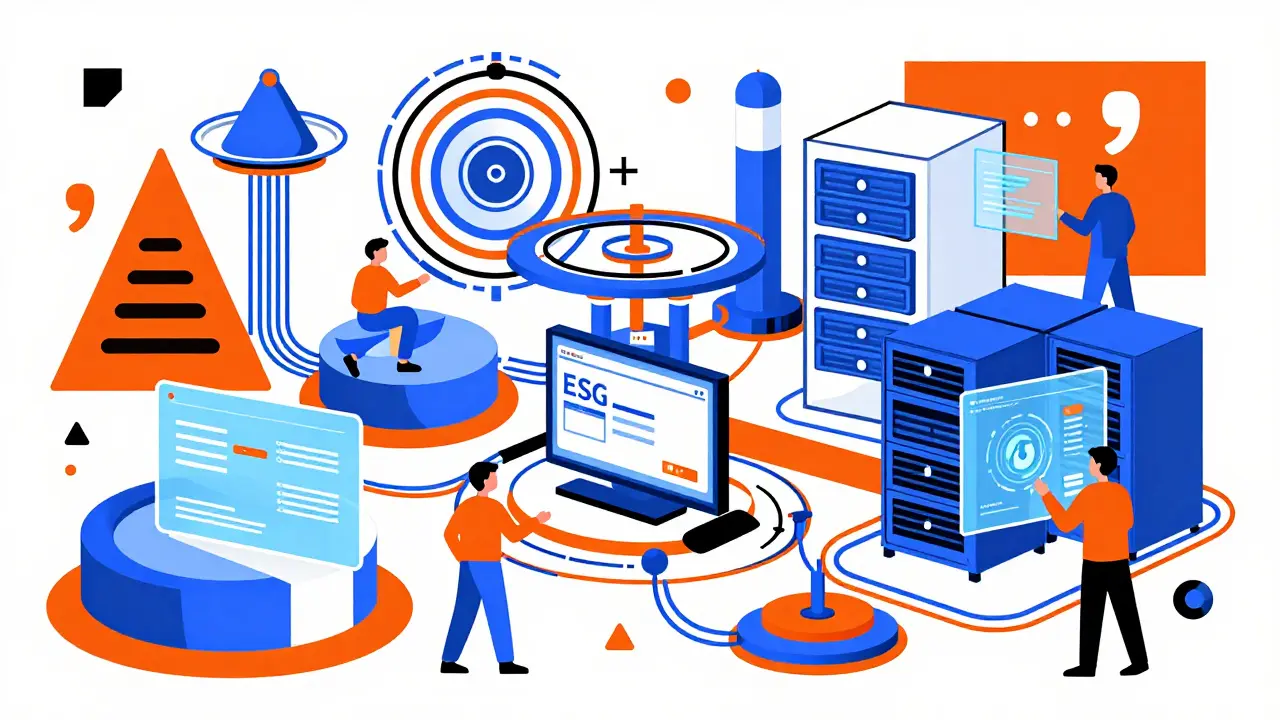
Baliola is an ESG-blockchain platform that consolidates sustainability metrics into a single immutable ledger. By storing Scope 1, 2, and 3 greenhouse gas emissions, water usage, and waste data on-chain, companies eliminate data silos. Smart contracts can automatically trigger reporting when specific thresholds are met. For instance, if a factory’s hourly CO2 emissions drop below a target, the system logs it immediately. Regulators and investors can then query the blockchain for real-time verification instead of waiting for end-of-year audits.
Kaleido provides enterprise blockchain infrastructure that enables granular supply-chain visibility, including tracking emissions down to individual shipments. Their approach allows multi-party governance where corporates, regulators, and NGOs all run nodes. This means you aren’t relying on a central administrator who could change the rules mid-game. You get full visibility, potentially even down to the exhaust output of a specific supply truck overseas.
| Feature | Traditional Databases | Blockchain Ledgers |
|---|---|---|
| Data Integrity | Vulnerable to unilateral edits | Immutable and cryptographically secured |
| Audit Frequency | Annual or quarterly | Real-time or continuous |
| Transparency | Limited to authorized users | Configurable access control with public verifiability |
| Reconciliation Time | Days to weeks | Seconds to minutes |
| Cost Structure | High audit fees | Higher initial setup, lower ongoing verification costs |
Tokenized Carbon Markets: Promise and Peril
The voluntary carbon market saw a surge of interest when projects like Toucan Protocol launched a bridge that converts legacy Verra Verified Carbon Units (VCUs) into on-chain tokens called Base Carbon Tonne (BCT). By mid-2022, Toucan had bridged over 20 million tonnes of CO2-equivalent credits onto the Polygon blockchain. This made carbon trading accessible to anyone with a crypto wallet, not just institutional players.
However, this experiment revealed deep flaws. Critics from organizations like CarbonPlan and Trove Research pointed out that many tokenized credits were from old, low-quality projects with questionable additionality. The price volatility of tokens like KlimaDAO’s KLA-which dropped over 95% from its peak-showed that speculative finance often overshadowed climate impact. In response, Verra, the largest voluntary carbon standard, announced in May 2023 that it would phase out third-party tokenization of retired credits. Instead, Verra plans to issue credits directly on-chain under its own control. This shift highlights a crucial lesson: blockchain provides transparency, but it does not guarantee the underlying asset’s quality.
Nature and Biodiversity Tracking
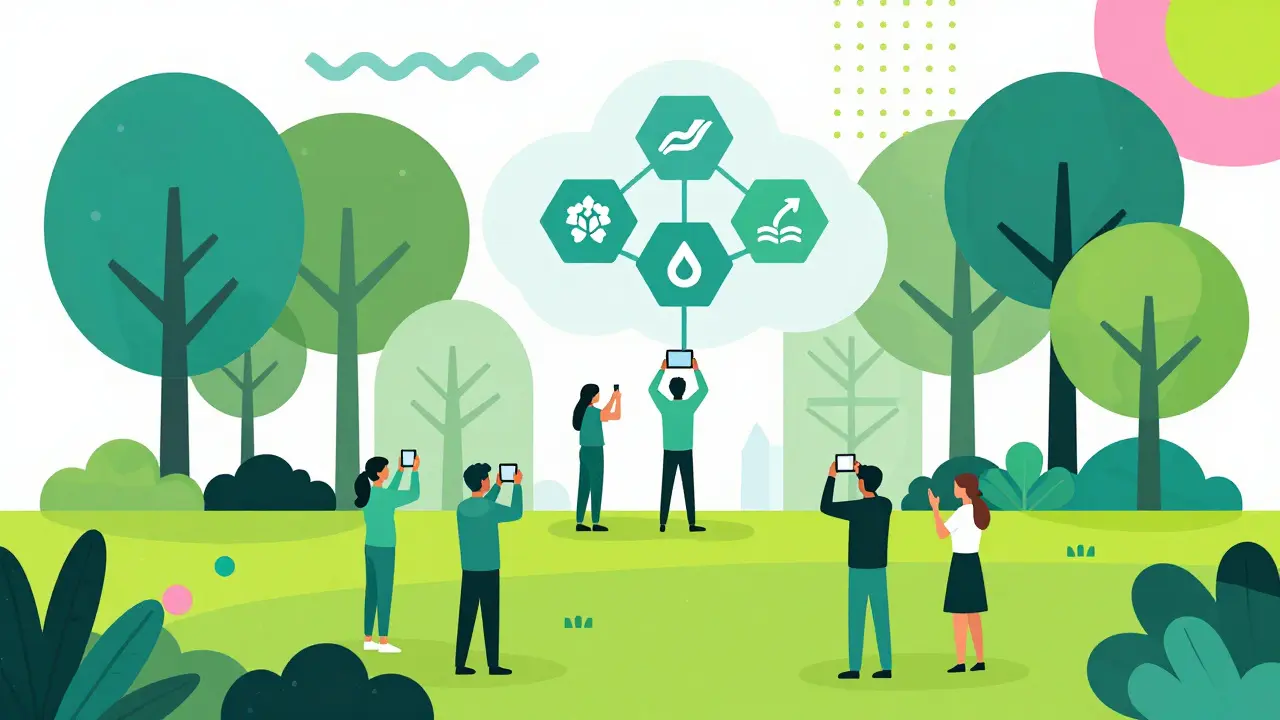
Carbon isn’t the only metric that matters. Forest health, soil quality, and ocean conservation require rigorous monitoring. Open Forest Protocol (OFP) is a decentralized protocol built on the NEAR blockchain that allows local communities to upload and validate forest monitoring data. Validators stake tokens to review satellite images and biometric data submitted by communities. If approved, the data is recorded on-chain, creating a trusted record for carbon crediting or results-based finance.
This model democratizes data collection. Local stakeholders, who often lack technical resources, become active participants in the ecosystem. They earn rewards for providing accurate data, while donors and investors gain confidence that their funds are supporting verified conservation efforts. Similarly, Regen Ledger tracks ecological state changes and issues ecocredits tied to regenerative agriculture and forest restoration. Each credit represents a quantified outcome, such as one tonne of CO2e sequestered or one hectare of land restored.
The Energy Paradox: Green Tech vs. High Consumption
You cannot talk about blockchain and sustainability without addressing the elephant in the room: energy use. Early blockchains like Bitcoin used Proof-of-Work (PoW), consuming vast amounts of electricity. The Cambridge Centre for Alternative Finance estimated Bitcoin’s annual consumption between 40 and 200 TWh, comparable to medium-sized countries. Using such networks to track carbon credits seemed counterproductive.
The landscape changed dramatically with Ethereum’s "Merge" on September 15, 2022. The switch to Proof-of-Stake (PoS) reduced Ethereum’s energy consumption by over 99.9%. Today, most environmental applications build on PoS chains like Polygon, Celo, or NEAR, or use permissioned systems like Hyperledger Fabric that consume negligible energy. However, the perception lingers. Projects must carefully choose their consensus mechanism to ensure their digital footprint doesn’t outweigh their environmental benefits.
Implementation Challenges and Future Directions
Deploying blockchain for environmental tracking is not plug-and-play. Enterprises typically face a 6-to-18-month journey involving requirements analysis, technology selection, smart contract development, and pilot deployments. Key barriers include:
- Regulatory Fragmentation: Laws around carbon credits and ESG reporting vary wildly by jurisdiction.
- Data Privacy: Companies are hesitant to share sensitive Scope 3 supply-chain data publicly.
- Integration Complexity: Linking IoT sensors, ERP systems, and blockchain ledgers requires robust data engineering.
- Digital Divide: Communities in the Global South may lack the internet connectivity or devices needed to participate in decentralized protocols.
Future developments point toward deeper integration with AI and IoT. Imagine cities using 5G-connected sensors to monitor air quality in real-time, with AI detecting anomalies and blockchain recording the data for accountability. Circular economy models will also benefit, tracking materials like recycled plastics through multiple life cycles to prove sustainability claims.
Is blockchain really necessary for ESG reporting?
Not strictly, but it solves specific problems like data fragmentation and trust. Traditional databases are cheaper and faster for internal use, but blockchain provides an immutable, shared record that reduces audit costs and prevents greenwashing in multi-party environments.
How does blockchain prevent double-counting of carbon credits?
It assigns a globally unique identifier (GUID) to each credit and records its status (issued, transferred, retired) on an append-only ledger. Systems like the Climate Action Data Trust link multiple registries, ensuring that once a credit is retired, it cannot be sold again.
What is the difference between public and permissioned blockchains for environmental tracking?
Public blockchains (like Ethereum) offer maximum transparency but raise privacy concerns for corporate data. Permissioned blockchains (like Hyperledger Fabric) restrict node access to authorized parties, offering better confidentiality and higher transaction speeds for enterprise use.
Did Ethereum’s Merge make blockchain more sustainable?
Yes. The shift from Proof-of-Work to Proof-of-Stake reduced Ethereum’s energy consumption by over 99.9%, making it viable for environmental applications without undermining climate goals.
Can blockchain track biodiversity beyond carbon?
Yes. Platforms like Open Forest Protocol and Regen Ledger track forest health, soil regeneration, and ocean conservation. They allow local communities to upload validated data, creating transparent records for nature-based financing.