
Cardano (ADA): Building a Sustainable Blockchain Explained
 Mar, 28 2026
Why Sustainability Matters for Cryptocurrency
When people talk about blockchain today, energy usage often comes up immediately. Bitcoin mining consumes vast amounts of electricity, drawing criticism from environmental groups and regulators alike. This reality creates a pressing need for alternative systems that offer security without the carbon footprint. Cardano is a public, decentralized blockchain platform designed specifically to balance security and sustainability while addressing the environmental challenges faced by earlier networks. Launched in 2017 and developed since 2015 with input from co-founder Charles Hoskinson, it stands out as a major project dedicated to longevity.
You might wonder why "sustainability" is more than just a buzzword here. For Cardano, it means building infrastructure that lasts economically, socially, and environmentally. Unlike many competitors that prioritize rapid feature releases, this network relies on peer-reviewed academic research to validate its core protocols before implementation. This rigorous approach ensures that when you interact with the chain, the underlying math guarantees security rather than relying solely on market hype.
The Two-Layer Architecture Strategy
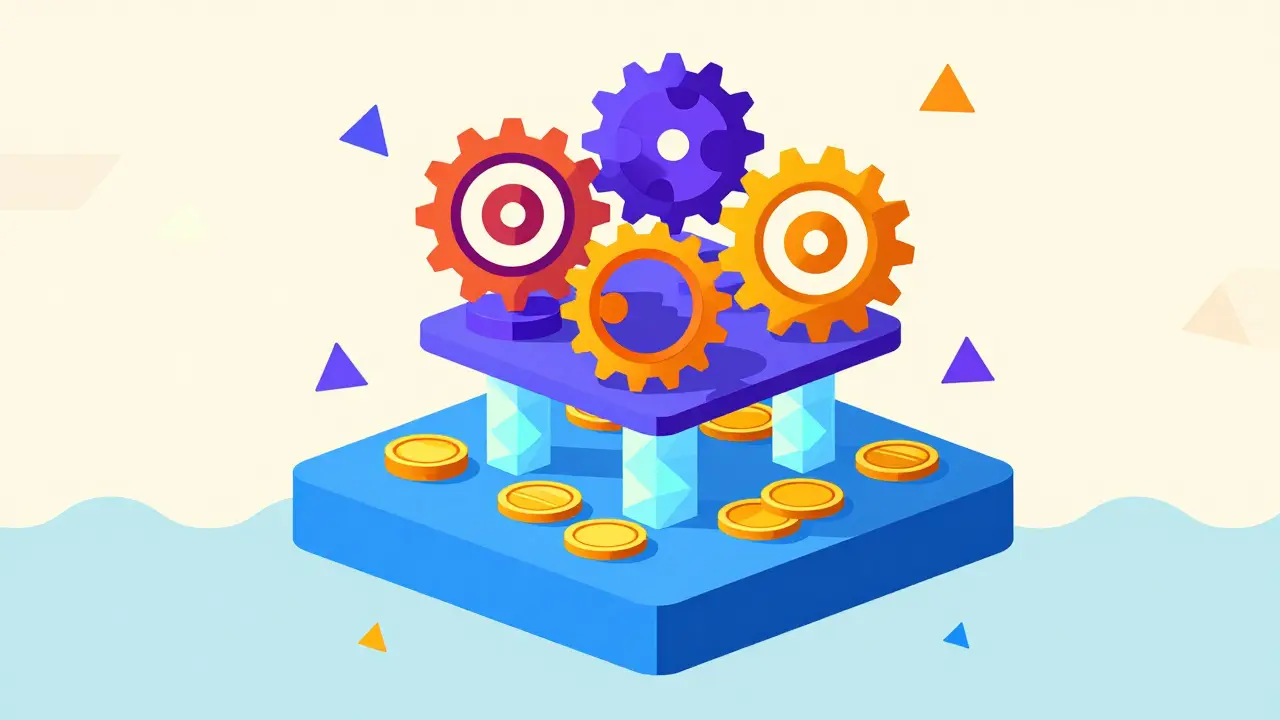
One of the most distinct features of this ecosystem is its architectural design. Most blockchains combine transaction handling and computation into a single layer. If you get one congested, everything slows down. The Cardano Settlement Layer is the part of the system dedicated exclusively to handling value transfers and accounting. It deals purely with sending and receiving ADA, the native currency named after mathematician Ada Lovelace.
Then there is the Cardano Computation Layer. This layer powers smart contracts and applications. By separating these functions, developers can upgrade the computation engine without disrupting basic payments. You benefit from this because your simple wallet transfer won't get stuck behind complex application code execution. It provides scalability that monolithic chains struggle to achieve.
Ouroboros: The Engine of Efficiency
To understand how this network stays green, you have to look at its consensus mechanism called Ouroboros. It is a proof-of-stake algorithm developed through formal academic research that secures the network using stake rather than computational power. In traditional mining systems like Bitcoin, miners compete to solve complex puzzles using specialized hardware. That process burns electricity constantly. Here, time is divided into epochs and slots.
| Feature | Proof-of-Work (Bitcoin) | Ouroboros (Cardano) |
|---|---|---|
| Energy Usage | Very High | Negligible |
| Hardware Requirement | Specialized ASICs | Standard Servers/Laptops |
| Security Basis | Computing Power | Economic Stake |
| Accessibility | High Cost Barrier | Open Delegation |
This difference allows anyone holding tokens to participate in securing the network. Participants can either run their own node or delegate their holdings to a Stake Pool. A stake pool is a node operated by individuals who aggregate the staking rights of different users to validate blocks. When you delegate, you don't lose ownership of your coins. You temporarily lock them to help run the system and earn rewards proportional to your contribution. This mathematical guarantee of security requires a fraction of the energy used by proof-of-work systems.
Understanding the ADA Token Utility
Many newcomers assume ADA is just another speculative asset. While its value fluctuates, its utility within the network is fundamental. First, it acts as the fuel for the machine. Every transaction requires a fee paid in ADA to prevent spam attacks and cover operational costs. Without this fee mechanism, malicious actors could flood the ledger with fake data.
Beyond fees, ADA represents governance power. Through a treasury system known as Project Catalyst, holders can vote on proposals. It is an on-chain voting and funding system that allows the community to decide how network funds are allocated. This shifts the decision-making process away from a central company and into the hands of the token holders. As the protocol evolves, your stake effectively gives you a voice in the roadmap. You aren't just holding a number; you're holding a share in the platform's future direction.
The EUTXO Model and Smart Contract Safety
If you've looked into other platforms, you've probably seen headlines about failed smart contracts draining money. This happens because many systems use an account-based model where contracts can be unpredictable. The Extended Unspent Transaction Output (EUTXO) model is an advanced transaction framework unique to this blockchain that improves predictability and security. It builds on the foundation used by Bitcoin but adds the ability to store rich data in each transaction output.
In this environment, smart contracts reside on-chain but execute actions off-chain. This separation enhances security by preventing unintended contract interactions. When you deploy a dApp (decentralized application), the system knows exactly what state changes will occur before the transaction is finalized. There is no guessing game during execution. This predictability protects you from unexpected failures that plague networks where resources are shared globally across all running apps.
Governance and Community Participation
Sustainability isn't just about energy; it's about social endurance. A project needs a way to adapt as needs change. That's why the governance layer is critical. You don't have to be a developer to contribute. By participating in delegation or simply holding ADA, you engage with the system. Stake Pool Operators are community members who run the nodes validating transactions. They form the backbone of decentralization.
There are thousands of independent pools spread across the globe. This geographic diversity strengthens security. If one region goes offline, others keep the ledger alive. Additionally, the community votes directly on treasury proposals through Project Catalyst. This ensures that development reflects actual user needs rather than the whims of a central board. Funds raised go back into the ecosystem, fostering innovation in areas like supply chain tracking, financial inclusion, and identity management.
Wallets and Security Practices
To interact with the network, you need a secure way to manage your assets. The Daedalus Wallet is a full-node digital wallet that downloads a complete copy of the blockchain history. Because it connects directly to the network, it offers high security but requires storage space on your device. Alternatively, lightweight clients exist for convenience, though they trade some independence for ease of use.
Regardless of the tool you choose, the seed phrase is your key. Losing access to this phrase means losing access to your funds forever. Since the system is decentralized, there is no customer support to call for recovery. This responsibility falls entirely on you. Understanding this distinction helps you appreciate the importance of backing up your credentials securely before engaging in any staking or trading activity.
What makes Cardano more sustainable than Bitcoin?
Cardano uses the Ouroboros proof-of-stake consensus mechanism, which validates transactions based on token stake rather than computational power. This eliminates the need for energy-intensive mining rigs, reducing energy consumption by roughly 99% compared to proof-of-work systems like Bitcoin.
Can I earn passive income with ADA?
Yes, through staking. You can delegate your ADA to a stake pool to help validate blocks and earn rewards. This process requires locking your tokens temporarily but poses low risk compared to active trading strategies.
How do smart contracts work on this network?
Smart contracts use the EUTXO model, which separates validation and execution. Contracts reference specific ledger entries to ensure predictable outcomes, mitigating risks of interference from other running applications on the chain.
What is the role of the Cardano Foundation?
Based in Zug, Switzerland, the foundation oversees the strategic development and adoption of the platform. It collaborates with various entities to ensure the long-term viability and compliance of the ecosystem.
Is ADA inflationary or deflationary?
The total supply has a hard cap. While new ADA is minted as staking rewards, the rate decreases over time until the cap is reached, creating a deflationary pressure once that limit is hit.