
Collateralization in DeFi: How It Protects Protocols
 Jul, 30 2026
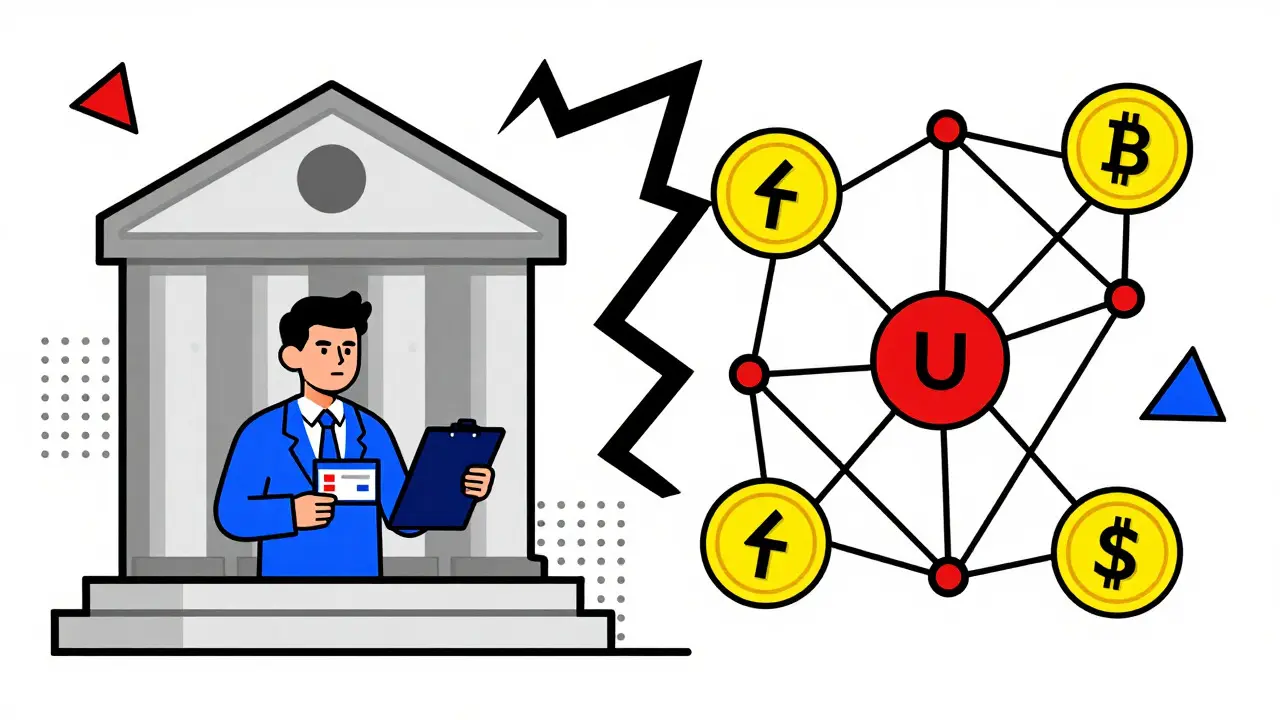
Imagine walking into a bank to get a mortgage. The banker checks your credit score, looks at your job history, and maybe even calls your boss to confirm you have steady income. Now imagine doing that on the blockchain, where no one knows who you are. How does the system trust you with money? The answer isn't trust-it's math. Specifically, it's collateralization. In the world of Decentralized Finance (DeFi), collateral is the only thing standing between a protocol and total insolvency.
Unlike traditional finance, which relies on identity and legal enforcement, DeFi relies entirely on code and assets. If you want to borrow crypto, you must lock up more value than you intend to borrow. This practice, known as over-collateralization, is the backbone of protocols like Aave, Compound, and MakerDAO. It protects lenders from default and keeps the entire ecosystem solvent, even when Bitcoin or Ethereum prices crash overnight.
The Mechanics of Over-Collateralization
In DeFi, "borrowing" doesn't work like taking out a personal loan. You don't fill out an application; you deposit assets into a smart contract. Let's say you want to borrow $100 worth of stablecoins (like USDC) to buy the dip in a volatile market. To do this, you might need to deposit $150 worth of Ethereum (ETH). That extra $50 is your safety buffer.
This buffer is governed by the Loan-to-Value (LTV) ratio. The LTV determines how much you can borrow against your collateral. If ETH has an LTV of 66% on a specific platform, you can borrow up to 66 cents for every dollar of ETH you deposit. This ratio isn't arbitrary. It is set by protocol governance based on the asset's volatility and liquidity. Stable assets like USDC often have higher LTVs (sometimes near 80-90%), while highly volatile altcoins might have LTVs as low as 30-40%.
| Feature | Traditional Bank Loan | DeFi Protocol (e.g., Aave) |
|---|---|---|
| Identity Check | Required (KYC/AML) | None (Pseudonymous) |
| Collateral Ratio | 70-90% (Under-collateralized possible) | 100-300%+ (Over-collateralized) |
| Enforcement | Courts & Debt Collectors | Automated Smart Contracts |
| Repayment Deadline | Fixed Schedule | Flexible (Until Liquidation) |
| Price Monitoring | Manual/Periodic | Real-time via Oracles |
The reason DeFi requires so much more collateral than a bank is simple: speed and anonymity. A bank can sue you if you default. A smart contract cannot. It can only seize what you've already deposited. Therefore, the system needs a massive cushion to absorb price shocks without leaving lenders unpaid.
How Smart Contracts Enforce Protection
The magic of DeFi collateralization lies in its automation. There is no loan officer calling you at 2 AM to ask for more funds. Instead, there are self-executing smart contracts monitoring your position 24/7. These contracts rely on decentralized oracle networks, primarily Chainlink, to fetch real-time price data from multiple exchanges. This prevents a single exchange from manipulating prices to trigger unfair liquidations.
When you deposit collateral, the smart contract locks those tokens. As long as the value of your collateral stays above the minimum required threshold (the LTV limit plus a safety margin), you are safe. You can keep the loan open for days, months, or years. There is no fixed repayment date. However, if the market turns against you, the protocol acts instantly.
For example, if you borrowed $100 against $150 of ETH, and ETH drops significantly, the value of your collateral shrinks. If the ratio of debt-to-collateral exceeds the maximum allowed LTV, the smart contract flags your position as "underwater." At this point, anyone in the network-a liquidator-can step in and repay your debt in exchange for your collateral at a discount. This process is called liquidation.

Liquidation: The Last Line of Defense
Liquidation sounds scary, but it is actually the feature that saves the protocol. Without it, lenders would be holding IOUs backed by worthless assets. When a position is liquidated, the borrower usually pays a penalty fee (often 5-15%) to incentivize liquidators to act quickly. This ensures that debts are repaid before the collateral value drops further.
Let's look at a concrete scenario. You deposit $300 worth of ETH to borrow $100 in DAI. Your collateralization ratio is 300%. Suddenly, a bear market hits, and ETH drops by 60%. Your collateral is now worth $120. Since $120 is still greater than your $100 debt, you are technically safe, but you are close to the edge. If ETH drops another 20%, your collateral is worth $96. Now you owe more than you have.
Before you hit zero, the protocol triggers liquidation. A liquidator pays off your $100 debt (plus interest) and takes your $96 worth of ETH. They make a small profit from the difference and the penalty fee. You lose your collateral, but the lender gets their money back. The protocol remains solvent. This automated seizure happens in seconds, not weeks.
Dynamic Risk Management and Oracle Security
As of 2026, DeFi protocols have become much smarter about managing these risks. Early versions of DeFi suffered from "flash crashes" where prices dipped momentarily, triggering mass liquidations unfairly. Today, protocols use time-weighted average prices (TWAP) from oracles. This means the protocol looks at the average price over the last 10 minutes, not just the current second. This smooths out volatility and prevents malicious actors from exploiting temporary glitches.
Furthermore, collateral requirements are dynamic. During periods of high market stress, some protocols automatically increase the required collateral ratio or decrease the LTV for risky assets. This proactive adjustment helps protect the pool of lenders from sudden drawdowns. Governance token holders vote on these parameters, ensuring that the community aligns incentives to keep the system secure.
Insurance mechanisms also play a growing role. While not part of the core collateralization model, many users purchase insurance from decentralized protocols to cover smart contract bugs or oracle failures. This adds a layer of protection beyond just the mathematical solvency of the collateral.
Why This Matters for Borrowers and Lenders
For borrowers, over-collateralization feels restrictive. Why give up $150 to get $100? The benefit is access to capital without giving up ownership of your primary assets. You can unlock liquidity from idle ETH to fund other investments, pay bills, or hedge positions, all without selling your ETH and triggering taxable events. Plus, the terms are transparent. You know exactly when you will be liquidated because the code is public.
For lenders, the over-collateralization model provides peace of mind. You aren't relying on a stranger's promise to pay. You are lending against hard assets that are locked in escrow. Even if the borrower disappears, the smart contract ensures you get paid from the seized collateral. This reduces credit risk to near zero, assuming the oracle data is accurate and the smart contract is bug-free.
The trade-off is capital efficiency. Because so much capital sits idle as collateral, borrowing costs (interest rates) can be higher than traditional banks during tight liquidity conditions. However, this cost reflects the premium for permissionless, borderless, and instant access to credit.
Common Pitfalls to Avoid
Even with robust protections, users can still lose money if they misunderstand the mechanics. Here are the most common mistakes:
- Ignoring Liquidation Prices: Many borrowers focus on the entry price of their collateral but forget to calculate the exact price at which they will be liquidated. Always check the "Liquidation Threshold" in the dashboard.
- Using Volatile Assets: Borrowing against highly volatile meme coins or low-cap tokens increases the risk of sudden liquidation. Stick to blue-chip assets like ETH, BTC, or stablecoins for better stability.
- Oracle Delays: In extreme market crashes, oracle updates might lag slightly. Keep a healthy buffer (e.g., maintain a 200% ratio instead of the minimum 150%) to survive brief dips.
- Gas Fees: If you need to add more collateral to avoid liquidation, you must pay gas fees. In congested networks, high gas fees can make it expensive to save your position. Plan ahead.
Understanding collateralization is key to navigating DeFi safely. It is not just a technical requirement; it is the fundamental economic engine that allows strangers to lend to each other without trust. By locking up more than you borrow, you create a system that is resilient, transparent, and immune to human error.
What happens if my collateral value drops below the loan amount?
If your collateral value drops below the required threshold (not necessarily the full loan amount, but the minimum LTV ratio), your position becomes eligible for liquidation. A liquidator will repay your debt and take your collateral at a discount. You lose your deposited assets, but the lender is protected.
Can I get a DeFi loan without collateral?
Traditionally, no. Most major protocols like Aave and Compound require over-collateralization. However, emerging models using credit scores (like EigenLayer restaking or social credit protocols) are experimenting with under-collateralized loans, but these are rare and carry higher risks for lenders.
What is a good collateralization ratio to stay safe?
While protocols may allow minimum ratios around 150%, experienced users often maintain a ratio of 200% or higher. This provides a larger buffer against sudden price volatility and reduces the likelihood of being liquidated during minor market dips.
How do oracles affect collateralization?
Oracles provide the price data that smart contracts use to calculate collateral value. If an oracle fails or reports incorrect data, liquidations can happen unfairly. Using reputable oracle services like Chainlink and understanding TWAP (Time-Weighted Average Price) mechanisms helps mitigate this risk.
Is DeFi collateralization safer than traditional banking?
It depends on the risk type. DeFi eliminates counterparty credit risk (the borrower defaulting) through over-collateralization. However, it introduces smart contract risk (bugs in the code) and oracle risk. Traditional banks have lower tech risk but higher systemic and credit risk.