
Cross-Chain Bridges: How They Shift Token Supply and Value
 Jun, 15 2026
Imagine you have a physical key to your house. Now imagine someone creates a perfect photocopy of that key and gives it to a friend in another city. If both keys work on the same lock, you have a serious problem. In the world of cryptocurrency, cross-chain bridges are the mechanism that allows assets to move between different blockchains, but they often function like that photocopy machine. They don't just move value; they fundamentally alter how much of an asset exists on any given chain, which directly impacts its price and stability.
If you are holding digital assets, understanding this dynamic is no longer optional. It is essential for protecting your capital. Bridges act as the connective tissue of the decentralized finance (DeFi) ecosystem, processing billions of dollars in volume weekly according to 2026 data from Eco.com and DeFiLlama. However, this convenience comes with hidden risks to token supply integrity and market value that many users overlook until something goes wrong.
How Bridges Actually Move Your Tokens
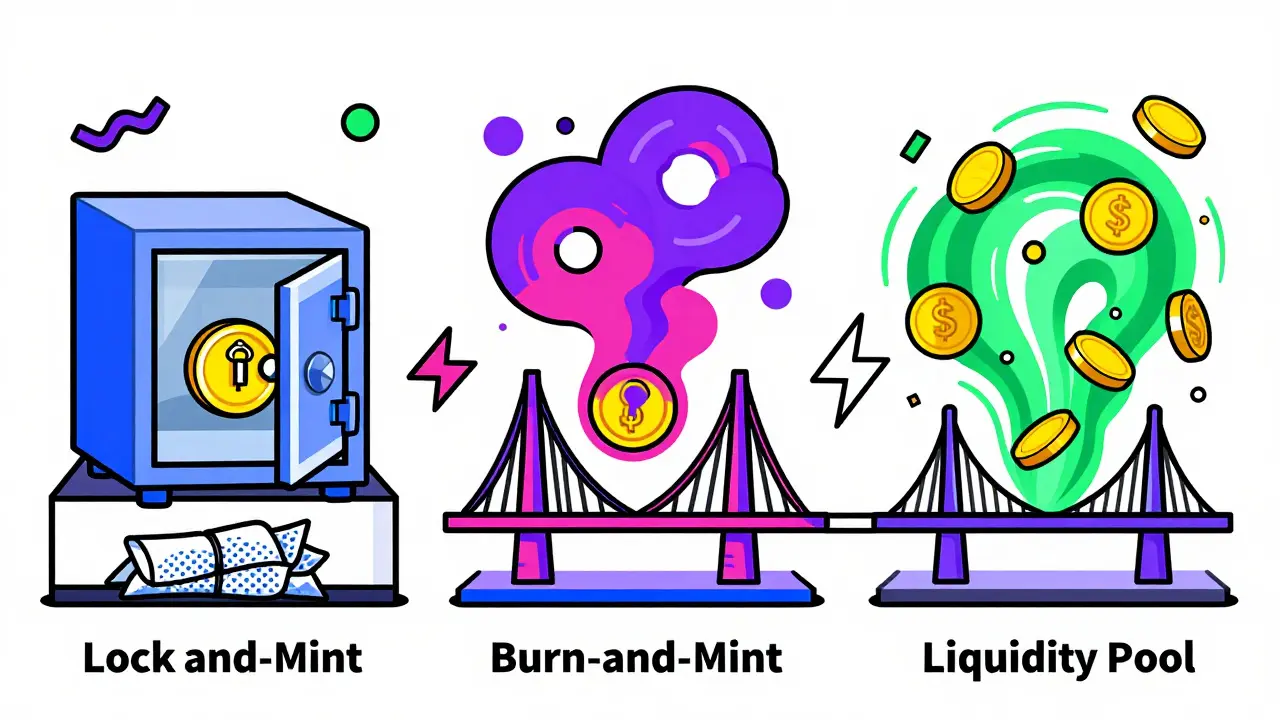
To understand the impact on value, we first need to look at the mechanics. A cross-chain bridge is software that lets isolated blockchains transfer assets or data. Since Blockchains like Ethereum and Solana cannot natively read each other’s state, bridges create a workaround. There are three primary ways this happens, and each has different implications for your money.
- Lock-and-Mint (Wrapped Tokens): This is the most common model. You send your original tokens (e.g., ETH) to a smart contract on the source chain, where they are locked. The bridge then mints a "wrapped" version (wETH) on the destination chain. The total global supply remains the same, but the local supply on each chain changes. You now hold an IOU-style representation of your asset.
- Burn-and-Mint (Canonical): Used by Circle for USDC via their Cross-Chain Transfer Protocol (CCTP). Instead of locking funds, the original token is burned on the source chain, and a new canonical token is minted on the destination chain. This eliminates long-term locked collateral and aims to keep the global supply strictly controlled by the issuer.
- Liquidity Pool Bridges: These systems, like Across, maintain pre-funded inventories on multiple chains. When you deposit on Chain A, a solver releases assets from the pool on Chain B instantly. No new tokens are minted; existing supply is just moved around. This is faster-often clearing in 2-30 seconds-but concentrates risk in the pool's balance sheet.
The distinction matters because "wrapped" tokens are not always identical to native tokens. While they aim for a 1:1 peg, they rely on the security of the bridge itself. If the bridge fails, the wrapped token may lose its backing, breaking the parity.
The Trust Model: Who Holds the Keys?
The security of these transfers depends heavily on the trust model. According to research from Taurus and academic surveys published in ACM journals, bridges are major security vectors because they control the ability to mint tokens.
| Bridge Type | Mechanism | Supply Risk | Speed |
|---|---|---|---|
| Trusted Multisig/MPC | A committee of validators signs off on transfers. | High. If keys are stolen, attackers can mint infinite tokens, diluting supply and crashing value. | Fast (minutes) |
| ZK Light-Client | Uses zero-knowledge proofs to verify source chain state cryptographically. | Low. Security relies on math, not human honesty. Harder to exploit for unauthorized minting. | Slower (proof generation time) |
| Liquidity Pool | Off-chain solvers front assets from pre-funded pools. | Medium. Risk lies in pool insolvency or solver manipulation, not direct minting exploits. | Very Fast (seconds) |
In trusted models, the integrity of your token supply depends on a small group of people keeping their private keys safe. History shows this is a weak point. In contrast, ZK bridges, such as those developed by Berkeley RDI, use cryptographic proofs to attest to transactions. This makes the supply change verifiable and resistant to arbitrary minting by a compromised committee. As the industry moves toward these trustless designs, the risk of artificial inflation of wrapped tokens decreases significantly.
Impact on Local Liquidity and Price
Even when bridges work perfectly, they reshape markets. A 2026 study titled “Exploring Cross-Chain Bridges and Their Economic Consequences” (arXiv:2604.03083v1) highlights a critical insight: increased interoperability exerts downward pressure on native token returns.
Here is why this happens. When assets become easily mobile across chains, capital flows rapidly to wherever yields are highest. If Chain A offers lower staking rewards than Chain B, users will bridge their tokens away. This outflow reduces the local circulating supply on Chain A, which might seem good for scarcity, but it also reduces the economic activity and demand for that chain’s native utility. Conversely, Chain B sees an influx of supply, which can saturate local markets.
This mobility means that token prices are no longer determined solely by the fundamentals of one blockchain. They are influenced by the relative yield opportunities across the entire multi-chain ecosystem. For traders, this means arbitrage opportunities appear and disappear quickly. For holders, it means that the "value" of a token is increasingly tied to its accessibility across networks rather than just its performance on a single chain.
Security Failures and Supply Imbalances
The most dramatic impact on token value occurs when bridges fail. Because bridges have the power to mint tokens, a successful hack can lead to an immediate and massive increase in the circulating supply of wrapped assets.
Consider a scenario where attackers exploit a vulnerability in a bridge’s validator logic. They could instruct the bridge to mint millions of wrapped ETH without locking any real ETH. Suddenly, the market is flooded with unbacked tokens. The price of the wrapped version plummets as sellers rush to exit. Often, this panic spills over into the native asset’s price as confidence erodes across the board.
Taurus notes that bridges are "major security risks" precisely because they combine custody (locking funds) with issuance (minting tokens). Past incidents have shown that when a bridge is exploited, the loss is not just a redistribution of wealth to hackers; it is a permanent distortion of supply accounting. Users left holding the wrapped tokens face depegging, where their asset trades at a significant discount to the underlying collateral.
The Rise of Canonical Assets
In response to these risks, the industry is shifting toward canonical assets. Circle’s CCTP protocol supports USDC across more than 13 chains, including Ethereum, Solana, Arbitrum, and Base. By burning tokens on the source chain and minting them on the destination, Circle ensures there is only one type of USDC everywhere. There are no "wrapped" variants with separate risk profiles.
This consolidation reduces fragmentation. Instead of managing dozens of slightly different versions of a stablecoin, each with its own bridge risk, users deal with a single, globally consistent supply. This approach minimizes the chance of depegging due to bridge-specific failures. However, it centralizes trust in the issuer (Circle) rather than distributing it across various bridge operators.

Practical Steps for Protecting Your Value
As a user, you can mitigate these risks by following a few key practices:
- Prioritize Canonical Transfers: Whenever possible, use burn-and-mint protocols like CCTP for major assets like USDC. Avoid wrapped versions if a native option exists.
- Check the Bridge Reputation: Stick to established providers with high Total Value Locked (TVL) and audited code. After the 2022 bridge hacks, the landscape consolidated. Providers like Across, LayerZero, and Wormhole handle the majority of volume, meaning they have more skin in the game and likely better security monitoring.
- Understand the Time Cost: Faster bridges (liquidity pools) are convenient but may carry higher fees or impermanent loss risks for the liquidity providers. Slower ZK bridges offer stronger security guarantees. Choose based on whether speed or security is your priority for that specific transaction.
- Diversify Exposure: Do not keep all your assets on a single bridge-connected chain. If one bridge fails, having assets on isolated or less interconnected chains can protect your portfolio from systemic contagion.
Future Trends in Interoperability
Looking ahead, the focus is shifting from simple connectivity to rigorous supply integrity. Newer protocols are integrating message-passing layers like Chainlink’s CCIP, which orchestrates complex cross-chain operations beyond simple token swaps. These systems treat security assumptions as part of the monetary policy surface.
We are also seeing a rise in intent-based architectures, where users express what they want (e.g., "I want USDC on Solana") and solvers compete to fulfill it optimally. This abstraction layer hides the complexity of bridging from the end-user, but it places even greater responsibility on the infrastructure providers to maintain accurate supply accounting.
Ultimately, cross-chain bridges are not neutral pipes. They are active participants in the economics of every token they touch. By understanding how they lock, mint, and move supply, you can make smarter decisions about where to hold your assets and how to navigate the multi-chain future.
What is the difference between a wrapped token and a canonical token?
A wrapped token is a representation of an asset created by a bridge after locking the original asset on another chain (e.g., wETH). It relies on the bridge's security. A canonical token is the native version of the asset on each chain, maintained through a burn-and-mint process (e.g., USDC via CCTP), ensuring a single global supply without reliance on external bridge custody.
Can a bridge hack affect the price of the original token?
Yes. If a bridge is hacked and attackers mint excessive amounts of wrapped tokens, the price of the wrapped version will crash. This loss of confidence often spills over to the native asset, causing its price to drop as well due to market panic and perceived systemic risk.
Why do some bridges take minutes while others take seconds?
Speed depends on the architecture. Lock-and-mint bridges must wait for confirmations on the source chain and validation by a committee, taking 1-30 minutes. Liquidity pool bridges use pre-funded assets on the destination chain to fulfill requests instantly (2-30 seconds), bypassing the need to wait for cross-chain finality.
Are Zero-Knowledge (ZK) bridges safer than traditional bridges?
Generally, yes. ZK bridges use cryptographic proofs to verify transactions instead of trusting a committee of validators. This removes the risk of key theft or collusion among signers, making unauthorized minting much harder to achieve compared to trusted multisig bridges.
How does cross-chain mobility affect token yields?
Increased mobility allows capital to flow quickly to higher-yield opportunities. This competition can compress yields on individual chains as users chase the best returns, forcing ecosystems to differentiate through features rather than just high emission incentives.