
Cross-Chain DeFi: How Bridges Move Liquidity and Where They Break
 Oct, 2 2026
Imagine you have a pile of gold in Manchester and another in London. You want to buy something in Paris using both piles simultaneously, but there’s no direct train between them. You’d need a courier system that locks your gold in Manchester, sends a signed note to Paris saying "Gold is safe here," mints a digital receipt in Paris, and lets you spend it. That’s essentially what Cross-Chain DeFi does for crypto assets. It connects isolated blockchains like Ethereum, Solana, and Bitcoin, allowing value to flow freely across networks. But this convenience comes with a massive price tag: security risks. By mid-2026, cross-chain bridges have lost over $2.8 billion to hacks-nearly 40% of all value stolen in Web3 history. If you’re using DeFi today, you’re likely relying on these bridges without realizing they are the single biggest point of failure in the entire ecosystem.
The Core Problem: Liquidity Silos vs. Unified Access
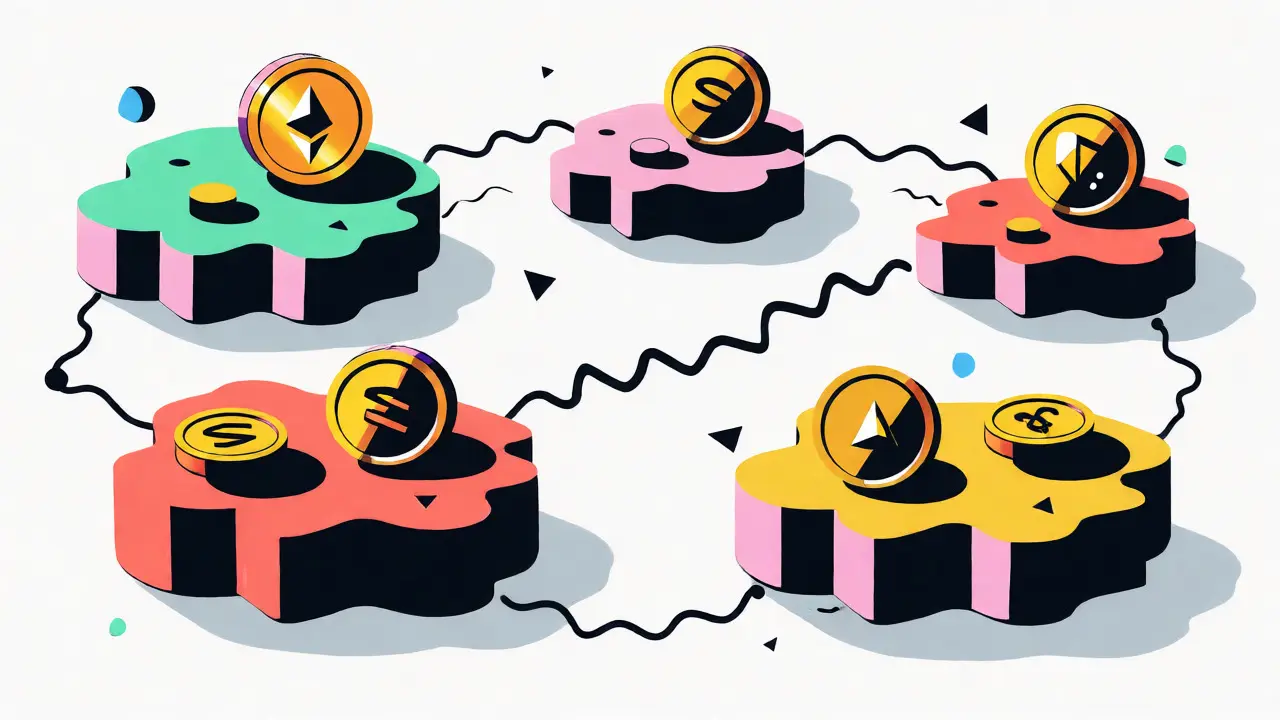
Blockchains were designed to be secure walled gardens. Ethereum doesn’t know what happens on Solana. This isolation creates liquidity silos. If you hold stablecoins on Arbitrum, you can’t easily use them in a lending protocol on Avalanche without jumping through hoops. Cross-Chain DeFi solves this by creating interoperability layers. These protocols lock assets on one chain and mint equivalent representations on another, or route messages directly between chains. The goal is simple: treat global liquidity as a single programmable surface. Instead of managing ten different wallets on ten different chains, you move funds once, and they appear everywhere.
This isn’t just about convenience; it’s about capital efficiency. In a single-chain world, your money sits idle if the best yield opportunity is elsewhere. Cross-chain protocols allow you to chase yields across dozens of networks instantly. However, this convenience shifts the security burden. Your assets are no longer protected solely by Ethereum’s robust consensus mechanism. They are now guarded by the bridge protocol itself, which often relies on smaller validator sets or complex cryptographic proofs. If the bridge breaks, your assets are gone, regardless of how secure the underlying chains are.
How Modern Bridges Actually Work
Old-school bridges were clunky. You locked ETH on Ethereum, waited minutes, and received Wrapped ETH on Polygon. Today, protocols like LayerZero use generalized messaging. Instead of custom code for every pair of chains, LayerZero deploys an Endpoint contract on each supported network. When you send a message from Chain A to Chain B, the Endpoint on Chain A emits an event. Relayers pick up this event and deliver it to the Endpoint on Chain B. Decentralized Verifier Networks (DVNs) check the validity of the message to ensure it wasn’t tampered with. Once verified, the smart contract on Chain B executes the command, such as minting tokens or releasing funds.
This architecture supports over 170 chains, including EVM-compatible networks, Solana, Sui, and TON. For developers, this means writing one smart contract that works everywhere. For users, it means seamless swaps. Protocols like Stargate build on top of this layer, creating liquidity pools for USDC and ETH across more than 60 chains. You swap on one interface, and the protocol handles the routing behind the scenes. It feels like magic, but it’s a delicate dance of cryptography and economic incentives.

The .8 Billion Hole: Anatomy of Bridge Hacks
If bridges are so great, why do they keep getting hacked? The answer lies in their design. Bridges are high-value targets because they hold enormous amounts of collateral. Attackers don’t need to break Ethereum; they just need to break the bridge. Data from DefiLlama and Chainalysis shows that bridge exploits account for roughly 40-69% of all DeFi hack losses depending on the timeframe. In 2022 alone, bridge hacks caused around $2 billion in losses.
Most failures fall into three categories:
- Private Key Leakage: This is the most common cause, responsible for nearly half of all exploits. If attackers steal the private keys of the validators who sign off on transactions, they can approve fake transfers. The Ronin Bridge hack in March 2022 is the prime example. The Lazarus Group compromised five out of nine validator keys, allowing them to drain $620 million in USDC and ETH. Since the quorum was only five signatures, they didn’t need to control the whole network-just enough to fool the bridge.
- Smart Contract Bugs: Sometimes the code itself is flawed. The Wormhole incident involved a missing signature verification check. An attacker crafted a transaction that looked valid to the contract but hadn’t actually been signed by the required authorities. This allowed them to mint wrapped ETH out of thin air, stealing approximately $320 million.
- Message Forgery: Bridges rely on proving that a state change happened on the source chain. If the proof system is flawed, attackers can forge messages. The BNB Bridge hack in October 2022 exploited a vulnerability in how headers were verified, allowing attackers to mint billions of BNB and drain $570 million.
| Bridge Protocol | Date | Loss Amount | Primary Vulnerability |
|---|---|---|---|
| Ronin Bridge | March 2022 | $620 Million | Validator Key Compromise |
| BNB Bridge | October 2022 | $570 Million | Message Forgery / Header Verification |
| Wormhole | February 2022 | $320 Million | Missing Signature Check |
| Nomad Bridge | August 2022 | $190 Million | Configuration Error / Replay Attack |
Why Bridges Are Weaker Than Blockchains
You might ask: "If Ethereum is secure, why isn’t the bridge secure?" Because they operate under different trust models. Ethereum has thousands of independent validators securing its network. A bridge might rely on a small set of relayers or a specific multisig wallet. If those few entities go offline, get hacked, or collude, the bridge fails. Academic surveys describe bridges as being "in their infancy," noting that they provide weaker security guarantees than their underlying base chains.
Furthermore, bridges introduce liveness risks. If the operators maintaining the bridge stop working, your funds might get stuck. You can’t withdraw, even though the assets are technically safe. This centralization trade-off is inherent to current technology. To achieve speed and low costs, bridges sacrifice some decentralization. As of 2026, many leading protocols are trying to fix this by using larger validator sets and better key management practices, but the risk remains non-zero.

Best Practices for Users and Developers
So, should you avoid cross-chain DeFi entirely? Probably not. The utility is too high. But you must manage the risk. Here’s how to navigate the landscape safely:
- Check TVL and Track Record: Look at the Total Value Locked (TVL) in the bridge. Higher TVL usually implies more scrutiny, but also a bigger target. More importantly, check if the bridge has survived major attacks. Protocols that have been audited and tested over years are generally safer than new, unaudited ones.
- Understand the Trust Model: Does the bridge use a decentralized network of validators, or does it rely on a centralized team? LayerZero, for instance, allows apps to choose their own DVNs, offering flexibility. Other bridges might use a fixed committee. Know who holds the keys.
- Limit Exposure: Don’t keep your entire portfolio in cross-chain positions. Treat bridge exposure like venture capital-high reward, high risk. Keep a significant portion of your assets on native chains where you control the keys directly.
- Monitor Security Updates: Follow security firms like Immunefi or Chainlink’s education hub. They publish real-time data on vulnerabilities. If a bridge announces a pause for maintenance after a minor bug report, take it seriously.
For developers, the mantra is "verify, then trust." Never assume a message is valid just because it arrived. Always validate the source chain ID, the sender address, and the payload integrity within your smart contract. Use established standards like Omnichain Fungible Tokens (OFT) rather than rolling your own token logic unless absolutely necessary.
The Future: From Risky Bridges to Native Interoperability
The industry knows bridges are a band-aid. The long-term solution is native interoperability, where chains communicate directly without middlemen. Projects like Polkadot and Cosmos attempt this with shared security models. However, until those ecosystems mature, cross-chain messaging protocols like LayerZero will remain the dominant infrastructure. The trend is moving toward "omnichain" applications-apps that exist everywhere at once. Imagine a lending market where you deposit collateral on Bitcoin and borrow stablecoins on Solana, all settled in seconds.
This future depends on solving the key management crisis. Research suggests that isolating keys-one per attester-and using hardware-backed storage reduces blast radius significantly. We are seeing a shift toward formal verification of bridge code, where mathematical proofs guarantee correctness before deployment. While we won’t eliminate risk entirely, we can reduce it from "catastrophic" to "manageable." Until then, stay skeptical, stay informed, and remember: in cross-chain DeFi, the bridge is only as strong as its weakest link.
What is the main difference between a bridge and a DEX?
A Decentralized Exchange (DEX) trades assets within a single blockchain. A bridge moves assets or messages between different blockchains. You often use a bridge to access a DEX on another chain.
Are cross-chain bridges safe to use in 2026?
They are safer than in 2022 due to better audits and key management, but they still carry higher risk than single-chain protocols. Over $2.8 billion has been lost historically. Use reputable bridges with large Total Value Locked (TVL) and limit your exposure.
How does LayerZero differ from traditional bridges?
Traditional bridges are asset-specific (e.g., locking ETH to mint WETH). LayerZero is a general-purpose messaging protocol. It can send any data, not just tokens, enabling complex cross-chain applications like lending and governance voting across 170+ chains.
What happens if a bridge gets hacked?
Usually, the bridge pauses operations. Funds may be frozen while the team investigates. In some cases, insurance covers losses, but often users bear the loss. This is why diversifying across multiple bridges and chains is critical.
Do I pay fees when using cross-chain DeFi?
Yes. You pay gas fees on the source chain to send the message, fees for the relayer/verifier network, and gas fees on the destination chain to execute the action. Costs vary by network congestion.