
Crypto Startup Security Audits: Scope, Testing Methods, and Remediation Plans
 Jul, 5 2026
Imagine spending months building a decentralized finance protocol, only to lose everything in minutes because of a single line of bad code. That is the harsh reality for many crypto startups. In an industry where bugs are not just errors but open doors for theft, security audits have become the non-negotiable backbone of trust. They are no longer a nice-to-have marketing badge; they are a survival mechanism.
As we move through mid-2026, the landscape has shifted dramatically. The days of slapping a logo on your website after a cursory check are over. Investors, regulators, and users now demand rigorous, transparent, and continuous security assessments. This guide breaks down exactly what goes into a modern security audit, how auditors test your code, and how you should handle the inevitable findings without panicking or delaying your launch indefinitely.
Defining the Scope: More Than Just Smart Contracts
When founders think about audits, they usually picture a team reviewing their Solidity or Rust code. While that is the core, the scope of a comprehensive security assessment for a crypto startup in 2026 is much broader. Trail of Bits and other top-tier firms now review complete blockchain systems. This includes not just the smart contracts, but also the off-chain infrastructure that interacts with them.
Your audit scope should typically cover:
- Smart Contracts: The primary logic governing token transfers, staking, or lending.
- Protocol Design: The economic incentives and governance mechanisms that could be exploited even if the code is bug-free.
- Cross-Chain Bridges: If you interact with multiple blockchains, these bridges are high-risk targets.
- Off-Chain Infrastructure: Admin dashboards, key management systems, RPC nodes, and APIs. Hackers often bypass complex smart contract logic by stealing admin keys from a poorly secured server.
Petronella’s 2026 guidelines emphasize that fixed-scope engagements must specify which folders or files are under review. Vague scopes lead to scope creep and unexpected costs. Be specific. Tell the auditor exactly what needs checking and what is out of bounds. For example, if you are using a standard ERC-20 library from OpenZeppelin, you might exclude those known-safe libraries from deep manual review to save budget, focusing instead on your custom logic.
Testing Methods: How Auditors Break Your Code
Auditors do not just read code like a book. They attack it. Modern security audits use a hybrid approach combining automated tools with deep human analysis. Understanding these methods helps you prepare your codebase and set realistic expectations.
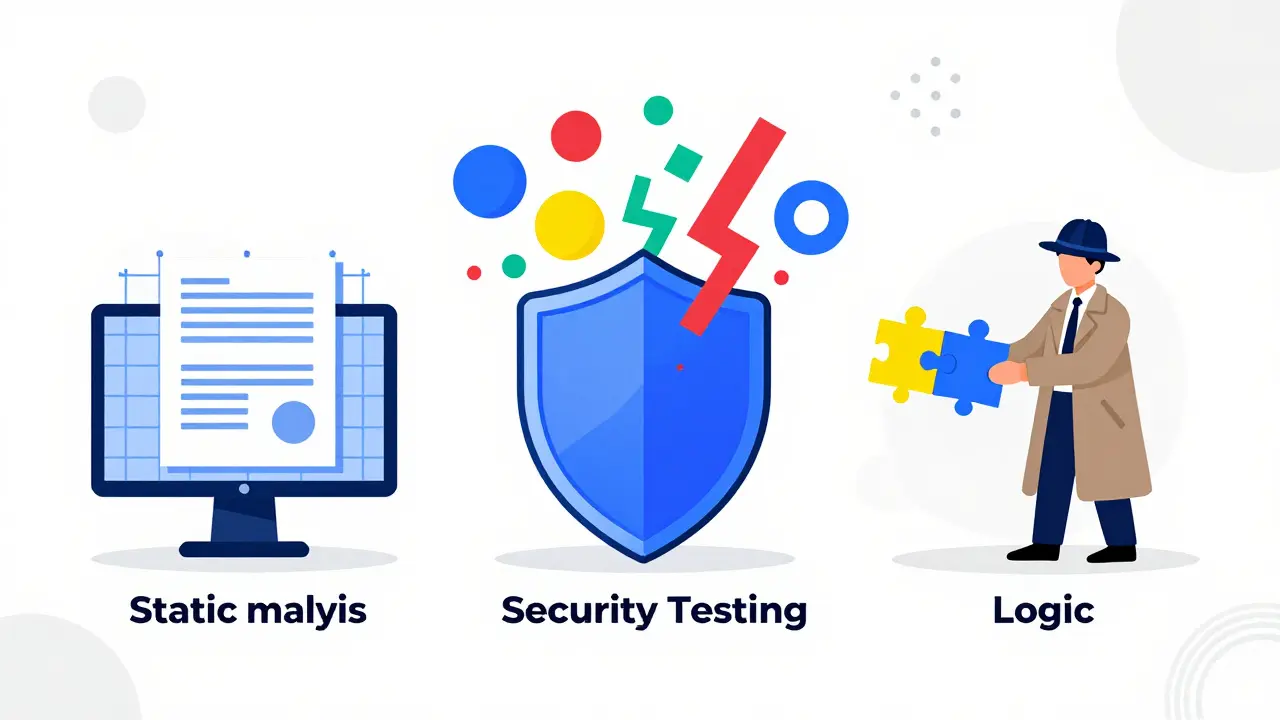
The process generally follows three main pillars:
- Static Analysis: Tools like Slither, Mythril, and Semgrep scan your codebase for known vulnerability patterns. These tools are fast and catch common mistakes like reentrancy flaws or integer overflows. However, they produce false positives, so they are never used alone.
- Fuzzing: This is where things get interesting. Fuzzers like Echidna, Foundry, and Halmos generate millions of random inputs to stress-test your contracts. They look for invariant violations-conditions that should always be true but break under weird circumstances. For instance, a fuzzer might discover that withdrawing funds twice in rapid succession drains the contract balance, something a human reviewer might miss during a casual read.
- Manual Review: This is the most expensive and valuable part. Senior auditors perform line-by-line reviews. They build mental models of your system, thinking like an attacker. They look for logical errors, design flaws, and edge cases that automated tools cannot detect. Trail of Bits notes that this phase involves defining properties and testing them against real-world attack scenarios.
Chainlink’s methodology highlights that auditors classify every finding by severity: Critical, High, Medium, Minor, and Informational. A Critical issue means immediate financial loss is possible. An Informational issue might just be poor coding style. Knowing this hierarchy is crucial when negotiating timelines and budgets.
The Cost Reality: Budgeting for Security in 2026
Let’s talk money. Security audits are not cheap, and prices have stabilized at higher levels as demand outstrips the supply of skilled auditors. According to data from Ulam Labs and Hedera in late 2025 and early 2026, here is what you can expect to pay:
| Project Type | Complexity | Estimated Cost (USD) | Timeline |
|---|---|---|---|
| Simple Token (ERC-20/721) | Low | $5,000 - $15,000 | 1 - 2 Weeks |
| Medium dApp / NFT Marketplace | Medium | $20,000 - $50,000 | 3 - 6 Weeks |
| Advanced DeFi Protocol | High | $75,000 - $150,000+ | 2 - 4 Months |
| Cross-Chain System | Very High | $100,000 - $200,000+ | 3 - 6 Months |
Why the variation? It comes down to risk and effort. A simple token has few interaction points. A DeFi protocol with flash loan integration, oracle dependencies, and governance tokens has thousands of potential failure states. Top-tier firms like Trail of Bits and OpenZeppelin charge premium rates ($$$$) because their brand carries weight with investors. Mid-tier firms like Halborn or Guardian Audits offer a good price-quality balance ($$). Beware of ultra-cheap audits from unknown providers; a "rubber stamp" audit gives false confidence and zero protection.
Also, factor in waiting times. Elite firms are booked months in advance. Start planning your audit engagement before you finish writing your code. Contact auditors early to secure a slot.

Remediation Plans: Fixing What’s Broken
Receiving an audit report is not the end; it’s the beginning of the hard work. You will find bugs. Good ones will find many. The key is how you handle them. A proper remediation plan is structured and disciplined.
First, prioritize based on severity. Do not waste time fixing "Informational" style issues while a "Critical" reentrancy bug sits open. Address Critical and High issues immediately. For Medium issues, assess the actual risk. Can an attacker realistically exploit it? If yes, fix it. If no, document why you are accepting the risk.
Second, implement fixes in a staging environment. Never patch directly on mainnet. Use tools like Hardhat or Foundry to simulate attacks against your patched code. Verify that the fix works and does not introduce new bugs. Regression testing is essential.
Third, engage in a retest. Reputable firms like Petronella and Cyfrin include a "RETEST" phase in their workflow. After you submit your fixes, the auditors review them again. This double-pass ensures that your solution actually solves the problem. Do not skip this step. It is cheaper to pay for a retest than to get hacked.
Finally, publish the final report. Transparency builds trust. Users want to see that you addressed the findings. Hide nothing. Explain what was found, how it was fixed, and any residual risks. This honesty distinguishes professional projects from scams.
Choosing the Right Auditor
Not all auditors are created equal. When selecting a firm, look beyond the logo. Check their track record. Have they audited protocols similar to yours? Do they specialize in your blockchain (Ethereum, Solana, BNB Chain)? Hashlock’s 2025 comparison stresses the importance of vertical specialization. An auditor who knows DeFi mechanics will spot economic exploits that a generalist might miss.
Ask for references. Talk to other founders who have worked with them. Look at their public reports. Are they detailed? Do they explain the root cause, or just list symptoms? CertiK, for example, offers mass-market audits with fast turnaround but mixed community feedback on depth. Trail of Bits offers elite, deep-dive audits but takes longer and costs more. Choose based on your project’s risk profile and budget.
Remember, an audit is one layer of defense. Combine it with bug bounties, continuous monitoring (like CertiK Skynet), and secure coding practices. Security is a journey, not a destination.
How long does a typical smart contract audit take?
Timelines vary by complexity. Simple tokens may take 1-2 weeks, while complex DeFi protocols can require 2-4 months. Top-tier firms often have waiting lists, so booking early is essential.
Is one audit enough to secure my project?
No. Audits are point-in-time assessments. As you update code or add features, new vulnerabilities can emerge. Industry best practice recommends multiple independent audits, ongoing bug bounties, and continuous monitoring.
What is the difference between static analysis and fuzzing?
Static analysis scans code for known patterns without executing it, catching syntax-level errors. Fuzzing executes the code with random inputs to find logical bugs and invariant violations that static tools miss.
Should I disclose critical vulnerabilities publicly?
Yes, but only after they are fixed. Publish a final audit report detailing resolved critical and high-severity issues. Transparency builds user trust, but disclosing unfixed critical bugs invites attackers.
Can I negotiate the cost of an audit?
You can negotiate scope, not necessarily hourly rates. By clearly defining what is in and out of scope, you can reduce costs. However, cutting corners on critical components to save money is risky.