
Decentralized GPU Marketplaces: How Crypto Incentives Are Cutting AI Training Costs
 Jul, 15 2026
Training a modern large language model used to mean begging for access to a centralized data center or paying sky-high rates to hyperscalers like AWS and Google Cloud. But in mid-2026, the landscape has shifted. A new breed of decentralized compute networks is turning idle graphics cards into a global, permissionless cloud. These platforms, often called GPU marketplaces, let anyone with hardware rent out their power, while developers pay significantly less to train AI models. The secret sauce? Cryptocurrency incentives that align the interests of hardware owners and AI builders.
This isn't just theoretical hype anymore. We are seeing live deployments, real revenue, and measurable cost savings. If you are a developer looking to cut compute bills, or an investor watching the Decentralized Physical Infrastructure Network (DePIN) sector, understanding how these networks work-and where they fail-is crucial. Let’s break down the major players, the economics, and the hard truths about security and usability.
The Rise of the Decentralized GPU Cloud
At its core, a decentralized GPU marketplace solves a simple supply-demand mismatch. On one side, millions of GPUs sit idle in homes, gaming rigs, and small data centers. On the other, AI companies are starving for compute. Traditional clouds charge a premium for reliability and support. Decentralized networks strip away that middleman, using smart contracts to handle payments and verification.
The market size for decentralized computing was estimated between USD 8.52 billion and USD 12.2 billion in 2024, with projections soaring to nearly USD 45 billion by 2033. This growth is driven by the DePIN sector, which aggregates physical infrastructure-like GPUs-into digital networks. By mid-2026, over 10.3 million devices were deployed across 199 countries, proving this is real-world infrastructure, not just speculative tokens.
| Network | Primary Use Case | Underlying Chain | Key Differentiator |
|---|---|---|---|
| Render Network | 3D Rendering & VFX | Solana | Burn-and-mint tokenomics; OctaneBench pricing |
| Akash Network | General AI Compute | Cosmos | On-chain auctions; 60-70% cheaper than AWS |
| io.net | Large-Scale Clustering | Solana | Ray framework integration; 10k+ GPU clusters |
| Gensyn | Verifiable ML Training | Ethereum Rollup | Cryptographic proof-of-learning; bitwise reproducibility |
| Bittensor | AI Model Marketplace | Bittensor Chain | Yuma Consensus; subnet-based inference/training |
| Aethir | Enterprise & Gaming | Ethereum L2 | Low-latency streaming (Atmosphere); enterprise-grade |
How the Major Players Stack Up
Not all decentralized networks are built the same. Some focus on raw rendering power, others on general-purpose AI training, and a few on cryptographic verification. Here is what you need to know about the leaders.
Render Network: The Rendering Specialist
Launched in 2016, Render Network is the veteran of the pack. It started as a peer-to-peer marketplace for 3D rendering and migrated to Solana in 2023 for better scalability. You price jobs in OctaneBench (OBH) units. As of late 2025, Tier 1 trusted nodes charged around €2.00 per 200 OBH, while economy tiers dropped to €0.25. The economic model burns 95% of the RNDR tokens used to pay for jobs, creating deflationary pressure. For node operators, an RTX 4090 can earn roughly USD 3-5 per hour, making it attractive for gamers with spare hardware.
Akash Network: The Cost Cutter
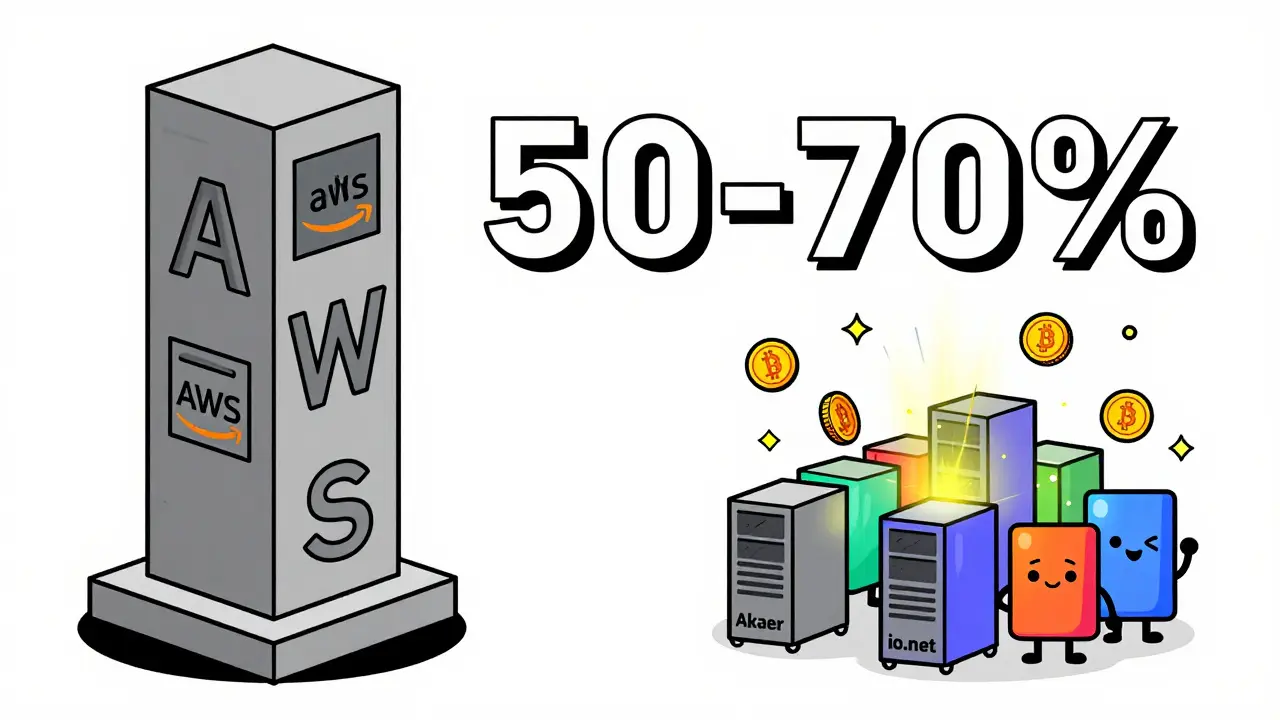
If your goal is pure savings, Akash is often the go-to. Built on Cosmos, it operates via on-chain auctions where providers bid for workloads. In mid-2026, H100 GPUs on Akash ranged from USD 1.20 to USD 1.80 per hour, compared to AWS prices of USD 4.50 to USD 5.50. That’s a 60-70% reduction. However, you get what you pay for in terms of convenience. You still need to handle containerization and Kubernetes orchestration yourself. There is no hand-holding here, but the savings are undeniable for teams comfortable with DevOps.
io.net: The Cluster Builder
io.net focuses on aggregating massive amounts of heterogeneous hardware into single, usable clusters. Using the Ray distributed computing framework, it can stitch together up to 10,000 accelerators. This is ideal for large-scale training jobs that need breadth rather than depth. Pricing analyses show io.net can be 33-53% cheaper than Render for specific visual tasks, and generally 50-70% below traditional clouds. The trade-off is complexity; managing a cluster of thousands of diverse GPUs requires robust monitoring and anomaly detection.
Gensyn: The Verification Pioneer
Gensyn tackles the hardest problem in decentralized AI: trust. How do you know a random node didn’t corrupt your training data? Gensyn uses an Ethereum rollup and a protocol called Verde Verification to provide cryptographic proofs of learning. It achieves bitwise reproducibility of ML workloads, meaning you can verify the exact steps of a training run. While more expensive than raw rental markets like Akash, it offers a level of auditability that centralized clouds don’t easily match. Its mainnet launched in April 2026, marking a significant step toward verifiable decentralized ML.
Bittensor: The AI Ecosystem
Bittensor is less about renting GPUs and more about building an open AI marketplace. Miners deploy models, validators score them, and users pay for inference. The TAO token rewards utility. In March 2026, Subnet 3 trained a 72-billion-parameter model, proving large-scale coordination is possible. However, user experience remains fragmented. Critics point out that some subnets farm emissions without delivering clear value, and the interface can be confusing for newcomers. Still, with a market cap exceeding USD 2.6 billion, it’s the heavyweight in decentralized AI inference.
Aethir: Enterprise and Gaming
Aethir targets latency-sensitive applications like cloud gaming and enterprise AI. Its Atmosphere product provides low-latency streaming, while other slices handle training. The ATH token coordinates staking and governance. Analysts rate its adoption at 7.5/10 in early 2026, noting strong tokenomics but emphasizing that long-term success depends on replacing incentive-driven usage with genuine demand.
The Economics: Why Crypto Incentives Matter
You might wonder why anyone would host a noisy, power-hungry GPU in their home. The answer is financial incentive. In these networks, tokens act as both payment and reward. When you rent a GPU on Akash, you pay in AKT. When you contribute to Bittensor, you earn TAO. This creates a self-sustaining loop: demand drives up token value, which attracts more suppliers, which lowers prices and increases availability.
However, token volatility is a double-edged sword. If the underlying token crashes, node operators may pull their hardware, causing supply shocks. Projects like Render mitigate this with burn mechanisms, while others rely on steady emission schedules. As a user, you must monitor these tokenomics closely. A cheap GPU today might become unavailable tomorrow if the reward structure changes.

Security and Verification Challenges
Let’s address the elephant in the room: security. Running AI workloads on untrusted hardware is risky. Unlike CPUs, GPUs are non-deterministic. Two identical inputs can produce slightly different outputs due to hardware quirks. This makes simple recomputation for verification nearly impossible.
Projects are tackling this in different ways. Gensyn uses probabilistic proof-of-learning and binary search dispute resolution. Others rely on Trusted Execution Environments (TEEs), though these have faced exploits. Sybil attacks, where one actor controls many fake nodes, remain a threat to governance. And then there’s the risk of data leakage. If you’re training proprietary models, sending weights to a stranger’s GPU is terrifying. Encryption in transit helps, but end-to-end encryption and secure enclaves are still evolving standards in this space.
Best practice? Don’t put mission-critical, highly confidential workloads on public decentralized networks yet. Use them for cost-sensitive, parallelizable tasks like batch inference, rendering, or experimental training. Keep your crown jewels in centralized, audited environments until verification protocols mature further.
Who Should Use Decentralized Compute?
This technology isn’t for everyone. If you are a startup burning cash on AWS H100s, Akash or io.net could save you 50-70%. If you are a 3D artist, Render Network offers a streamlined workflow. If you care about transparency and open-source AI, Bittensor and Gensyn provide unique value propositions.
But if you need guaranteed SLAs, zero-latency responses, or hands-off management, stick with hyperscalers. Decentralized networks require technical competence. You need to understand containerization, wallet management, and network variability. The barrier to entry is higher, but the payoff in cost and decentralization is significant.
Is decentralized GPU compute cheaper than AWS or Google Cloud?
Yes, significantly. For high-end GPUs like H100s and A100s, networks like Akash and io.net offer prices 50-70% lower than centralized providers. However, this comes with trade-offs in reliability, ease of use, and lack of formal SLAs.
Can I really earn money by hosting my GPU?
You can. An RTX 4090 on Render Network can generate USD 3-5 per hour, while enterprise cards like the A100 can earn USD 5-10 per hour. However, you must account for electricity costs, hardware wear, and internet bandwidth. Profitability varies based on local energy prices and network demand.
How do these networks ensure my AI training job isn’t corrupted?
Verification methods vary. Render uses tiered trust levels. Akash relies on reputation and slashing penalties. Gensyn employs cryptographic proofs (Verde Protocol) to verify training steps. Most networks recommend redundancy-running jobs across multiple nodes-to mitigate individual failure or malice.
What is the biggest risk of using decentralized AI networks?
The primary risks are data privacy and reliability. Your data runs on third-party hardware, raising leakage concerns. Additionally, nodes can go offline unexpectedly, potentially interrupting long training jobs. Token volatility also affects long-term cost predictability.
Which network is best for beginners?
For 3D artists, Render Network is the most user-friendly. For general AI developers, Akash offers straightforward deployment guides despite requiring DevOps skills. Bittensor is complex due to its subnet structure. Start with smaller jobs to test reliability before scaling up.