
Delegation Markets in DAOs: How Renting Voting Power Works
 Aug, 22 2026
Imagine you own a house but let a property manager decide who can use the backyard. In many Decentralized Autonomous Organizations (DAOs) is a group of people who use blockchain technology to make decisions together without a central leader, that’s exactly what happens with your tokens. You hold the asset, but you might rent out your say in how it’s managed. This isn't just theory; it's happening right now in major protocols like Arbitrum and Ethereum Name Service (ENS). But does renting your vote help democracy, or does it just sell it to the highest bidder?
The Core Mechanism: Delegating Without Selling Ownership
To understand these markets, we first need to look at the basic tool: delegated voting. In most DAOs, you don’t have to vote on every single proposal yourself. Instead, you can assign your voting weight to another wallet address known as a delegate. The key technical detail here is separation. When you delegate, you transfer the governance right, but you keep the economic rights. If the token price goes up, you still profit. If the delegate votes against your interests, you can usually revoke that delegation at any time.
This setup was originally designed to solve a simple problem: apathy. Most token holders are busy people. They don’t want to read 50-page proposals every week. So, they pick a trusted community member-a "professional" delegate-and let them handle the details. However, once voting power becomes something you can hand over, it also becomes something you can trade. That’s where the market begins.
From Helpful Delegates to Vote Brokers
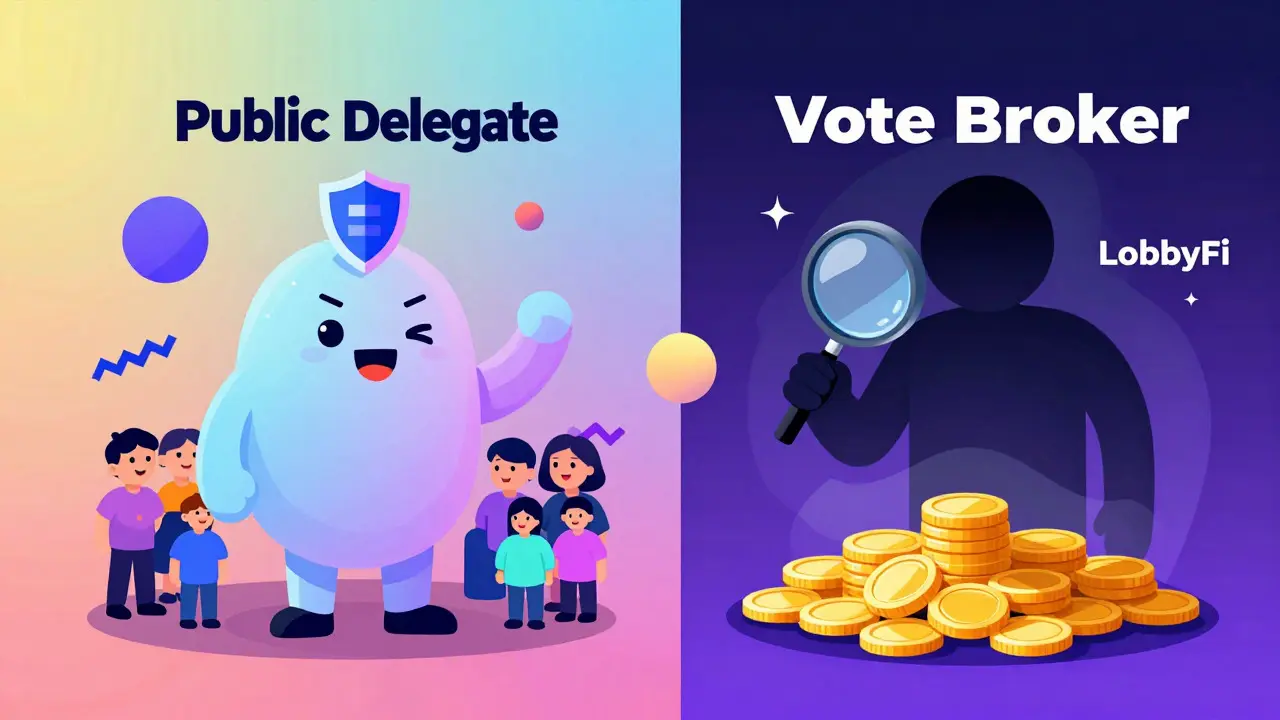
In the early days, delegation was mostly non-monetary. You picked someone because you liked their track record. Today, the landscape has shifted. We see a spectrum of activity ranging from passive representation to active commercialization. On one end, you have public delegates who build reputations. On the other, you have platforms like LobbyFi is a platform that allows users to aggregate their voting power and rent it out to interested parties for compensation.
How does LobbyFi work? It acts as an aggregator. Token holders delegate their votes to LobbyFi’s smart contract. In return, LobbyFi promises to share rewards if those votes are used to influence a specific outcome. For a holder who doesn’t care about the technical nuances of a protocol upgrade, this looks like free money. It turns idle governance power into yield. But for the DAO, it means a large block of votes is no longer aligned with the community’s best interest-it’s aligned with whoever paid the most for it.
The Rise of Dark DAOs and Opaque Bribery
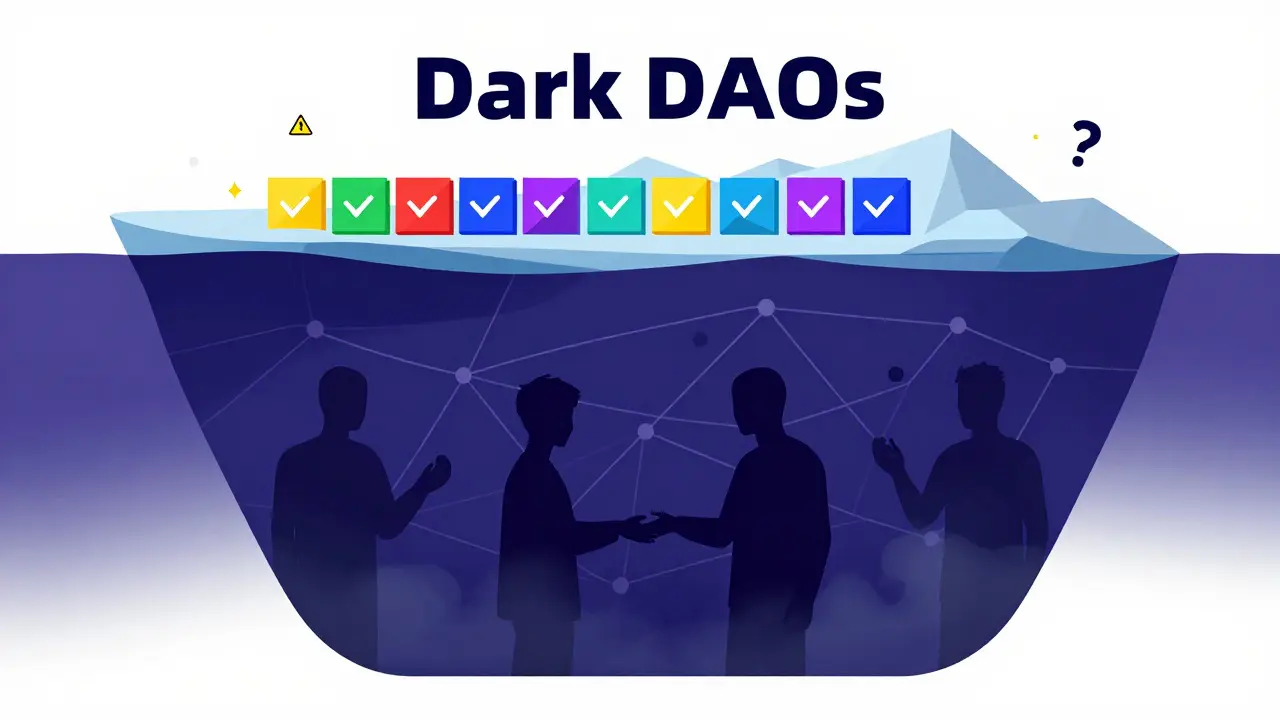
If public platforms are the visible tip of the iceberg, Dark DAOs is a hidden network of actors that coordinate off-chain to buy votes and subvert decentralized governance processes is the underwater mass. Researchers at Cornell University have formalized this concept. A Dark DAO doesn’t necessarily exist as a visible entity on the blockchain. Instead, it uses private messaging channels, spreadsheets, or multisig wallets to coordinate a group of voters.
The goal is simple: control the outcome of a critical vote by paying voters directly. Because the coordination happens off-chain, it’s hard to trace who is buying whose vote. The only thing visible on-chain is the final vote and potentially a bribe contract. This creates a dangerous environment where a small cartel of whales can effectively hijack a DAO’s direction without the rest of the community ever knowing a deal was struck.
| Type | Transparency | Primary Goal | Risk Level |
|---|---|---|---|
| Public Delegate | High | Efficient representation | Low to Medium |
| Bribe Platforms (e.g., LobbyFi) | Medium | Monetize idle votes | Medium to High |
| Dark DAOs | Low | Opaque control/capture | Very High |
Why Concentration Makes This Dangerous
You might wonder: if everyone is free to vote, why do these markets matter so much? The answer lies in data. Studies show that governance in DAOs is already highly centralized. In many protocols, the top 10% of voters control over 76% of the voting power on a typical proposal. Sometimes, a single whale holds more than 37% of the total weight.
When you add delegation to this mix, the concentration often gets worse, not better. Why? Because rational users tend to delegate their entire balance to one prominent figure rather than splitting it among many. This creates massive voting blocs. Researchers use a metric called Voting-Bloc Entropy (VBE) to measure this. Low VBE means power is concentrated in few hands. When VBE is low, bribery is cheaper. A Dark DAO only needs to convince a few big delegates to flip their stance, rather than bribing thousands of small retail holders. Delegation markets amplify this risk by giving those big delegates a financial incentive to listen to bidders.
Case Study: The ENS Experiment
Not all experiments aim to maximize profit. The Ethereum Name Service (ENS) DAO recently proposed a different approach to tackle both apathy and centralization. In July 2026, they drafted a plan to delegate 5 million ENS tokens from the treasury to a set of community volunteers.
Here’s the twist: these voters get the voting power, but no financial exposure to the tokens themselves. This separates the act of governing from the act of owning. The proposal splits the power into four groups of 1 million tokens each. If a voter stays inactive for six months, their power is redistributed. This design tries to create a meritocracy of engagement rather than a marketplace of capital. It acknowledges that voting power is a responsibility, not just an asset to be rented out for yield.
How to Protect Your Vote (and the DAO)
If you’re a token holder, what should you do? First, understand that your default state is often "no vote." By doing nothing, you allow others to define the rules for you. If you choose to delegate, ask yourself: Are they voting based on merit, or are they being paid? Check if they are listed on bribe aggregators.
For DAOs looking to fix this, the path forward involves structural changes. Experts suggest implementing delegation caps so no single person can hold too much power. Multi-delegation, where you split your vote among several delegates, can also break up large blocs. Finally, adding cryptographic noise to vote tallies makes it harder for bribers to verify if you actually voted as promised, raising the cost of running a Dark DAO attack.
The future of DAO governance depends on balancing efficiency with integrity. Delegation markets offer a way to activate passive capital, but without guardrails, they risk turning our digital democracies into pay-to-play arenas controlled by a few invisible brokers.
Do I lose ownership of my tokens when I delegate?
No. Delegation transfers only the voting right. You retain full economic ownership, including staking rewards and price appreciation, unless the specific DAO protocol states otherwise.
What is a Dark DAO?
A Dark DAO is a hidden coalition that coordinates off-chain to buy votes in public DAOs. It uses private channels to organize bribery, making it difficult for the target DAO to detect who is controlling the votes.
Is renting out your vote illegal?
Currently, there is little regulation specifically targeting on-chain vote selling. However, it may conflict with the spirit of decentralization and could face scrutiny if DAOs are classified as regulated entities in certain jurisdictions.
How can I check if my delegate is being bribed?
You can monitor on-chain transactions to see if your delegate interacts with known bribe platforms or receives large transfers before voting. Tools that track Voting-Bloc Entropy can also alert you to sudden shifts in voting patterns.
Does delegation always increase participation?
In the short term, yes, it reduces the effort required to vote. However, long-term studies suggest it can reduce new voter onboarding if power becomes too concentrated among entrenched professional delegates.