
Demat Accounts in India Explained: How to Open and Use Your First Demat Account
 May, 18 2026
You want to buy shares of Tata Motors or Reliance Industries. You have the money, you have the idea, but you hit a wall immediately. You can’t just walk into a bank and hand over cash for stocks anymore. Since 2001, the Indian stock market has been dematerialized. This means physical share certificates are history. Today, every share you own exists as digital data in a Demat account, which is a digital repository that holds financial assets like stocks, bonds, and mutual funds in electronic form. Without this account, you are locked out of the market entirely.
If you are new to investing, the terminology can feel intimidating. Terms like DP ID, Client ID, and PAN linkage sound like technical jargon reserved for experts. They aren’t. Opening a Demat account is one of the simplest steps in your financial journey, yet it is the most critical infrastructure piece for your wealth creation. Let’s break down exactly what this account is, why you need it, and how to get yours set up without losing money on unnecessary fees.
What Is a Demat Account and Why Do You Need It?
A Demat account, short for "dematerialized" account, acts as the vault for your investments. Think of it like a bank account, but instead of holding rupees, it holds securities. When you buy a stock through a trading platform, the shares don’t go to your phone; they move into this Demat account. Conversely, when you sell, the shares leave the account, and the proceeds hit your linked bank account.
In India, two entities manage these accounts: NSDL (National Securities Depository Limited) and CDSL (Central Depository Services India Limited). These are the depositories. You don’t choose between NSDL and CDSL directly; rather, you choose a Depository Participant (DP). A DP is usually a broker or a bank that provides the interface to access these depositories. Whether your DP connects to NSDL or CDSL makes no difference to your experience. Both are regulated by the SEBI (Securities and Exchange Board of India), ensuring your assets are safe.
The primary reason you need this account is safety and efficiency. Physical shares could be lost, stolen, or damaged. Demat accounts eliminate that risk. They also speed up transactions. Settlement happens in T+1 days now, meaning if you buy a stock today, it settles in your Demat account by tomorrow. This efficiency reduces the counterparty risk significantly.
Demat vs. Trading Account: What’s the Difference?
New investors often confuse these two. You cannot trade without both, but they serve different purposes. Here is the simple distinction:
- Trading Account: This is where you execute orders. It is the bridge between you and the stock exchange (BSE or NSE). You use this to buy and sell.
- Demat Account: This is where the assets rest after the trade is executed. It holds your holdings.
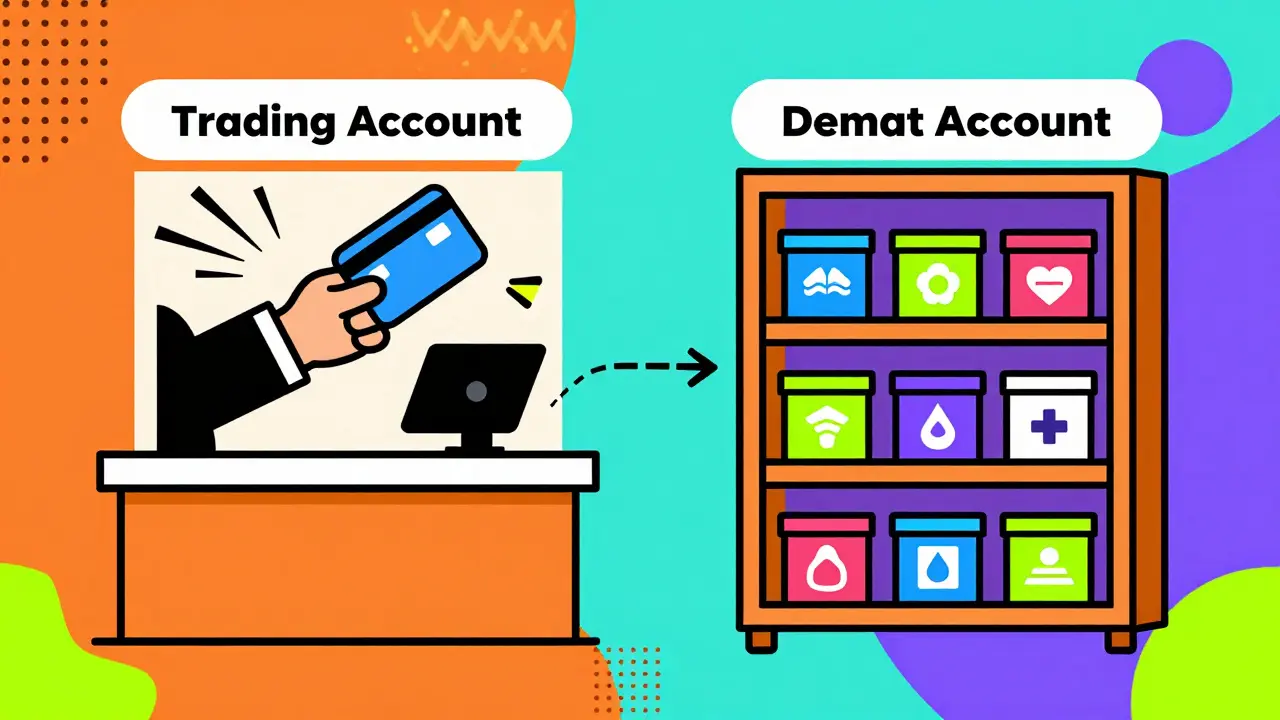
Imagine going to a supermarket. The trading account is the checkout counter where you pay and scan items. The Demat account is your home pantry where you store those items until you need them. You need both to complete the cycle. Most brokers offer a "3-in-1" account, which combines your Bank Account, Trading Account, and Demat Account under one login. This simplifies fund transfers and reconciliation.
| Feature | Trading Account | Demat Account |
|---|---|---|
| Primary Function | Executing buy/sell orders | Holding securities electronically |
| Lifespan | Active only during market hours | Always active (24/7) |
| Linked To | Stock Exchanges (NSE/BSE) | Depositories (NSDL/CDSL) |
| Fees | Brokerage charges per trade | Annual maintenance charges (AMC) |
Documents Required to Open a Demat Account
The process is fully online now, thanks to Aadhaar-based eKYC (Electronic Know Your Customer). However, you still need specific documents ready before you start. Having these scanned or photographed clearly will save you time.
- PAN Card: This is non-negotiable. Your Permanent Account Number links all your financial activities. Ensure the name matches your other IDs exactly.
- Aadhaar Card: Used for identity verification and address proof. It must be linked to your mobile number for OTP verification.
- Bank Account Details: You need a savings account from a scheduled commercial bank. The name on the bank account must match your PAN and Aadhaar.
- Passport-sized Photograph: Usually required for the agreement signing.
- Digital Signature: If you are not using Aadhaar eKYC, you may need a digital signature certificate, though this is rare for retail investors now.
Note: If your PAN and Aadhaar names differ, you will face rejection. Fix this discrepancy at the Income Tax portal or UIDAI center before applying.
Step-by-Step Guide to Opening Your First Demat Account
You can open an account in under 15 minutes if your documents are ready. Here is the exact workflow used by major brokers like Zerodha, Upstox, Angel One, and Groww.
Step 1: Choose a Broker
Don’t just pick the first name you see. Look at the Annual Maintenance Charges (AMC). Many discount brokers offer zero AMC if you maintain a minimum balance or trade a certain volume. Compare brokerage structures. Flat fees (e.g., ₹20 per trade) are better for frequent traders, while percentage-based models might suit large-volume infrequent investors.
Step 2: Submit the Application
Visit the broker’s website or app. Fill in your personal details. The system will often auto-fetch data from your Aadhaar if you consent. Double-check your email and phone number; these are your recovery keys.
Step 3: Upload Documents Upload clear images of your PAN, Aadhaar, and bank statement/cancelled cheque. The AI systems used by brokers are strict about image clarity. Blurry edges mean rejection.
Step 4: Video KYC (V-KYC) This is mandatory. You will be connected to a compliance officer via video call. They will ask you to read a script aloud and show your original documents. Keep your background neutral and ensure good lighting. This step verifies that you are a real person and not a bot.
Step 5: E-Signing You will receive a link via SMS or email to digitally sign the client agreements. Use your Aadhaar OTP to sign. Once signed, the application goes to the depository for final processing.
Step 6: Activation Within 24-48 hours, you will receive your Client ID and DP ID. Log in to your trading platform, link your bank account for auto-payments, and you are ready to trade.
Costs Involved: Hidden Fees to Watch Out For
Opening the account is often free, but maintaining it isn’t always cheap. Be aware of these costs:
- Annual Maintenance Charge (AMC): Traditionally ₹300-₹500 per year. Many brokers waive this if you hold assets worth ₹50,000+ or make at least one trade per quarter.
- Brokerage: Discount brokers charge flat ₹20 per equity trade. Full-service brokers charge 0.03%-0.05% of the turnover. For intraday trading, fees are lower.
- Stamp Duty: Charged by the government on every purchase. It is roughly 0.015% of the transaction value. You cannot avoid this.
- SEBI Transaction Charges: A tiny fee (0.0001%) paid to the regulator for every trade.
- Inactivity Fee: Some brokers charge ₹50-₹100 per month if you don’t log in or trade for three consecutive months. Check the fine print.
Pro Tip: If you plan to invest long-term (buy and hold), prioritize brokers with low or zero AMC. If you plan to trade daily, prioritize low brokerage rates.

How to Use Your Demat Account Effectively
Once activated, here is how you navigate your new asset vault:
Transferring Funds: Link your bank account via UPI or net banking. Money moves from your bank to your trading account instantly. Remember, money goes to the *trading* account first, then buys shares that move to the *Demat* account.
Placing Orders: Use the search bar to find a stock. Select "Buy." Choose the quantity. Set your price limit. Click "Buy." The order goes to the exchange. If matched, the shares are credited to your Demat account on T+1.
Viewing Holdings: Log in to your broker’s dashboard. Go to the "Holdings" tab. Here you see every stock, mutual fund unit, and bond you own. You can also download statements here for tax filing.
Selling Assets: Go to "Holdings," select the stock, click "Sell," and specify the quantity. The shares are debited from your Demat account, and the cash appears in your trading account. You can then withdraw this cash to your bank account.
Safety and Security Best Practices
Your Demat account holds significant value. Protect it like a fortress.
- Enable Two-Factor Authentication (2FA): Always require an OTP for logins and withdrawals.
- Monitor Statements: Download your monthly holding statement. Check for unauthorized trades or unknown holdings.
- Never Share Passwords: No broker will ever ask for your password via phone or email. If they do, it is a scam.
- Update Contact Info: If you change your phone number, update it in the broker’s portal immediately. Lost phone numbers mean lost access to OTPs.
Also, understand that SEBI protects your interests. If a broker defaults, your assets in the Demat account are still safe because they are held in the depository (NSDL/CDSL), not the broker’s private pocket. This segregation is a key safety feature of the Indian market.
Common Mistakes New Investors Make
Avoid these pitfalls to keep your investing journey smooth:
1. Ignoring AMC Waivers Many users pay ₹300 annually when they could have waived it by making one small trade. Read the terms.
2. Mixing Personal and Business Accounts If you run a business, keep your personal Demat account separate. Mixing funds complicates tax audits and expense tracking.
3. Forgetting to Link Aadhaar If your Aadhaar is not linked to your Demat account, you may face restrictions on high-value transactions. Ensure linkage early.
4. Using Multiple Brokers Unnecessarily Having five Demat accounts spreads your attention and increases annual fees. Stick to one reliable broker unless you have a specific strategic reason to diversify platforms.
Can I have more than one Demat account?
Yes, you can have multiple Demat accounts with different brokers. However, you cannot have two Demat accounts with the same Depository Participant (broker) under the same name. It is generally advised to stick to one broker to simplify tracking and reduce annual maintenance costs.
Is it safe to keep money in a Demat account?
A Demat account does not hold cash; it holds securities. Cash resides in your linked trading account or bank account. Your securities are safe because they are held in the depositories (NSDL or CDSL), which are regulated by SEBI. Even if your broker goes bankrupt, your shares remain secure in the depository.
How long does it take to open a Demat account?
With Aadhaar-based eKYC, you can open an account in 15-30 minutes. The activation usually takes 24-48 hours. If manual document verification is required, it may take up to 3-5 working days.
What is the difference between NSDL and CDSL?
Both are central depositories in India that hold securities electronically. As an investor, there is no functional difference for you. Your choice depends on which depository your chosen broker partners with. Both are equally safe and regulated by SEBI.
Do I need a Demat account for mutual funds?
Not necessarily. You can invest in mutual funds through a folio number without a Demat account. However, having a Demat account allows you to view all investments (stocks and mutual funds) in one place, simplifying portfolio management and tax reporting.