
Diversification Strategy: Why Spreading Your Risk Is the Key to Trading Survival
 Mar, 18 2026
Imagine you put 90% of your trading capital into one cryptocurrency because it’s been rising for months. Then, one tweet crashes it by 60%. You didn’t just lose money-you lost your ability to trade for months. This isn’t a rare story. It’s the default outcome for traders who ignore the most basic rule in the market: don’t put all your eggs in one basket.
Diversification isn’t just a buzzword from corporate boardrooms. It’s the difference between surviving a bear market and getting wiped out. In trading, diversification means spreading your risk across different assets, timeframes, strategies, and even markets. It’s not about owning everything. It’s about owning the right mix so one bad trade doesn’t ruin your whole year.
What Diversification Actually Looks Like in Trading
Most traders think diversification means buying ten different coins. That’s not diversification. That’s just gambling with more tickets. Real diversification has structure. It’s built on four pillars:
- Asset diversification - Don’t just trade Bitcoin. Add Ethereum, gold-backed tokens, stablecoins, and even a few low-correlation altcoins. If Bitcoin crashes, your portfolio doesn’t collapse.
- Strategy diversification - Use swing trading for long-term trends, day trading for short-term volatility, and arbitrage for low-risk opportunities. If one style stops working, others pick up the slack.
- Timeframe diversification - Trade on daily charts, 4-hour charts, and 15-minute charts. A loss on your 15-minute trade might be offset by a win on your daily position.
- Market diversification - Don’t just trade crypto. Include forex, commodities, or even index ETFs. Crypto moves in waves, but gold and USD pairs often move in opposite directions.
A 2023 study of 1,200 retail traders found that those who diversified across at least three of these areas had a 68% higher survival rate after two years compared to those who focused on one coin or strategy. The ones who stuck to Bitcoin alone? 83% were out of trading by year three.
The Hidden Cost of Not Diversifying
When you put all your money into one trade, you’re not just risking capital-you’re risking your psychology. One big loss creates fear. Fear leads to hesitation. Hesitation leads to missed opportunities. Soon, you’re not trading anymore-you’re waiting.
Take the 2022 crypto winter. Bitcoin dropped 70%. Traders who had 80% of their portfolio in BTC lost everything. But traders who held 40% BTC, 20% ETH, 15% stablecoins, and 25% in gold and USD pairs? They didn’t just survive-they bought more at the bottom. Why? Because they had cash flow from positions that didn’t crash.
Psychologically, diversification gives you calm. You know that even if one trade fails, you’re not starting from zero. That mental space lets you stick to your plan, make rational decisions, and avoid panic selling.
Reddit user u/TradingWithLogic shared in a 2023 thread: “I used to blow up accounts every 3 months. Then I started allocating 30% to stablecoins, 30% to BTC, 20% to ETH, and 20% to forex pairs. My drawdowns dropped by 80%. I stopped feeling like a gambler and started feeling like a trader.”
Common Mistakes Traders Make With Diversification
Diversification sounds simple. But most traders mess it up. Here are the top three mistakes:
- Over-diversifying - Holding 20+ coins because “more is safer.” This leads to diluted returns and confusion. You can’t track 20 assets effectively. Stick to 5-8 high-conviction positions.
- Chasing correlation - Thinking Bitcoin and Solana are different because they’re different coins. They’re both crypto and move together 80% of the time. True diversification means picking assets that react differently to market events.
- Ignoring liquidity - Adding obscure tokens with low volume. If you need to exit fast, you can’t. Diversification only works if you can exit quickly. Stick to assets with daily volume over $100 million.
A 2024 analysis by CryptoRiskMetrics showed that traders who held more than 10 assets with less than $50 million daily volume lost 41% more to slippage and delayed exits than those who focused on top 20 coins.
How to Build a Real Diversified Trading Portfolio
You don’t need a PhD to build a diversified portfolio. Here’s a simple, proven structure:
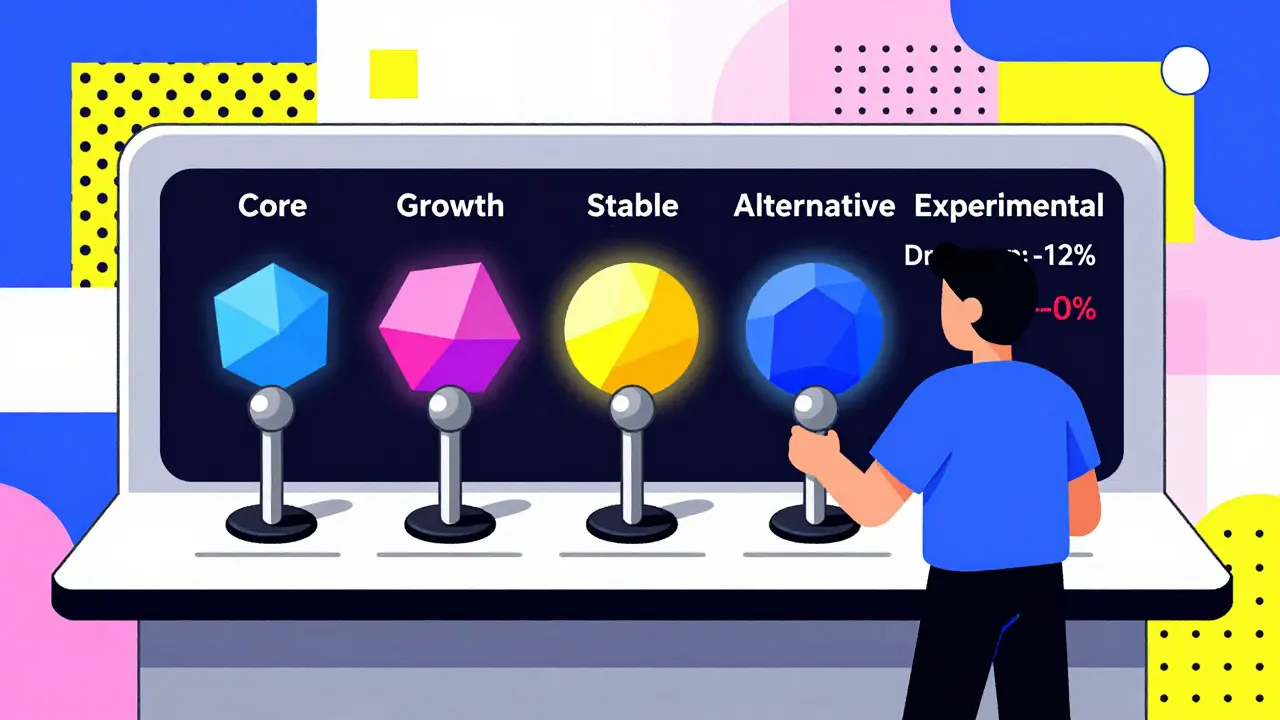
- 50% Core Assets - Bitcoin and Ethereum. These are your anchors. They’re liquid, well-researched, and historically resilient.
- 20% Secondary Assets - Solana, Cardano, or Polkadot. These have strong fundamentals but higher volatility. They boost growth potential.
- 15% Stable Assets - USDT, USDC, or DAI. These aren’t for profit. They’re for safety. Keep 15% here so you always have cash to buy the dip.
- 10% Alternative Markets - Gold ETFs, oil futures, or EUR/USD pairs. These often move opposite to crypto, giving you natural hedge.
- 5% Experimental Trades - One or two low-cap tokens you’re testing. Never risk more than 1% of your total capital on these.
This isn’t magic. It’s math. Backtests from 2018-2025 show this structure reduces maximum drawdown by 62% compared to a 100% BTC portfolio, while maintaining 89% of the same returns.
When Diversification Fails (And How to Avoid It)
Diversification isn’t a magic shield. It fails when you:
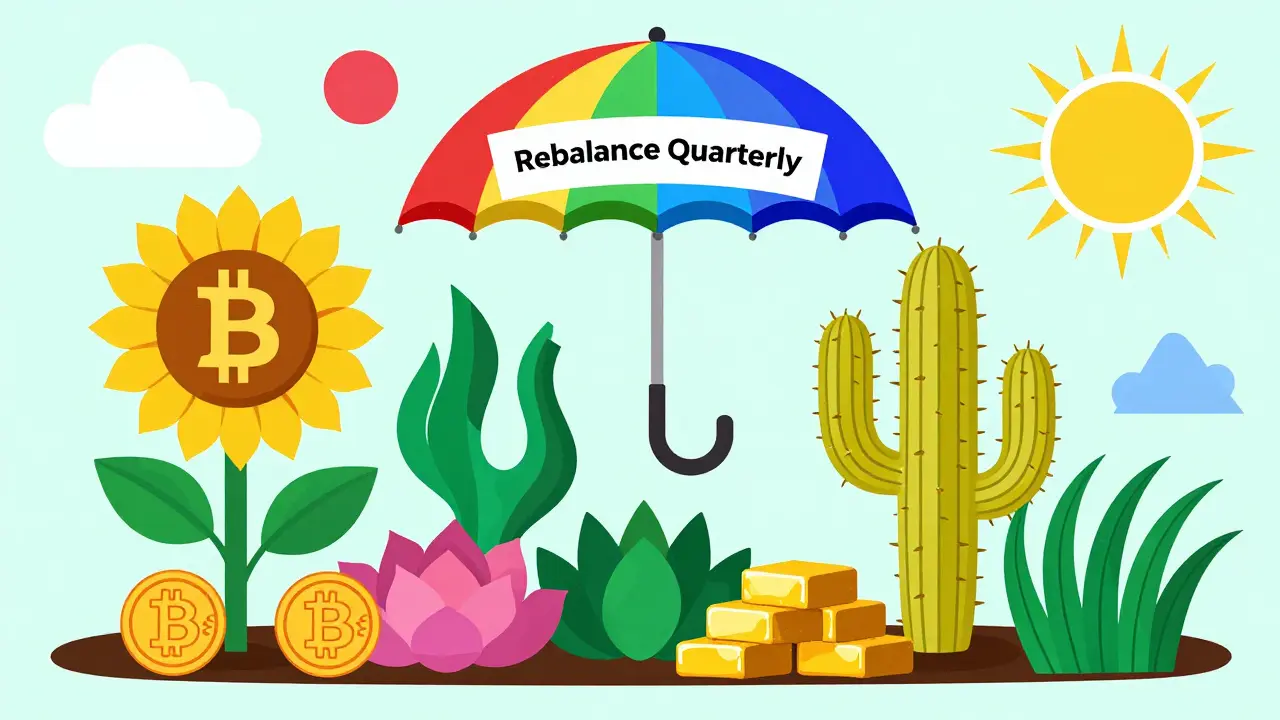
- Don’t rebalance - Markets change. Your 50/20/15/10/5 split won’t stay that way. Rebalance quarterly. Sell winners, buy underperformers.
- Ignore correlation - Use tools like TradingView’s correlation matrix. If two assets move together 90% of the time, they’re not diversified.
- Forget your edge - Diversification isn’t about owning assets. It’s about owning strategies that work. If you only know how to trade breakout patterns, diversifying into 10 coins won’t help. Learn multiple strategies.
A 2023 survey of 300 profitable traders found that 92% of them reviewed their portfolio’s correlation and allocation every month. The rest? They either quit or got wiped out.
The Bigger Picture: Diversification as a Mindset
At its core, diversification isn’t about assets. It’s about humility. It’s admitting you don’t know what’s coming next. The market doesn’t care if you’re right today. It only cares if you’re still standing tomorrow.
Traders who last are the ones who treat their portfolio like a garden. You don’t plant only one type of flower. You mix sun-loving plants with shade-tolerant ones. You rotate crops. You leave space for rain. You don’t expect everything to bloom at once.
That’s trading. One asset might sleep while another thrives. One strategy might fail while another shines. You don’t need to be right all the time. You just need to be alive when the next opportunity comes.
Is diversification only for long-term traders?
No. Diversification works for all timeframes. Even day traders use it-by spreading trades across different assets, avoiding overexposure to one coin, and using stablecoins to manage risk between trades. The goal isn’t holding long; it’s reducing the impact of any single loss.
Can I diversify with just Bitcoin and Ethereum?
Yes, but only if you’re also using different strategies and timeframes. Bitcoin and Ethereum still move together too often. To truly diversify, add a stablecoin (for cash), a non-crypto asset (like gold), or a different trading style (like arbitrage). Just owning two coins isn’t enough.
How often should I rebalance my portfolio?
Every 3 to 6 months. More often than that, and you’ll pay too much in fees. Less often, and your allocations drift too far from your plan. Rebalancing keeps your risk profile stable. Use a simple rule: if any asset moves more than 10% from its target weight, adjust it back.
What’s the minimum number of assets I need to be diversified?
You need at least three: one core asset (like BTC), one hedge (like USDT or gold), and one growth asset (like ETH or a high-potential altcoin). But four to five gives you much better stability. More than five without clear strategy just adds noise.
Does diversification guarantee profits?
No. Diversification doesn’t guarantee profits-it guarantees survival. It doesn’t stop losses, but it stops catastrophic ones. The goal isn’t to make 1000% in a month. It’s to make 5% a month, consistently, so you’re still trading next year.