
Emergency Fund for Retirees in India: Where to Park Safety Corpus
 Aug, 15 2026
Imagine you are sitting on your balcony in Pune or Bangalore, enjoying the evening breeze. Suddenly, your phone rings. It is a hospital admitting officer. A family member needs immediate surgery, and the advance payment is due by tomorrow. Or perhaps your roof leaks during the monsoon, requiring urgent repairs that cost more than your monthly grocery bill.
For a working professional, this might mean tapping into savings or taking a short-term loan. But for a retiree in India, cash flow is fixed. You cannot ask for a raise. You cannot work overtime. This is why an emergency fund is not just a financial suggestion; it is your peace of mind insurance. The question is not whether you need one, but where to park this money so it stays safe, earns decent interest, and is available instantly when disaster strikes.
Why Retirees Need a Dedicated Emergency Bucket
You might think your regular retirement corpus covers everything. However, mixing your long-term wealth with your emergency cash is a recipe for stress. If a medical emergency hits and you have to sell stocks or mutual funds during a market downturn, you lock in losses permanently. This is known as sequence of returns risk.
An emergency fund acts as a buffer. It ensures that unexpected expenses do not force you to touch your core investment portfolio. For retirees in India, inflation runs around 6-7%, while medical costs rise at 10-15% annually. Your emergency fund needs to be accessible without penalty and protected from market volatility.
How Much Should You Keep Aside?
The standard advice for young professionals is three to six months of expenses. For retirees, the rule changes. Since your income is predictable and often lower, but your health risks are higher, financial experts suggest keeping enough to cover six to twelve months of essential living expenses plus a separate medical contingency.
Let’s break this down with a real-world example. If your monthly essential expenses (food, utilities, basic care) are ₹40,000, your base emergency fund should be between ₹2.4 lakh and ₹4.8 lakh. On top of that, consider a specific medical buffer of ₹5-10 lakh, depending on your age and existing insurance coverage. This total amount is what we call your "safety corpus."
Where to Park Your Emergency Money in India
Safety comes first. Liquidity comes second. Returns come third. Here are the best places to park your safety corpus in the current Indian financial landscape.
| Option | Safety Level | Liquidity | Expected Return (Post-Tax) | Best For |
|---|---|---|---|---|
| Savings Account | High (DICGC insured up to ₹5L) | Instant | 2.5% - 3.5% | Immediate daily access |
| Liquid Mutual Funds | High (Low credit risk) | T+1 Day | 6.5% - 7.5% | Balancing returns and speed |
| Overnight Funds | Very High | T+1 Day | 6.0% - 7.0% | Ultra-safe parking |
| Senior Citizen Fixed Deposits | High (DICGC insured) | Penalty for early break | 6.5% - 7.5% | Predictable income, not emergencies |
| Arrears Savings Accounts | High | Instant | 7.0% - 8.0% | Maximizing interest on idle cash |
1. Arrears Savings Accounts: The Hidden Gem
Most people pay their bills via auto-debit from their main savings account. Banks usually pay interest on the lowest balance held between the 10th and the last day of the month. This means if you spend money on the 5th, you lose interest for that month.
Arrears Savings Accounts, offered by banks like ICICI Bank and HDFC Bank, change this game. They calculate interest on the average daily balance of the entire month. Even better, they credit the interest after the month ends. This allows you to keep all your money invested for the full 30 days, even if you withdraw most of it on the 1st. For retirees, this can boost returns by nearly 1% compared to standard accounts.
2. Liquid and Overnight Mutual Funds
If your emergency fund exceeds the DICGC limit of ₹5 lakh per bank, look at debt mutual funds. Liquid Funds invest in high-quality government securities and commercial paper with maturities of up to 91 days. Overnight Funds go one step further, investing in instruments maturing in just one day.
Why choose these over fixed deposits? First, there is no lock-in period. You can redeem units, and the money hits your bank account by the next business morning (T+1). Second, tax efficiency. For senior citizens, gains from equity-oriented funds are taxed differently, but for debt funds, indexation benefits may apply if held longer, though for pure liquidity, the pre-tax return is the key metric. Currently, these funds offer post-tax returns that often beat traditional savings accounts.
3. Senior Citizen Fixed Deposits (With Caution)
Senior Citizen Fixed Deposits offer attractive rates, currently hovering around 7.5% to 8.0%. However, breaking an FD before maturity attracts a penalty of 0.5% to 1% on the interest rate. While this is acceptable for planned expenses, it is risky for true emergencies where every rupee counts. Use FDs for your core retirement income, not your emergency buffer. If you must use them, split the corpus into smaller tranches so you only break one small FD if needed.
The Role of Insurance in Protecting Your Corpus
Your emergency fund is the first line of defense, but insurance is the shield. In India, out-of-pocket medical spending remains high. Relying solely on cash savings for major health events will deplete your corpus faster than inflation.
Ensure you have a dedicated Health Insurance Policy with a sum insured of at least ₹10-15 lakh. Super top-up plans are excellent for retirees on a budget. They provide high coverage (₹1 crore+) for a low premium once your base limit is exhausted. Additionally, consider a Critical Illness Rider which pays a lump sum upon diagnosis of diseases like cancer or stroke, allowing you to pay for treatment and lost income without touching your emergency fund.
Structuring Your Safety Corpus: A Step-by-Step Plan
Do not dump all your emergency money into one place. Diversify for liquidity and safety.
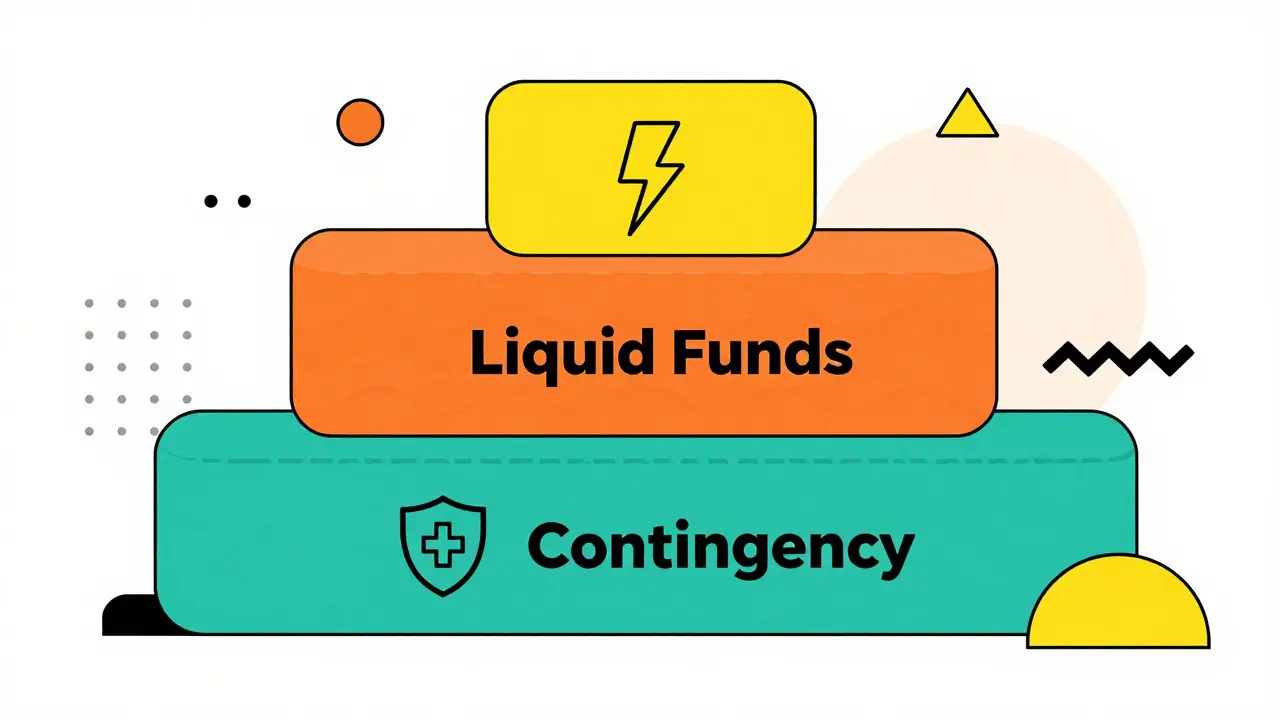
- Layer 1: Instant Access (1 Month Expenses). Keep this in your primary Savings Account. This covers minor surprises like a broken appliance or a sudden trip. Ensure this account has zero minimum balance fees.
- Layer 2: Quick Liquidity (5 Months Expenses). Park this in Liquid Mutual Funds or Overnight Funds. Link these funds directly to your bank account for instant redemption. This layer offers better returns than savings accounts while maintaining T+1 liquidity.
- Layer 3: Medical Contingency (Separate Pot). Keep a separate chunk, say ₹5-10 lakh, in a mix of Senior Citizen FDs and highly rated debt funds. This is not for daily bills but for major health events. Since you likely have insurance, this acts as a co-pay buffer or for treatments not covered by policy.

Tax Implications for Retirees
Tax planning is crucial because net returns matter more than gross returns. Interest from savings accounts and fixed deposits is added to your total income and taxed at your slab rate. As a senior citizen (above 60 years), you enjoy a higher basic exemption limit. Under the new tax regime, however, many deductions are removed, so calculate carefully.
Gains from liquid funds held for less than three years are taxed as short-term capital gains (STCG) at your slab rate. If held for more than three years, they qualify as long-term capital gains (LTCG) with indexation benefits, significantly reducing the tax burden. For pure emergency funds, you rarely hold for three years, so focus on funds with consistent performance rather than tax breaks.
Common Mistakes to Avoid
- Keeping too much in cash: Cash under the mattress loses value to inflation. Every rupee should earn at least the savings account rate.
- Locking everything in long-term FDs: Breaking multiple FDs incurs heavy penalties. Keep only the core income portion locked.
- Ignoring liquidity ratios: Don't invest emergency money in gold ETFs or stocks. Market crashes often coincide with personal emergencies, forcing you to sell at a loss.
- Not reviewing annually: Inflation erodes purchasing power. Review your emergency fund size every year and top it up if necessary.
Final Thoughts on Peace of Mind
Retirement in India should be a time of freedom, not financial anxiety. By structuring your emergency fund correctly, you ensure that life's unpredictabilities do not derail your comfort. Start by calculating your exact monthly burn rate. Then, allocate your safety corpus across arrears savings accounts, liquid funds, and targeted fixed deposits. Finally, verify that your health insurance covers the gaps your cash cannot fill. With this setup, you can sleep soundly, knowing your finances are resilient against any storm.
Is it safe to keep emergency funds in mutual funds?
Yes, specifically liquid and overnight mutual funds. These funds invest in very short-term, high-quality debt instruments. While not guaranteed like fixed deposits, the risk of principal loss is extremely low. They offer better liquidity than fixed deposits and higher returns than savings accounts, making them ideal for emergency buffers.
What is the difference between an arrears savings account and a normal savings account?
A normal savings account calculates interest based on the lowest balance between the 10th and the end of the month. An arrears savings account calculates interest on the average daily balance of the entire month. This means you earn interest on money you spend during the month until the interest is credited at the end, maximizing your returns.
How much emergency fund does a retiree need in India?
Financial advisors recommend keeping 6 to 12 months of essential living expenses plus a separate medical contingency fund. For a retiree spending ₹40,000 monthly, this translates to ₹2.4-4.8 lakh for daily needs and an additional ₹5-10 lakh for health emergencies, depending on insurance coverage.
Should I break my Fixed Deposit for an emergency?
Only as a last resort. Breaking an FD attracts a penalty of 0.5% to 1% on the interest rate. It is better to structure your FDs in tranches so you only break a small portion if needed. Ideally, keep your emergency liquidity in savings accounts or liquid funds to avoid penalties.
Are liquid funds taxable for senior citizens?
Yes. Gains from liquid funds held for less than three years are treated as short-term capital gains and taxed at your applicable income tax slab rate. If held for more than three years, they qualify for long-term capital gains with indexation benefits, which reduces the tax liability significantly.