
ERC-1155 Multi-Token Standard: A Practical Guide for Ethereum Developers
 Nov, 6 2026
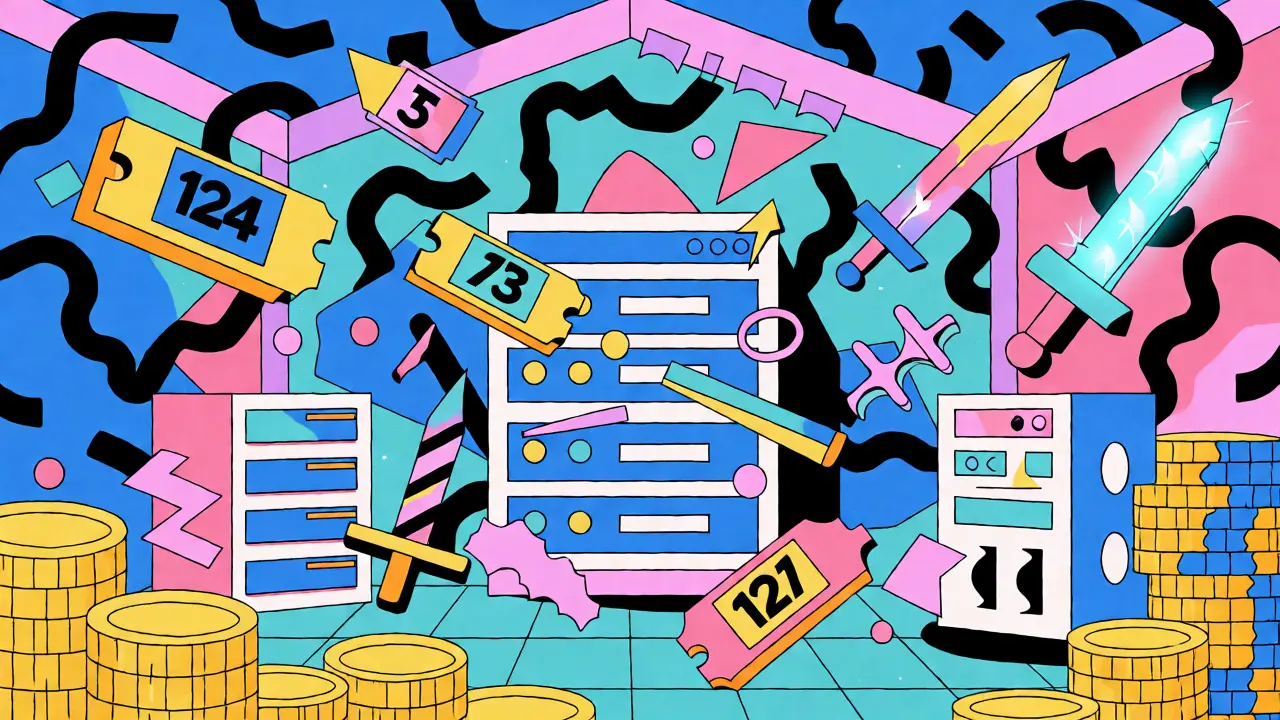
Imagine you are building a blockchain game. You need to issue gold coins (fungible), rare swords (non-fungible), and limited-edition tickets (semi-fungible). In the old days, you might have deployed three separate smart contracts just to handle this inventory. That’s expensive, slow, and a nightmare to manage. Enter ERC-1155, a multi-token standard on Ethereum that allows a single smart contract to manage multiple types of tokens simultaneously. It’s not just a technical upgrade; it’s a fundamental shift in how we think about digital assets on-chain.
If you’ve ever felt the pain of high gas fees when transferring ten different NFTs one by one, ERC-1155 is likely the solution you didn’t know you needed. But what exactly makes it different from its predecessors, ERC-20 and ERC-721? And more importantly, should you use it for your next project? Let’s break down the mechanics, the benefits, and the pitfalls without getting lost in academic jargon.
What Exactly Is ERC-1155?
ERC-1155 is an Ethereum Request for Comments 1155 standard created in 2018 by Witek Radomski and others at Enjin. Unlike previous standards that forced developers to choose between fungibility (like money) or uniqueness (like art), ERC-1155 lets you do both in one place. Think of it as a warehouse rather than a series of individual shops. In this warehouse, every item has a unique ID number. If you mint 100 copies of "Item #42," they all share that same ID. If you mint just one copy of "Item #99," it still uses the same system but acts like a unique NFT.
This flexibility is the core value proposition. The standard defines a set of rules for how these tokens interact with wallets and marketplaces. It doesn’t care if your token is a currency, a collectible, or a consumable potion. It only cares about the balance of specific IDs held by specific addresses. This abstraction layer reduces the complexity of managing diverse asset classes within a single ecosystem.
The Technical Backbone: How It Works
To understand why ERC-1155 saves money and time, you need to look at the data model. In ERC-20, the standard for fungible tokens, each account has a single balance per contract. In ERC-721, the standard for non-fungible tokens, each token ID has one owner. ERC-1155 combines these concepts.
Every token type is identified by a uint256 ID. Each address has a separate balance for each ID. This means:
- An ID with a supply greater than 1 functions as a fungible or semi-fungible item.
- An ID with a supply of exactly 1 functions as a unique NFT.
- All these can exist within the exact same contract deployment.
The magic happens during transactions. The standard includes functions like balanceOfBatch and safeBatchTransferFrom. These allow you to check balances or transfer multiple token IDs in a single transaction. Instead of sending ten separate transactions to move ten different swords, you send one transaction containing an array of IDs and values. This consolidation is where the efficiency gains come from.
Why Bother With Batch Transfers?
Gas fees are the elephant in the room for any Ethereum developer. Every operation on the blockchain costs gas, which is paid in ETH. When you deploy a new contract, you pay a base fee. When you call a function, you pay for the computational steps required.
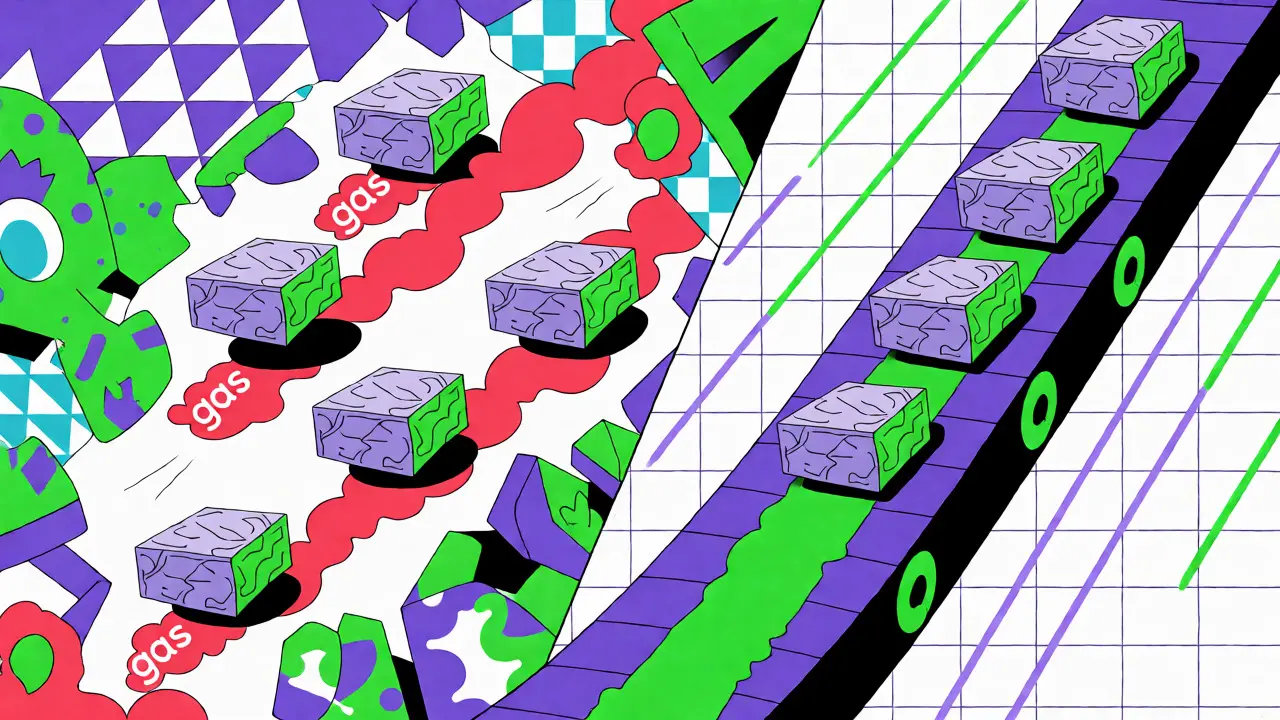
With ERC-721, moving five unique NFTs requires five separate calls to transferFrom. Each call incurs overhead for signature verification, state checks, and event logging. With ERC-1155, you can move those same five assets using safeBatchTransferFrom. While the exact gas savings depend on the complexity of the receiving contract and the size of the arrays, benchmarks often show reductions ranging from 42% to 87% compared to sequential ERC-721 transfers.
Consider a gaming scenario. A player finishes a level and earns a sword, a shield, and 50 gold coins. In an ERC-721 world, this might require three separate transactions (or complex proxy patterns). In an ERC-1155 world, the game server can trigger one batch transfer. The user pays one gas fee instead of three. For users who hate seeing their wallet drain on small actions, this is a massive quality-of-life improvement.
Safe Transfers and Receiver Hooks
One of the most critical features of modern token standards is safety. What happens if you accidentally send tokens to a smart contract that doesn’t know how to handle them? They could be stuck forever. ERC-1155 solves this with "safe transfers."
When you use safeTransferFrom or safeBatchTransferFrom, the contract checks if the recipient is a smart contract. If it is, the sender calls a specific function on the receiver: onERC1155Received or onERC1155BatchReceived. The receiving contract must return a specific selector code (0xf23a6e61 for single, 0xbc197c81 for batch) to confirm it accepts the tokens. If it returns anything else, or reverts, the entire transaction fails.
This mechanism prevents accidental loss of assets. However, it introduces a security risk known as reentrancy. Because the receiver is being called back into the sender’s logic, a malicious contract could potentially call back again before the first transfer is fully finalized. Developers must strictly follow the "checks-effects-interactions" pattern to mitigate this.
Comparison: ERC-20 vs ERC-721 vs ERC-1155
Choosing the right standard depends entirely on your use case. Here is a breakdown to help you decide.
| Feature | ERC-20 | ERC-721 | ERC-1155 |
|---|---|---|---|
| Token Type | Fungible Only | Non-Fungible Only | Mixed (Fungible & Non-Fungible) |
| Contract Count | 1 per asset type | 1 per collection | 1 for many asset types |
| Batch Transfers | No native support | No native support | Yes, via safeBatchTransferFrom |
| Metadata Storage | Usually off-chain URI | Per-token URI or off-chain | URI template per ID |
| Best For | Currencies, Points | Unique Art, Deeds | Gaming, Editions, Mixed Assets |
Use ERC-20 if you are launching a simple utility token or stablecoin. Use ERC-721 if every single item is unique and you want simple ownership semantics. Use ERC-1155 if you are building a game, a marketplace with editions, or an application that needs to move large volumes of mixed assets efficiently.

Implementation Tips for Developers
If you are ready to build, don’t start from scratch. Most developers use OpenZeppelin Contracts, a library of reusable smart contracts that provides audited implementations of ERC-1155. Their implementation handles the heavy lifting of interface detection, safe transfers, and metadata management.
Here is a practical checklist for deploying your first ERC-1155 contract:
- Define Your IDs: Decide how you will assign IDs. Will you use incremental integers? Hashes? This choice affects metadata retrieval.
- Set Up Metadata: Use the
uri(uint256 id)function. A common pattern is to store a base URI and append the ID, e.g.,baseURI + id + ".json". This saves significant gas compared to storing full URIs on-chain. - Implement Minting Logic: Restrict who can create new tokens. Usually, this is done with access control modifiers like
onlyOwner. - Test Batch Operations: Ensure your front-end correctly formats arrays for
balanceOfBatchandsafeBatchTransferFrom. Mismatched array lengths will cause reverts. - Verify Marketplace Support: Check that platforms like OpenSea or Rarible support your specific metadata format. They read the JSON returned by your URI function to display images and traits.
Common Pitfalls and Security Risks
While ERC-1155 is powerful, it’s not foolproof. One major limitation is compatibility. An ERC-1155 token with a supply of 1 is technically an NFT, but it is not an ERC-721 token. Wallets and marketplaces must explicitly support the ERC-1155 interface. If you assume every NFT platform understands ERC-1155, you might find your assets invisible on certain sites.
Another risk is metadata permanence. Since metadata is often stored off-chain (like IPFS or AWS S3), you need a strategy for keeping those links alive. If your server goes down, your tokens might lose their names and images, even though the ownership on-chain remains intact.
Finally, watch out for callback vulnerabilities. As mentioned earlier, safe transfers invoke external code. Always ensure your contract updates its internal state (balances) before calling the receiver hook. Failing to do so opens the door to reentrancy attacks, where a malicious contract drains funds or manipulates balances mid-transaction.
Future Outlook and Ecosystem
As of late 2026, ERC-1155 remains a cornerstone of blockchain infrastructure, particularly in gaming and digital collectibles. Platforms like Immutable zkEVM and major marketplaces continue to optimize support for batch operations. While newer standards like ERC-3525 offer more expressive models for semi-fungible financial instruments, ERC-1155’s simplicity and widespread tooling make it the default choice for most general-purpose applications.
It won’t replace ERC-20 for pure currencies, nor will it completely displace ERC-721 for high-value unique art. But for any project involving inventory, quantities, or mixed asset types, it offers the best balance of efficiency and functionality. If you’re building for scale, it’s the standard you should be looking at.
Can I convert an ERC-721 token to ERC-1155?
Not directly on-chain without a wrapper contract. Since they are different interfaces, you cannot simply change the standard of an existing token. You would need to burn the ERC-721 tokens and mint equivalent ERC-1155 tokens, or use a migration bridge that handles the swap.
Does ERC-1155 support royalties?
The core ERC-1155 standard does not define royalty enforcement. Royalties are typically handled at the marketplace level (like OpenSea's creator fees) or through additional extensions like ERC-2981. You must implement royalty logic separately if you want it enforced on-chain.
Is ERC-1155 cheaper to deploy than ERC-721?
Deployment cost is similar for a single contract. However, ERC-1155 becomes significantly cheaper overall when you consider that one contract can manage hundreds of different token types, whereas ERC-721 usually requires a new contract for each distinct collection.
How do I check my ERC-1155 balance?
You use the balanceOf(address account, uint256 id) function for a single token type, or balanceOfBatch(address[] accounts, uint256[] ids) to check multiple balances in one call. Most wallets now display these balances automatically if they recognize the contract.
What happens if I send ERC-1155 tokens to a wrong address?
If you send to a regular Externally Owned Account (EOA), the tokens arrive safely. If you send to a smart contract that hasn't implemented the onERC1155Received function, the transaction will revert, and no tokens will be transferred. This prevents permanent loss.