
Expense Ratio Caps in India: What SEBI Regulations Mean for Investors
 Feb, 17 2026
When you invest in a mutual fund in India, you’re not just paying for the fund manager’s expertise-you’re also paying for the operational costs behind the scenes. These costs show up as the expense ratio, a percentage of your investment that goes toward managing the fund. But since 2018, SEBI has been tightening the screws on how much fund houses can charge. And that change has made a real difference in how much money stays in your pocket.
What Exactly Is an Expense Ratio?
The expense ratio is the total annual cost of running a mutual fund, expressed as a percentage of your investment. It includes things like fund manager salaries, administrative fees, marketing costs, and even office rent. If a fund has a 1.5% expense ratio and you invest ₹1,00,000, you’re paying ₹1,500 every year just to keep the fund running-even if the fund makes no money.
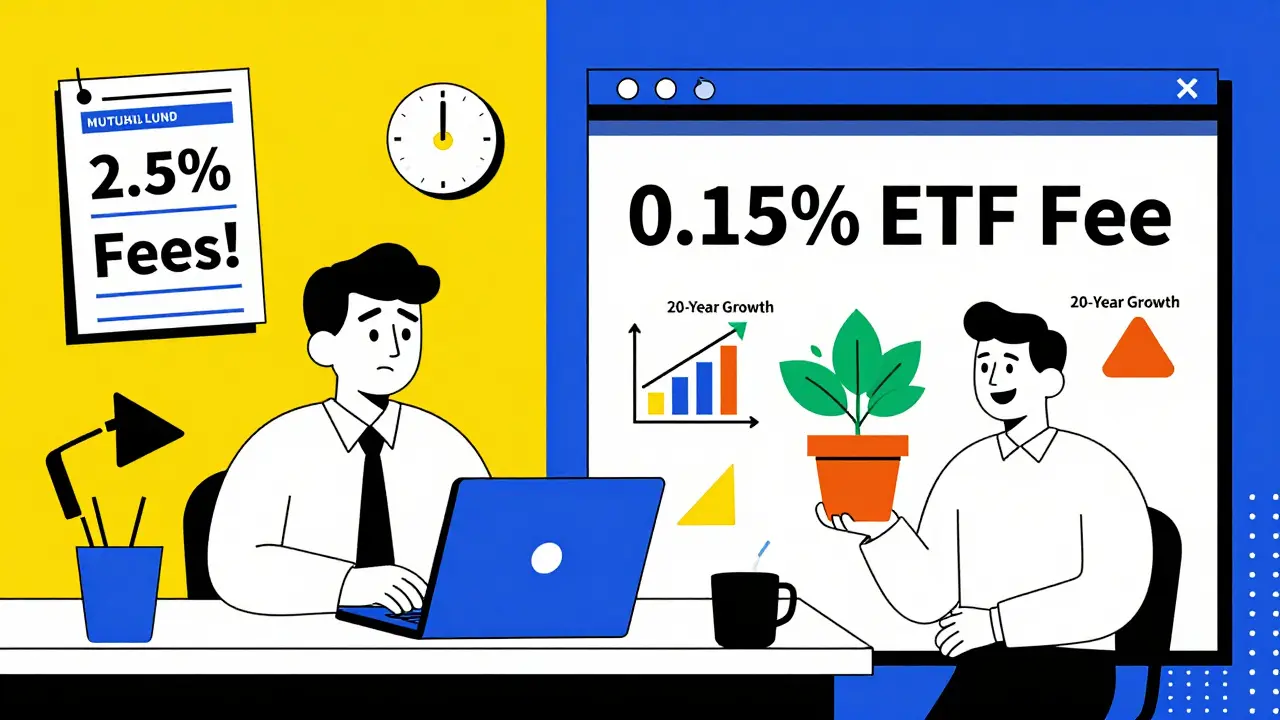
It might not sound like much, but over time, fees compound. A 1% difference in expense ratio can cost you lakhs over a 20-year investment horizon. For example, if two funds both return 10% annually, but one charges 1.8% and the other 0.8%, the lower-cost fund will leave you with nearly 20% more money after two decades. That’s not magic-that’s just math.
SEBI’s Caps: The Rules That Changed Everything
In 2018, SEBI introduced strict expense ratio caps based on fund size. Before that, some fund houses were charging over 2.5% for small schemes, even when they didn’t outperform the market. SEBI said: enough. Now, the maximum you can be charged depends on how much money the fund manages.
Here’s how it breaks down as of 2026:
| Assets Under Management (AUM) | Equity Fund Cap | Debt Fund Cap |
|---|---|---|
| Up to ₹500 crore | 2.25% | 2.00% |
| ₹500 crore to ₹750 crore | 2.00% | 1.75% |
| ₹750 crore to ₹1,000 crore | 1.75% | 1.50% |
| ₹1,000 crore to ₹5,000 crore | 1.60% | 1.40% |
| ₹5,000 crore to ₹20,000 crore | 1.50% | 1.35% |
| ₹20,000 crore to ₹50,000 crore | 1.40% | 1.30% |
| Over ₹50,000 crore | 1.25% | 1.20% |
These caps apply to the fund house’s entire portfolio, not just one scheme. That means if a fund house manages ₹1 lakh crore in total, even its smallest fund can’t charge more than the cap for that AUM tier. This stops fund houses from hiding high fees in tiny schemes.
What About Index Funds and ETFs?
SEBI made an exception for passive funds. Index funds and ETFs, which just track a benchmark like the Nifty 50, don’t need active managers. So their expense ratios are capped even lower:
- Index funds: max 1% for AUM under ₹50,000 crore
- ETFs: max 0.35%
That’s why ETFs like Nippon India ETF Nifty 50 or ICICI Prudential Nifty Next 50 ETF often charge just 0.05% to 0.15%. For long-term investors, this difference is huge. Over 25 years, a 1% fee versus 0.1% can mean the difference between ₹28 lakh and ₹41 lakh in returns on a ₹10 lakh investment.
How This Helps You as an Investor
Before SEBI’s caps, fund houses had little incentive to cut costs. Many charged high fees because investors didn’t know what they were paying. Now, transparency is built into the system. Every fund’s expense ratio is clearly listed on its fact sheet and on SEBI’s website.
You no longer need to dig through fine print. If a fund’s expense ratio is higher than the SEBI cap, it’s illegal. Fund houses that violate the rules get fined, and their schemes can be suspended. This level of enforcement has forced fund houses to compete on performance-not on hidden fees.
For retail investors, especially those starting with small amounts, this means more money stays invested instead of going to fund house salaries and advertising. A ₹5,000 monthly SIP in a fund with a 1.2% expense ratio instead of 2.0% could add over ₹4 lakh to your corpus in 20 years.
What’s Still Missing?
SEBI’s caps are a big win, but they don’t cover everything. There’s still no rule limiting exit loads or transaction charges on fund switches. Some fund houses still push investors to move money between schemes, charging fees each time. And while the caps apply to direct plans, many investors still buy through distributors who earn commissions-sometimes hidden in the expense ratio.
That’s why you should always choose direct plans. They don’t pay commissions to agents, so their expense ratios are lower. You can buy them directly through the fund house’s website or apps like Groww, Zerodha, or Upstox. The difference in returns? Often 0.5% to 1% per year.

How to Check Your Fund’s Expense Ratio
Here’s how to find the real cost of your mutual fund:
- Go to the fund house’s official website (like HDFC Mutual Fund or Axis Mutual Fund).
- Search for your fund and click on "Scheme Information" or "Fact Sheet."
- Look for "Total Expense Ratio" (TER) under the "Fees and Charges" section.
- Compare it to SEBI’s cap for that fund’s AUM tier.
- If it’s higher, ask why. If it’s close to the cap, consider switching to a lower-cost alternative.
You can also use third-party platforms like Value Research or Morningstar India. They list TER for every fund and even show how fees impact your returns over time.
What’s Next for Mutual Fund Fees?
SEBI is already looking at further changes. In late 2025, they proposed a rule to cap the total cost of all fund-related charges-including exit loads, transaction fees, and platform charges-at 1.5% for equity funds. If approved, this would be the next big step.
They’re also pushing for clearer disclosures on how much of your expense ratio goes to marketing versus management. Right now, some funds spend 40% of their expense ratio on advertising. That’s not necessarily bad-but you should know where your money is going.
Bottom Line: Fees Are the Silent Killer of Returns
You can’t control market returns. You can’t predict which fund will outperform. But you can control the fees you pay. And in India, SEBI’s expense ratio caps have made that easier than ever.
Stop focusing only on past returns. Look at the expense ratio. Compare direct plans. Choose low-cost index funds for long-term goals. And if your fund’s fee is higher than the SEBI cap, it’s not just expensive-it’s illegal. Report it. Switch it. Your future self will thank you.
Is the expense ratio the same as the total cost of investing in a mutual fund?
No. The expense ratio covers only the fund’s operational costs. It doesn’t include exit loads (fees for selling early), transaction charges for switching funds, or distributor commissions paid separately. Always check all fees before investing.
Can a mutual fund legally charge more than SEBI’s cap?
No. Any fund charging above SEBI’s expense ratio cap is violating regulations. If you find one, report it to SEBI through their online complaint portal. Funds that break this rule can be penalized or suspended.
Why are ETFs cheaper than regular mutual funds?
ETFs track an index automatically, so they don’t need active fund managers. That cuts down on salaries, research, and trading costs. SEBI allows them to charge as low as 0.35%, and most charge under 0.15%.
Should I switch from a regular plan to a direct plan?
Yes-if you’re comfortable managing your investments. Direct plans have lower expense ratios because they don’t pay commissions to distributors. The savings can add up to 1% per year, which compounds into lakhs over time.
Do expense ratio caps apply to sectoral or thematic funds?
Yes. All equity mutual funds-including sectoral and thematic ones-must follow SEBI’s expense ratio caps. They’re not exempt just because they’re specialized.