
FinCEN Compliance for Crypto Businesses: MSB Registration and AML Program Basics
 Aug, 2 2026
Running a crypto business in the United States isn't just about building great software or offering low fees. It's about surviving the regulatory gauntlet. If you are an exchange, a wallet provider, or even a peer-to-peer platform, the Financial Crimes Enforcement Network (FinCEN) is watching. This bureau of the U.S. Department of the Treasury doesn't care if your ledger is on a blockchain; it cares if you are moving money. For most crypto businesses, this means you are classified as a Money Services Business (MSB), and you need to comply with the Bank Secrecy Act (BSA) just like a traditional bank.
The stakes have never been higher. Remember the November 2023 settlement involving Binance Holdings Limited? The company agreed to pay approximately $4.32 billion in penalties across multiple agencies, including FinCEN, for failing to maintain adequate anti-money laundering controls. They also accepted a five-year independent monitorship. That wasn't a glitch; it was a warning shot. As we move through 2026, the message from Washington is clear: if you accept or transmit convertible virtual currency (CVC) for others, you play by the same rules as Wall Street.
Determining Your Status: Are You an MSB?
The first step in compliance is knowing where you stand. Not everyone touching crypto is an MSB, but the net has tightened significantly since FinCEN issued its landmark guidance in 2013 and expanded it in 2019. The core question is simple: do you act as an intermediary between two parties?
According to FinCEN’s interpretive guidance FIN-2013-G001 and the subsequent 2019 CVC guidance, roles are defined clearly:
- User: An individual who obtains virtual currency to purchase goods or services for their own use. Users are generally not MSBs. If you mine Bitcoin and hold it in your personal wallet, you are likely safe from registration requirements.
- Administrator: An entity that issues and/or redeems virtual currency. Think of stablecoin issuers. These entities are typically considered MSBs.
- Exchanger: An entity engaged in the business of exchanging virtual currency for real currency, other virtual currency, or any other thing of value. Exchanges are definitely MSBs.
If your business accepts CVC from one person and transmits it to another, you are a money transmitter. This includes hosted wallet providers, crypto exchanges, and certain decentralized finance (DeFi) platforms that intermediate transfers. Even if you call yourself a "tech company" or a "software developer," if you control the private keys or facilitate the transfer of funds for customers, FinCEN views you as a financial institution.
| Business Activity | Typical MSB Status | Key Reason |
|---|---|---|
| Crypto Exchange (CEX) | Yes | Acts as an exchanger and money transmitter |
| Hosted Wallet Provider | Yes | Accepts and transmits CVC on behalf of customers |
| P2P Platform (Intermediated) | Yes | Facilitates transmission between users |
| Non-Custodial Wallet Software | No | Software only; user retains control of keys |
| Mining Pool (Personal Use) | No | User activity, not transmission for others |
The Registration Process: FinCEN Form 107
Once you determine you are an MSB, the clock starts ticking. You cannot operate legally without registering with FinCEN. The process revolves around FinCEN Form 107, the Registration of Money Services Business.
Here is the timeline you need to memorize:
- Initial Filing: You must file Form 107 within 180 days after the date your business is established. "Established" usually means when you begin operations or when you meet the definition of an MSB.
- Renewal: Registration is not a one-time event. You must renew every two years. The renewal form is due by December 31 of the second calendar year preceding the new registration period. For example, if your initial registration covers 2025-2026, your renewal is due by December 31, 2026.
- Signatory: The form must be signed by the owner or controlling person of the MSB. This adds a layer of personal accountability.
The form requires detailed information about your business volume, ownership structure, and agents. You must keep a copy of the filed registration, estimates of business volume, and ownership records at a U.S. location for at least five years. If you have agents-people or entities authorized to conduct money services activities on your behalf-you must maintain an annual list of them. Note that agents themselves do not need to register unless they also conduct money services activities on their own behalf.

Building a Robust AML Program
Registration is just the entry ticket. The real work lies in establishing a written Anti-Money Laundering (AML) program under 31 CFR § 1022.210. FinCEN requires this program to be "reasonably designed" to prevent your business from being used for money laundering or terrorist financing. For crypto firms, this means addressing specific risks like pseudonymous addresses and cross-border flows.
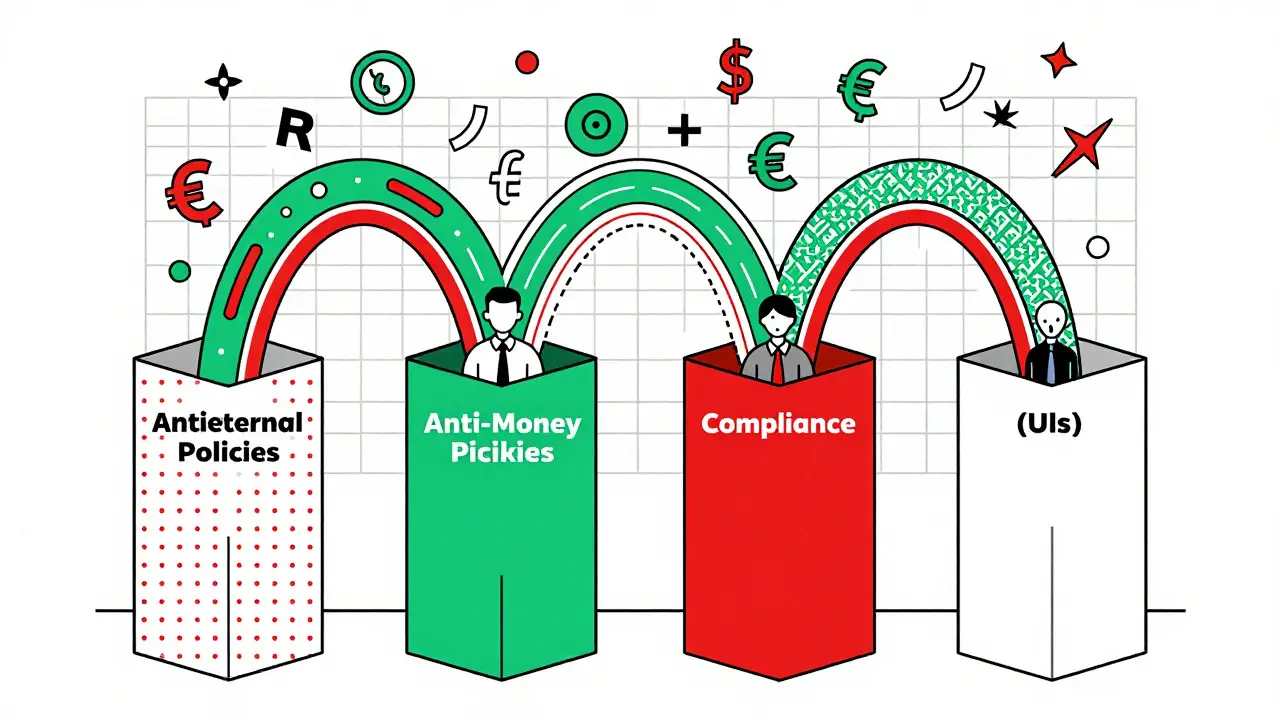
Your AML program must include four core pillars:
- Internal Policies, Procedures, and Controls: Documented rules for how you handle customer data, verify identities, and monitor transactions. These must be tailored to your specific risk profile.
- Designation of an AML Compliance Officer: You need a named individual responsible for day-to-day compliance. This person should have sufficient authority and resources to implement the program.
- Ongoing Employee Training: Staff must understand BSA obligations. Training should cover red flags specific to crypto, such as rapid mixing of funds or interactions with sanctioned wallets.
- Independent Testing: Regular audits by an internal or external party to ensure the program works. This is often where companies fail during enforcement reviews.
In the crypto context, your controls must be sophisticated. Simple name checks aren't enough. You need blockchain analytics tools to trace the origin of funds. You must screen against sanctions lists, particularly those maintained by the Office of Foreign Assets Control (OFAC). The Binance case highlighted failures in these exact areas: inadequate screening and poor transaction monitoring.
Reporting Obligations: SARs and CTRs
An effective AML program generates reports. Two key documents dominate FinCEN compliance:
Suspicious Activity Reports (SARs): If you detect a transaction involving $5,000 or more that has no business purpose, involves known criminals, or lacks economic sense, you must file a SAR. In crypto, this might look like a user trying to move funds through a mixer immediately after receiving a large deposit from a high-risk jurisdiction. You have 30 days from the date of detection to file.
Currency Transaction Reports (CTRs): While traditionally associated with cash, CTRs apply to crypto when legal tender is involved. If a customer deposits or withdraws more than $10,000 in currency in a single business day, you must file a CTR. However, for pure crypto-to-crypto transactions, CTRs are less common, but SARs remain critical.
Recordkeeping is equally vital. You must retain records of all transactions, customer identification documents, and internal policies for five years. These records must be stored at a U.S. location and be readily accessible for inspection.
Enforcement Reality: Lessons from Binance
Why does this matter? Because the consequences of non-compliance are severe. The November 21, 2023 consent order against Binance serves as the primary case study for 2026. FinCEN found that Binance failed to register properly, had an ineffective AML program, and did not file required SARs. The result was a historic penalty and a five-year monitorship.
This wasn't an isolated incident. Regulators are treating large crypto exchanges as systemically significant institutions. They expect enterprise-grade compliance infrastructure. Small startups might get a pass initially, but as soon as you scale, the scrutiny intensifies. The Department of Justice (DOJ) and Commodity Futures Trading Commission (CFTC) often coordinate with FinCEN, creating a multi-agency enforcement web.
For a crypto business, compliance is not a cost center; it is a survival strategy. Building a robust framework early saves millions in potential fines and prevents operational shutdowns.
Practical Steps for Implementation
If you are launching a crypto venture today, follow this checklist:
- Conduct a Risk Assessment: Map your business model against FinCEN’s definitions. Consult legal counsel to confirm MSB status.
- File Form 107: Register within 180 days of establishment. Set calendar reminders for biennial renewals.
- Hire a Compliance Officer: Appoint someone with experience in BSA/AML regulations. They should oversee policy creation and staff training.
- Implement Technology: Invest in blockchain analytics and KYC (Know Your Customer) solutions. Manual checks will not scale.
- Document Everything: Create a written AML program manual. Train employees annually. Conduct independent audits.
- Monitor Transactions: Set up automated alerts for suspicious patterns. File SARs promptly when thresholds are met.
The regulatory landscape is durable. FinCEN’s 2013 and 2019 guidance remains the cornerstone of crypto regulation in 2026. There is no indication of relaxation; instead, there is a trend toward stricter enforcement and higher expectations for transparency.
Who needs to register as an MSB with FinCEN?
Any person or entity that acts as a money transmitter, currency dealer, check casher, or issuer of traveler's checks must register. For crypto businesses, this includes exchanges, hosted wallet providers, and administrators of virtual currencies. Individuals using crypto for personal purchases are generally exempt.
What is the deadline for filing FinCEN Form 107?
You must file FinCEN Form 107 within 180 days after the date your business is established. Registration must then be renewed every two years, with the renewal form due by December 31 of the second calendar year preceding the new period.
Does a non-custodial wallet provider need to register?
Generally, no. If the software simply allows users to manage their own private keys and does not accept or transmit funds on their behalf, it is considered a tool rather than a money transmitter. However, if the provider offers any custodial services or intermediates transactions, MSB status may apply.
What are the four pillars of an AML program?
The four pillars are: 1) Internal policies, procedures, and controls; 2) Designation of an AML compliance officer; 3) Ongoing employee training; and 4) Independent testing. These must be documented and tailored to the specific risks of the business.
How long must MSBs retain records?
MSBs must retain copies of registration forms, business volume estimates, ownership information, and transaction records for at least five years. These records must be kept at a U.S. location and be readily accessible for inspection.