
Generative Art NFTs: How AI Creates Unique Digital Collectibles
 Jan, 27 2026
Imagine a machine that paints a thousand unique artworks-each one different, each one rare-and you own one of them. Not a print. Not a copy. A one-of-a-kind digital original, locked on the blockchain, verified forever. That’s what generative art NFTs are. They’re not just pixels on a screen. They’re algorithm-born masterpieces, created by code, owned by you, and valued because they’re impossible to replicate exactly.
How Generative Art NFTs Actually Work
Generative art NFTs aren’t drawn by hand. They’re built using rules. Artists create a set of visual parts-like backgrounds, faces, clothing, accessories-and assign each part different chances of appearing. For example, a project might have 10 background options, 15 eye styles, and 8 hat types. The algorithm randomly mixes them together, but with weights. A normal hat might show up 70% of the time. A glowing alien crown? Maybe 0.2%. That’s rarity. That’s value.
When you buy one of these NFTs, you’re not picking from a gallery. You’re triggering the algorithm. The moment you pay, the code runs, and your unique piece is born. No two are the same. Even if two pieces look similar, their underlying traits and rarity scores are different. That’s why collectors hunt for specific combinations-like a zombie with a golden crown and neon eyes. Those are the ones that sell for 100x what you paid.
These pieces live on blockchains, mostly Ethereum. Each one has a digital fingerprint-its metadata-stored directly on-chain. That means no one can alter it. No one can fake it. You own the original, even if someone screenshots it. The screenshot is just a picture. Yours is the proof.
Why This Is Different From Regular NFT Art
Traditional digital NFT art is made one at a time. An artist draws 10,000 pieces by hand (or with a tablet), and each one is uploaded individually. It’s slow. It’s expensive. It’s limited.
Generative art flips that. One artist, one algorithm, 10,000 unique pieces. That’s the power. It scales. It’s efficient. And because the rarity is built into the code, the scarcity feels real-not manufactured.
Market data shows this matters. Generative NFT collections average 23% higher resale values than static digital art NFTs. CryptoPunks and Art Blocks projects held their value during the 2022 crypto crash when other NFTs dropped hard. Why? Because their rarity system made them feel like collectibles, not just digital images.
But it’s not all smooth. Some early projects had glitches. Bad coding led to 40% of pieces looking broken-floating eyes, missing limbs, mismatched colors. When the algorithm doesn’t follow clean rules, the art falls apart. That’s why top projects like Art Blocks spend 20-40 hours perfecting each collection’s code before launch.
Who’s Making This Art-and How?
Generative art isn’t made by AI alone. It’s made by artists who code. People like Tyler Hobbs, who created Fidenza. He didn’t train a neural net on Picasso paintings. He wrote JavaScript that draws abstract shapes with controlled randomness. His rules defined how lines bend, how colors blend, how layers overlap. The result? A collection that sold for 0.15 ETH at mint and peaked at 150 ETH. That’s a 1,000x return.
To get started, artists use tools like p5.js or Processing. These are free, open-source libraries that let you draw with code. You don’t need to be a software engineer. But you do need to understand how variables, loops, and conditionals work. Most successful creators spend 3-5 months practicing before launching their first collection. They test, tweak, and fix until the output looks intentional-not random.
And intentionality matters. Sarah Zucker, curator at the Whitney Museum, says the best generative art feels like it was made with purpose. “It’s not about randomness,” she says. “It’s about constraints.” The artist sets the boundaries. The machine works within them. That’s the art.
The Hidden Risks
Not every generative NFT project survives. In 2022, a project called PixelSoul crashed because its algorithm accidentally generated 3,200 nearly identical pieces. Buyers felt scammed. Prices dropped 99% in three days. The team vanished.
Other risks include:
- Gas fees: Minting on Ethereum can cost $5-$50. During peak times, it spikes to $150. Many new buyers get locked out because they didn’t budget for it.
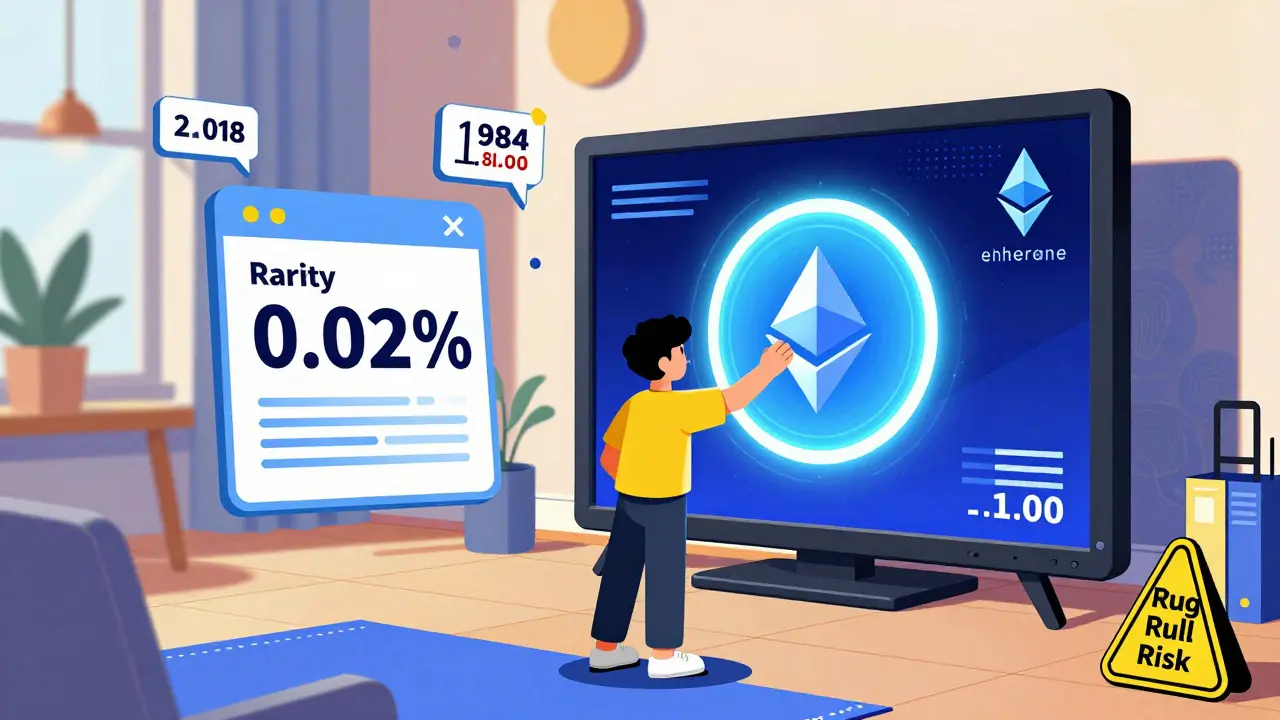
- Rug pulls: 12 major projects between 2021-2023 disappeared after minting, taking investors’ money. Some changed the code after launch to make rare traits disappear.
- Copyright issues: A 2023 IEEE report found 43% of AI-generated NFTs used training data that likely stole from copyrighted images. That’s a legal gray zone.
- Low liquidity: Even if your NFT is rare, you might not find a buyer. Only 2% of generative art has sold at major auction houses like Sotheby’s.
Platforms like Art Blocks have built trust by curating projects. They vet artists, review code, and only accept work that meets quality standards. That’s why they hold 68% of the market. Open platforms like Rarible are cheaper to join-but riskier.
Is This Real Art?
Some critics say no. The Museum of Contemporary Art in Los Angeles surveyed 100 art critics in 2023. Two-thirds said algorithmic outputs don’t count as “true art.” They argue there’s no soul. No hand. No intention.
But that’s changing. Dr. Ahmed Elgammal from Rutgers University found that human-curated generative art-where artists guide the algorithm’s choices-commands 38% higher prices than fully automated outputs. That suggests people aren’t rejecting the machine. They’re rejecting lazy machines.
Generative art isn’t about replacing artists. It’s about expanding what art can be. It’s code as brushstroke. Math as composition. Rules as rhythm.
What’s Next?
The next wave is smarter generation. Projects like Art Blocks Engine now create art that changes based on live blockchain data-like Bitcoin price, weather, or even Twitter trends. Imagine an NFT that looks different every day because it responds to the world around it.
Zero-knowledge proofs are being added to verify traits without revealing the full code. Cross-chain support is coming-Art Blocks plans to launch on Polygon and Solana by late 2024, making minting cheaper and faster.
And AI is getting involved. In 2023, 89% of new generative projects used machine learning to suggest color palettes, shapes, or layouts. But here’s the twist: the best ones still let the human artist decide. AI suggests. The artist chooses.
Should You Get Involved?
If you’re a collector: Start small. Buy one piece from a curated platform like Art Blocks. Look for projects with clear rarity charts, active Discord communities, and artists who’ve shown work before. Avoid anything that promises “guaranteed returns.”
If you’re an artist: Learn p5.js. Build 3 practice projects. Test your algorithm with 500 simulated mints. Fix the glitches. Then launch. Don’t rush. The best generative art takes months, not days.
If you’re skeptical: That’s fine. This isn’t for everyone. But if you’ve ever bought a rare trading card, a vintage vinyl, or a limited-edition sneaker-you already understand scarcity. Generative NFTs are just the next version of that.
The art isn’t in the pixels. It’s in the system that made them.
Are generative art NFTs the same as AI art?
Not exactly. Generative art NFTs use code to combine pre-made visual elements with defined rules. AI art usually trains a model on thousands of images and generates something new from scratch. Many generative NFTs use AI as a tool-like suggesting colors-but the core structure is still human-coded. The best projects blend both: human design + machine variation.
Can I change my generative NFT after buying it?
Almost never. Once minted, the traits are fixed on the blockchain. Only 3 out of 45 major platforms offer any kind of trait modification, and even those are limited to cosmetic tweaks like color shifts. You can’t add a hat to a piece that doesn’t have one. That’s part of the point-the rarity is permanent.
How much does it cost to create a generative NFT collection?
It varies. A simple 5,000-piece collection might take 2-3 months and cost $2,000-$5,000 in developer time and gas fees. Complex projects with custom animations, sound, or interactive elements can cost $20,000+ and take 6+ months. Most successful creators spend months practicing before launching anything commercial.
Why do some generative NFTs sell for so much more than others?
It’s all about rarity and demand. A piece with a trait that appears in only 1 out of 10,000 pieces will be valuable if collectors want it. But it also depends on the artist’s reputation, the community’s size, and whether the project is curated. A rare trait in a poorly made collection won’t sell. A rare trait in an Art Blocks project? That’s a blue-chip asset.
Is it safe to buy generative NFTs?
It’s safer on curated platforms like Art Blocks, Fxhash, or MakersPlace. These sites vet artists and review code. Avoid projects with anonymous teams, no Discord, or vague whitepapers. Always check the contract address on Etherscan. If the contract allows the creator to change traits after minting, don’t buy. That’s a red flag.
Do I need cryptocurrency to buy generative NFTs?
Yes. You need Ethereum (ETH) or another supported crypto to pay for the NFT and the gas fees. Some platforms let you buy with a credit card, but those are usually centralized exchanges-not the actual blockchain. For true ownership, you need a wallet like MetaMask and real crypto.
Can generative art NFTs be displayed in real life?
Absolutely. Many collectors print their NFTs on canvas, frame them, or display them on digital screens. Some even use NFTs as digital wallpaper on smart TVs. The file is yours-so you can use it however you want. The blockchain just proves you’re the original owner.
What’s the difference between Art Blocks and Rarible?
Art Blocks is curated. Artists must apply and be approved. Collections are high-quality, with verified code and strong community support. Rarible is open-anyone can launch a collection. That means more variety, but also more risk. Art Blocks has 68% of the market share in curated generative art. Rarible has more volume but less trust.