
How Merkle Trees Secure Cryptocurrency Transactions on the Blockchain
 Dec, 11 2025
Every time you send Bitcoin or any other cryptocurrency, there’s a quiet, invisible system making sure that transaction can’t be faked, altered, or lost. That system? Merkle trees. They’re not flashy, they don’t get headlines, but without them, blockchain technology wouldn’t work at scale. And yet, most people using crypto have no idea how they work. Let’s fix that.
What Exactly Is a Merkle Tree?
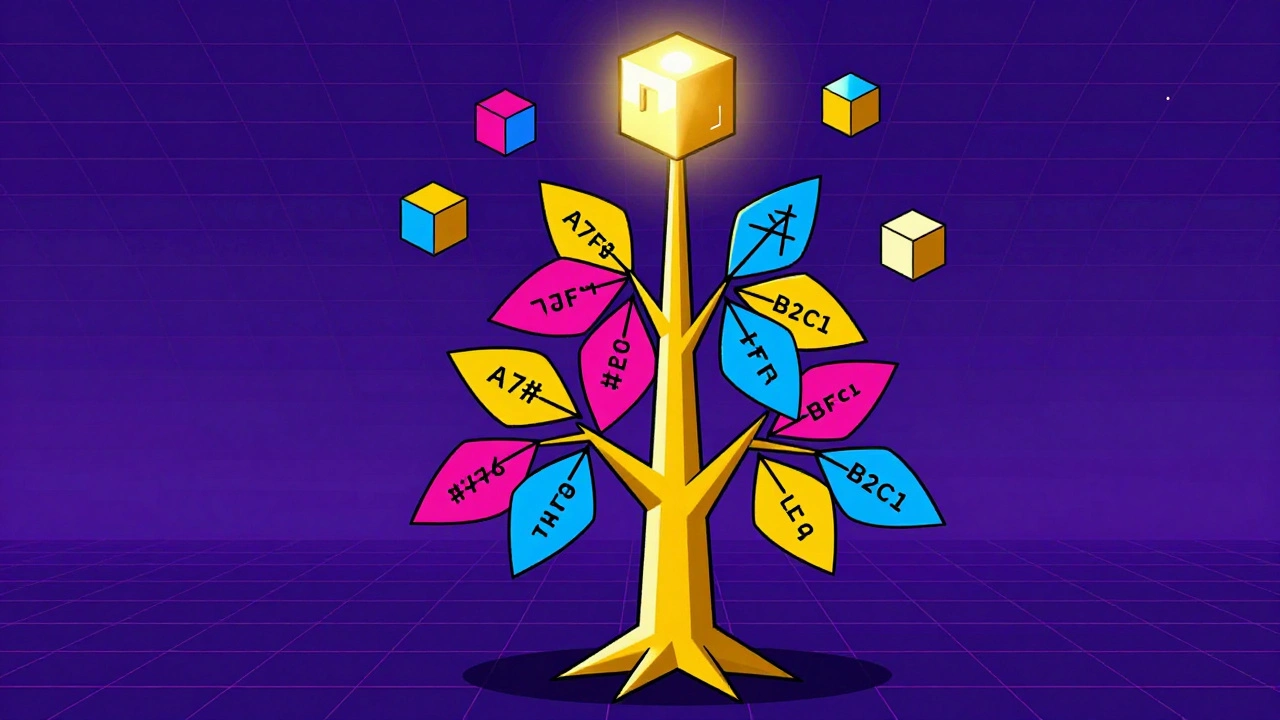
A Merkle tree is a way of organizing data using cryptography. Think of it like a family tree-but instead of people, it’s made of hash values. Each transaction in a block gets turned into a unique string of letters and numbers using SHA-256, a cryptographic hash function. These become the bottom layer of the tree-the leaves. Then, pairs of these hashes are combined and hashed again. This keeps happening, layer by layer, until you end up with just one final hash at the top: the Merkle root. It’s called a tree because of how it branches upward. But here’s the twist: it’s upside down. The wide base holds all the transactions, and it narrows to a single point at the top. That top point, the Merkle root, is the only thing stored in the block header. Everything else? It’s buried in the block body. And that’s the magic.Why the Merkle Root Matters
The Merkle root is like a fingerprint for the entire block. If even one transaction changes-even one letter in one transaction-the entire Merkle root changes. That’s because hash functions are extremely sensitive. Change one input, and the output becomes completely different. So if someone tried to tamper with a transaction after the block was added to the chain, the Merkle root wouldn’t match. Nodes on the network would instantly reject it. This is why the Merkle root is so powerful. It doesn’t store the transactions. It doesn’t even list them. It just confirms they’re all there, unchanged. And that’s enough to build trust without needing to download everything.How Light Wallets Verify Transactions Without Downloading the Whole Blockchain
Here’s where Merkle trees get really useful. Most people don’t run full Bitcoin nodes. You don’t need to. You use a lightweight wallet like Electrum or Trust Wallet. These apps don’t store the whole blockchain-they’re maybe 100MB instead of 500GB. How do they know your transaction is real? They use a Merkle proof. Instead of sending you all 2,500 transactions in a block, the wallet only needs to send you the few hashes that connect your transaction up to the Merkle root. For a block with 2,500 transactions, you only need about 12 hashes to verify your transaction. That’s less than 400 bytes. Your phone can handle that in under a second. This is called SPV (Simplified Payment Verification). It’s what makes mobile crypto wallets possible. Without Merkle trees, you’d need to download every single transaction ever made to verify one payment. That’s not just slow-it’s impossible on a phone.
What Happens When There’s an Odd Number of Transactions?
Bitcoin blocks don’t always have an even number of transactions. Sometimes you get 17, or 23, or 101. Merkle trees need pairs to work. So what happens? The last transaction hash gets copied. It’s paired with itself. That’s it. No fancy workaround. Just duplicate the last one, hash it, and keep building up. It’s simple, but effective. And it’s been part of Bitcoin since day one, as described in Satoshi Nakamoto’s original whitepaper. Some users have reported issues when this happens-especially in early wallet versions. But modern wallets handle it flawlessly. Blockchain.com, for example, processes over a million Merkle proofs every day with a success rate of 99.998%. The edge cases are well understood and solved.Merkle Trees vs. Other Structures
Not all blockchains use the same structure. Ethereum, for example, uses something called a Merkle Patricia Tree. Why? Because Bitcoin only needs to verify transactions. Ethereum needs to track account balances, smart contracts, and state changes. That’s more dynamic. Merkle trees are great for static data-once a block is mined, the transactions don’t change. But if you’re constantly updating account balances, you need something that can update efficiently. Merkle Patricia Trees allow for that. They’re more complex, but they’re built for state management, not just transaction grouping. For pure transaction verification, Merkle trees are still the gold standard. They’re faster, simpler, and use less data. A 2021 study showed they require 98% less computational overhead than Patricia trees for verifying transaction histories.Security and Real-World Proofs
In 2013, Bitcoin had a fork. Two miners found blocks at almost the same time. One had a corrupted transaction. Nodes using Merkle trees quickly spotted the mismatch. The invalid block was rejected within seconds. That’s how the network self-corrects. And it’s not just theory. Dr. Andreas Antonopoulos, a leading Bitcoin educator, says the Merkle root is what makes blockchain tamper-proof. If you change one transaction, the root changes. If the root changes, the block becomes invalid. It’s that simple. Even regulators recognize this. The EU’s MiCA regulation, which came into effect in January 2024, explicitly accepts Merkle-based verification as a valid method for confirming cryptocurrency transactions. That’s a big deal. It means governments trust this math.
What’s Next? Verkle Trees and Quantum Threats
The future isn’t static. Bitcoin’s Taproot upgrade in 2021 improved how Merkle trees handle complex transactions like multisignature wallets. It cut the proof size by 25%. Ethereum is moving toward Verkle trees-a new design that promises to shrink proof sizes by up to 90%. That’s huge for lightweight clients and scaling. It’s not a replacement for Merkle trees, but an evolution. And then there’s the long-term threat: quantum computers. SHA-256, the hash function behind Merkle trees, could be broken by quantum algorithms in the next decade. NIST is already working on post-quantum cryptography. The solution? Replace SHA-256 with lattice-based hashes that quantum computers can’t crack. Merkle trees themselves aren’t the problem-it’s the hash function. And that’s fixable.How Developers Use Merkle Trees
If you’re a developer building a crypto app, you won’t code a Merkle tree from scratch. You’ll use libraries like bitcoinjs-lib or btcd’s merkle package. These are battle-tested, used by thousands of projects. The real challenge? Handling edge cases. Getting the byte order right. Making sure you’re hashing in the right sequence. One wrong byte, and your proof fails. That’s why most developers rely on existing code. Bitcoin Core’s RPC commandtxid_merkle_proof is a favorite-it’s reliable and well-documented.
There’s no need to reinvent the wheel. The math is solid. The implementations are proven. Your job is to use them correctly.