
How Nonce and Difficulty Targets Power Proof-of-Work Mining
 Nov, 7 2026
Imagine trying to guess a random number between 1 and infinity. You don’t know the answer, you can’t get closer by guessing wrong, and you have no idea how many tries it will take. That’s essentially what Proof-of-Work is: a brute-force lottery where miners race to find a specific number that unlocks the next block in a cryptocurrency chain. If you’ve ever wondered why your laptop fan spins up when you try to mine crypto at home, or why Bitcoin mining requires massive warehouses full of specialized machines, the answer lies in two technical concepts: the nonce and the difficulty target. These aren’t just jargon; they are the engine room of blockchain security.
The Core Problem: Why Can’t We Just Pick the Next Block?
In traditional databases, an administrator decides who writes the next entry. In decentralized networks like Bitcoin, there’s no admin. So how do thousands of independent computers agree on one truth? They use work as proof of sincerity. The rule is simple: to add a block, you must find a hash (a digital fingerprint) that starts with a certain number of zeros. This isn’t something you can predict. It’s pure chance, but it costs energy and time to play the game.
This mechanism stops spammers and attackers. If creating a block were free, anyone could flood the network with garbage blocks. By making it expensive-requiring billions of calculations-the network ensures that only serious participants compete. The costliness is intentional. It aligns incentives: miners spend electricity to earn rewards, and the more secure the network becomes, the harder it is to cheat.
What Exactly Is a Nonce?
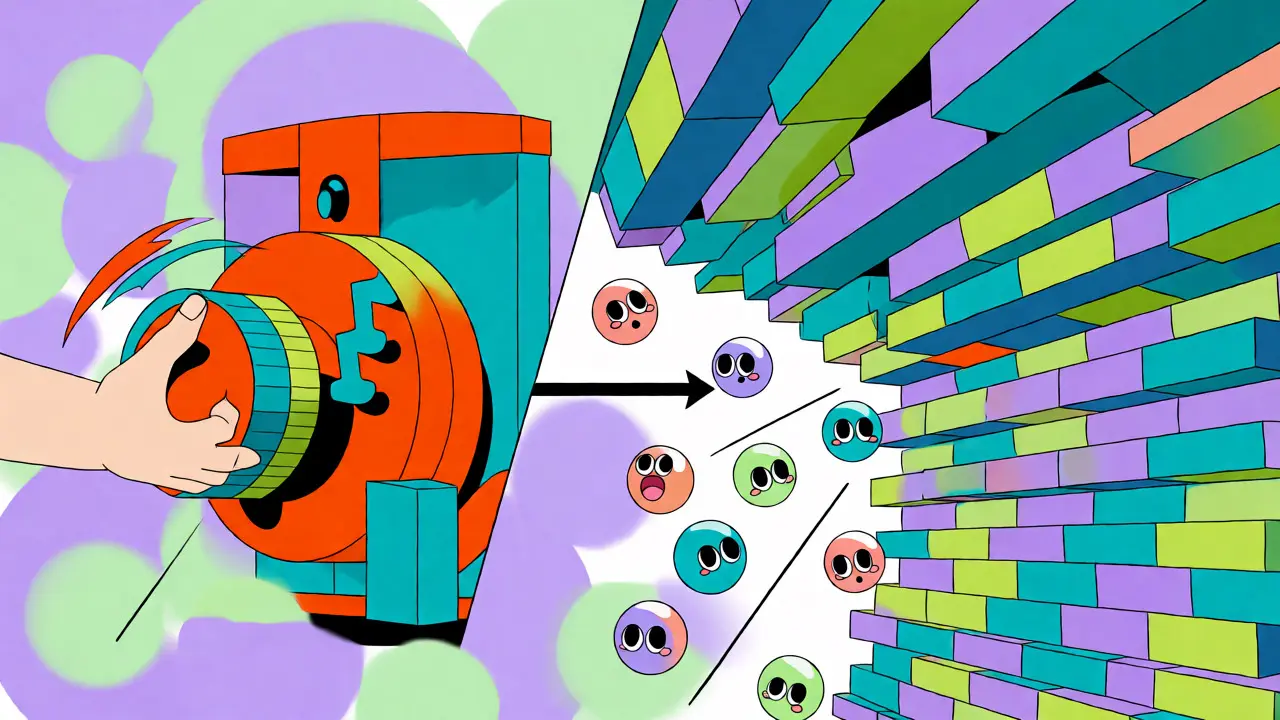
A nonce stands for "number used once." It’s a 32-bit integer included in every Bitcoin block header. Think of it as a dial on a lock. Miners turn this dial from 0 to 4,294,967,295 (the maximum value for a 32-bit number), checking each position to see if the resulting lock opens (i.e., the hash meets the requirement).
Here’s the catch: modern hardware is so fast that it burns through all possible nonce values in under 200 milliseconds. Once the nonce range is exhausted, miners don’t stop. They tweak other parts of the block header, like the timestamp or the data in the first transaction (the coinbase). This changes the entire hash input, giving them a fresh set of nonces to try. It’s not just about spinning one dial; it’s about resetting the whole lock mechanism repeatedly until it clicks.
Understanding the Difficulty Target
If the nonce is the dial, the difficulty target is the tightness of the lock. Technically, it’s a 256-bit number that serves as a ceiling. A valid block hash must be numerically lower than this target. The smaller the target, the fewer numbers qualify, and the harder it is to find one.
You might hear people say, "The hash needs four leading zeros." That’s a simplification. In reality, the hash is treated as a giant integer. If the target is $10^{20}$, any hash below that number works. Leading zeros are just a visual way to represent small numbers in hexadecimal format. More zeros mean a smaller number, which means a stricter target.
Bitcoin adjusts this target every 2,016 blocks-roughly every two weeks. If blocks are being found too quickly (less than 10 minutes apart), the protocol lowers the target, making it harder. If blocks are slow, it raises the target, making it easier. This feedback loop keeps the average block time near 10 minutes, regardless of how much total computing power joins or leaves the network.
| Variable | Function | Impact on Mining |
|---|---|---|
| Nonce | Iterative input variable | Exhausted quickly; requires header modification to continue search |
| Difficulty Target | Threshold for valid hash | Determines probability of success per attempt |
| Hash Rate | Computational speed | Higher rate increases odds of finding a block first |
| Block Interval | Target time between blocks | Fixed at ~10 minutes via dynamic difficulty adjustment |
The Lottery Mechanics: Probability vs. Skill
Mining is often misunderstood as a skill-based competition. It’s not. It’s a probabilistic lottery. Every hash attempt is independent. Failing to find a valid hash after a billion tries doesn’t mean you’re "close" to the solution. Each new attempt has the exact same low probability of success.
Your expected share of the rewards depends entirely on your slice of the total network hash rate. If you control 1% of the global computational power, you expect to find 1% of the blocks over time. But short-term variance is huge. You might go months without finding a block solo, while someone else finds three in a day. This is why most miners join pools-they combine their hash rate to smooth out income, splitting rewards based on contributed work rather than waiting for a rare solo win.
Hardware and Economics: The Industrial Reality
Gone are the days when you could mine Bitcoin with a gaming PC. Today, mainnet mining is dominated by Application-Specific Integrated Circuits (ASICs). These chips do one thing: calculate SHA-256 hashes. They are incredibly efficient but also obsolete within a few years as newer, faster models hit the market.
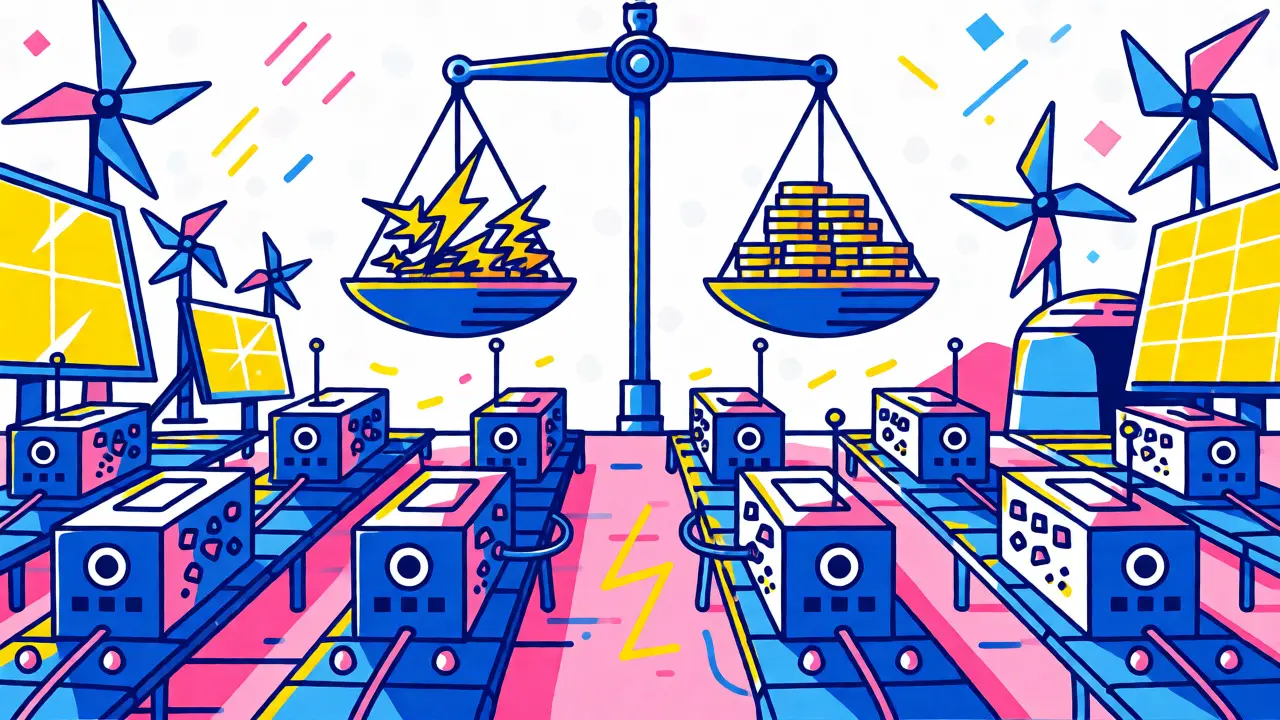
Profitability hinges on three factors: electricity cost, hardware efficiency, and Bitcoin’s price. As of late 2026, competitive miners need electricity rates below $0.10 per kWh to break even with modern ASICs. Older machines become unprofitable quickly if power costs rise or Bitcoin’s price dips. This economic pressure drives miners to locations with cheap, surplus energy, such as hydroelectric regions in Scandinavia or stranded gas fields in Texas.
Security Implications and Energy Concerns
The beauty of Proof-of-Work is its simplicity. Verification is instant-a node checks the hash against the target in microseconds. Production is hard. This asymmetry secures the network. To rewrite history, an attacker would need to redo all the work for subsequent blocks, requiring more than 50% of the network’s total hash rate. Given the current scale, this would require billions of dollars in hardware and electricity, making attacks economically irrational.
Critics point to energy consumption. Bitcoin uses roughly 138 TWh annually, comparable to medium-sized countries. Proponents argue this expenditure buys global settlement security and incentivizes renewable energy development, as miners often seek out excess green power. Alternatives like Proof-of-Stake reduce energy use dramatically but shift security from physical resources to capital stake, introducing different risks around wealth concentration.
Frequently Asked Questions
Can I still mine Bitcoin with my computer?
Technically, yes, but you won’t make money. Your CPU or GPU is millions of times slower than an ASIC. You’ll likely spend more on electricity than you earn in fractions of a cent, unless you’re mining smaller altcoins that resist ASIC dominance.
Why does difficulty change every two weeks?
To maintain a steady block production rate of approximately 10 minutes. If more miners join, blocks arrive faster, so the protocol makes the puzzle harder (lowers the target). If miners leave, blocks slow down, so the puzzle gets easier (raises the target).
Is mining a scam because it wastes energy?
It’s a design choice, not a bug. The energy cost creates a barrier to entry and secures the network against Sybil attacks. Whether it’s "waste" depends on whether you believe decentralized, permissionless monetary policy is worth the energy bill.
What happens if a miner finds a block with a hash above the target?
The block is rejected by the network. Nodes validate every incoming block against the current difficulty target. If the hash doesn’t meet the threshold, the block is considered invalid and ignored, wasting the miner’s effort.
Does higher difficulty mean better security?
Generally, yes. Higher difficulty implies more aggregate computational power securing the chain. This makes it exponentially more expensive for an attacker to gain 51% control, thereby increasing resistance to double-spending and censorship.