
How to Avoid Mutual Fund Mis-Selling in India: Red Flags and Due Diligence
 Dec, 16 2025
Every year, thousands of investors in India lose money not because mutual funds are risky, but because they were sold the wrong ones. Mis-selling isn’t always a scam-it’s often a pushy advisor pushing high-commission products, hiding fees, or promising guaranteed returns. You didn’t get scammed by a stranger. You trusted someone you thought had your best interest at heart. That’s the real danger.
What Mutual Fund Mis-Selling Actually Looks Like
Mis-selling happens when a financial advisor recommends a mutual fund that doesn’t match your goals, risk tolerance, or financial situation. It’s not always illegal. Sometimes, it’s just lazy advice. You’re told to invest in a tax-saving fund when you don’t need tax benefits. You’re sold an equity fund with 10-year lock-ins when you need money in 2 years. Or worse-you’re promised returns of 15% or more, with no mention that past performance doesn’t guarantee future results.
The biggest red flag? When your advisor says, “This is the best fund for everyone.” There’s no such thing. Your needs are different from your neighbor’s, your colleague’s, or your cousin’s. If the advice sounds generic, it’s probably designed to move volume, not protect your money.
Top 7 Red Flags of Mutual Fund Mis-Selling
- Guaranteed returns - No mutual fund guarantees returns. If someone says “you’ll get 12% every year,” walk away. Even bank FDs don’t promise that anymore.
- Pressure to invest quickly - “This offer ends today,” “Only 100 units left,” or “The fund is closing for subscription.” These are classic sales tactics. Mutual funds don’t run out of units. The door is always open.
- Hidden commissions - Advisors earn commissions from fund houses. Some earn up to 5% upfront and 1% every year just for keeping you invested. Ask: “How much do you earn if I invest here?” If they hesitate, that’s your answer.
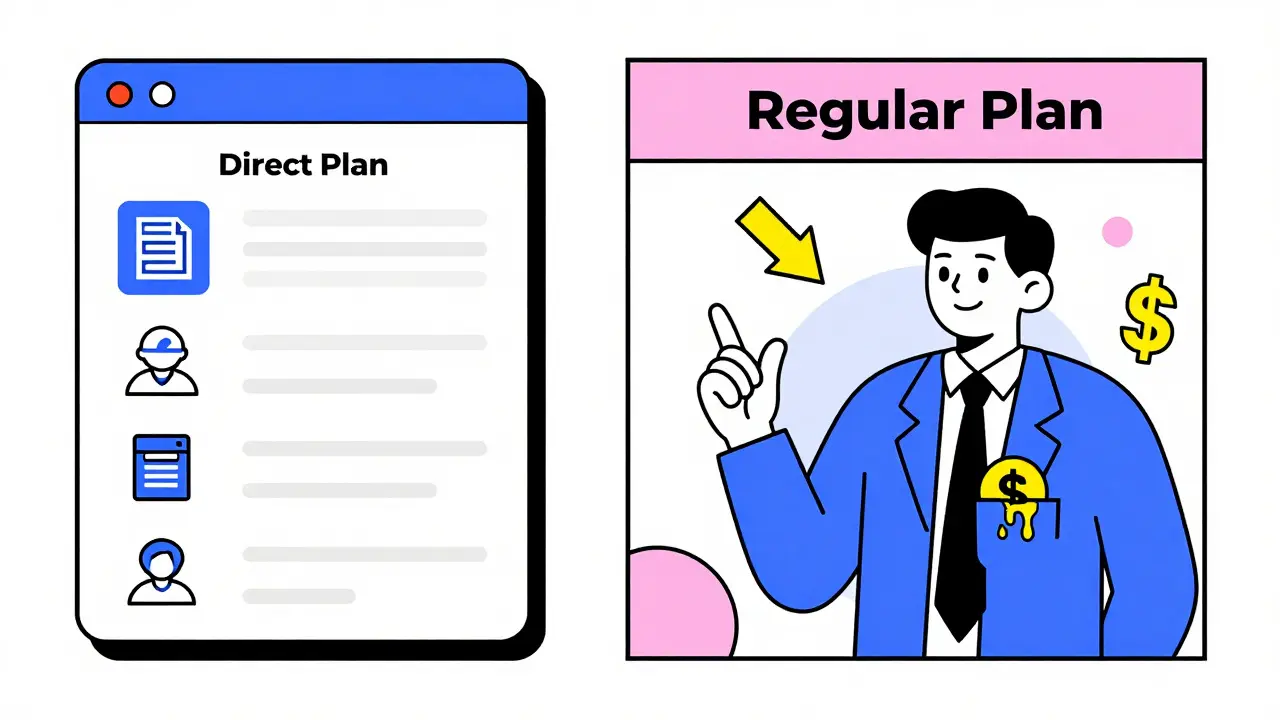
- Pushing direct plans as regular plans - Direct plans have lower expense ratios. But many advisors still sell regular plans because they earn trail commissions. If you’re not told the difference, you’re being overcharged.
- Not asking about your goals - A good advisor asks: “When do you need this money?” “What are you saving for?” “How much risk can you handle?” If they skip these questions, they’re not advising-they’re selling.
- Using complex jargon to confuse you - “This is a multi-cap dynamic allocation hybrid with a 3-year lock-in and a Sharpe ratio of 1.4.” If you don’t understand it, and they don’t simplify it, they’re hiding something.
- Only recommending one fund house - If your advisor only pushes funds from HDFC, ICICI, or SBI, they’re probably tied to that house. A true advisor compares across fund houses.
How to Do Real Due Diligence Before Investing
Don’t rely on your advisor’s word. Do your own checks. Here’s how:
- Check the fund’s objective - Go to the fund house website. Read the “Scheme Information Document.” Does the fund’s goal match yours? If you want steady growth, don’t invest in a small-cap fund that swings 30% up or down yearly.
- Compare expense ratios - Direct plans save you 0.5% to 1.5% per year. Over 10 years, that’s tens of thousands in extra returns. Use platforms like Value Research or Morningstar to compare.
- Look at the portfolio - Does the fund hold 20+ stocks? Or just 5? Concentrated funds are riskier. If it holds a lot of debt, is it investment-grade? Check the credit ratings.
- Check consistency - Don’t just look at 1-year returns. Look at 3-year, 5-year, and 7-year performance. Does it beat its benchmark? Does it beat other funds in the same category?
- Read the riskometer - SEBI requires every fund to show a risk level: Low, Moderate, High, Very High. If you’re 55 and retiring in 5 years, you shouldn’t be in a “Very High” risk fund.
- Verify the advisor’s credentials - Are they registered with SEBI as an Investment Advisor? Check at SEBI’s website. If they’re only a distributor, they’re paid to sell, not advise.
- Use direct plans - Go to the fund house website or use apps like Groww, Zerodha, or Coin by Zerodha. You’ll pay less, get the same fund, and avoid middlemen.
Why You Should Never Rely on Word-of-Mouth
Your friend invested in Fund X and made 20% last year. So you should too? Not necessarily. That fund might have been lucky. It might be too risky for you. Or it might be about to drop 30% next year. Past performance is just that-past. It doesn’t predict the future.
Also, people don’t tell you about their losses. They brag about gains. That’s confirmation bias. You’re hearing only half the story. Don’t make investment decisions based on social media posts or WhatsApp forwards.
What to Do If You’ve Already Been Mis-Sold
If you realize you were pushed into the wrong fund, don’t panic. You still have options.
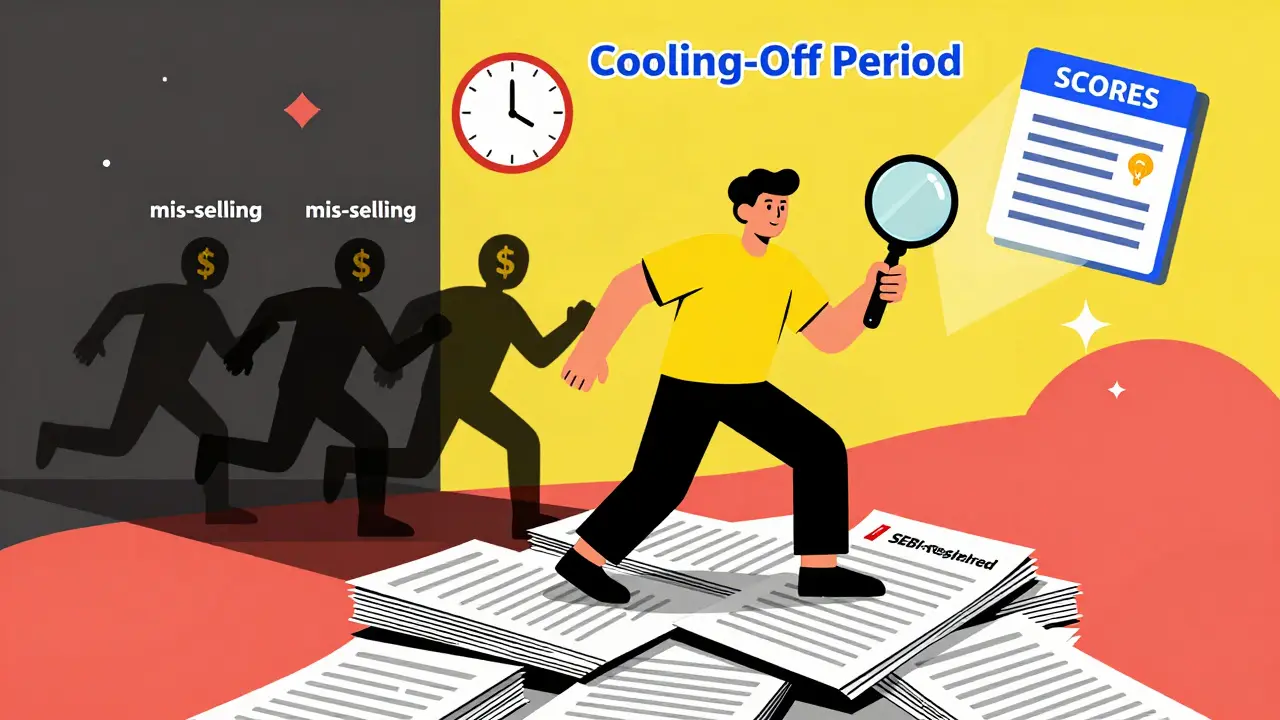
- If it’s been less than 30 days, you can cancel the investment and get your money back. This is called the “cooling-off period.”
- If it’s been longer, you can switch to a better fund. Use the Systematic Transfer Plan (STP) to move money gradually and avoid market timing.
- If you believe you were misled or lied to, file a complaint with the fund house’s grievance cell. If they don’t respond in 30 days, escalate to SEBI’s SCORES portal.
SEBI’s SCORES portal is free, fast, and effective. You can file online at scores.gov.in. You’ll need your folio number, fund name, and a copy of your transaction statement. Most complaints are resolved within 15-30 days.
How to Find a Real Financial Advisor
If you want help, find someone who’s paid to advise-not to sell.
- Look for a SEBI-registered Investment Advisor (RIA). They charge a flat fee or hourly rate. They don’t earn commissions from fund houses.
- Ask for their Form ADV (the disclosure document). It shows their fees, conflicts of interest, and disciplinary history.
- Start with platforms like Finology, MyFMS, or PlanMyWealth that connect you with fee-only advisors.
- Interview three advisors. Ask: “What’s the first thing you’d change in my portfolio?” If they give a generic answer, move on.
Final Rule: Your Money, Your Rules
There’s no shortcut to protecting your money. No app, no advisor, no guru can do it for you. You have to be the one asking questions. You have to be the one reading the fine print. You have to be the one saying “no” when something feels off.
Every rupee you invest should have a reason. A goal. A timeline. A risk level you’re comfortable with. If you can’t answer those three questions, don’t invest. Wait. Learn. Ask again.
Mutual funds aren’t the problem. The pressure to buy, the fear of missing out, and the silence around fees are. You’re not behind. You’re not stupid. You’re just being sold to. And now, you know how to fight back.
How do I know if my mutual fund advisor is mis-selling?
Look for red flags: promises of guaranteed returns, pressure to invest quickly, no questions about your goals, or only recommending funds from one fund house. If your advisor doesn’t explain fees clearly or pushes regular plans over direct plans without reason, they’re likely earning commissions, not helping you.
Can I get my money back if I was mis-sold a mutual fund?
Yes, if you act within 30 days of purchase. Mutual funds have a cooling-off period where you can cancel the transaction and get a full refund. After that, you can switch to a better fund using a Systematic Transfer Plan (STP) or file a complaint with SEBI’s SCORES portal if you believe you were misled.
What’s the difference between direct and regular mutual fund plans?
Direct plans are bought directly from the fund house and have lower expense ratios because they don’t include advisor commissions. Regular plans are sold through advisors and include those commissions in the fees. You get the same underlying portfolio, but you pay more in regular plans-often 0.5% to 1.5% extra per year.
How do I check if my advisor is SEBI-registered?
Go to SEBI’s official website at https://www.sebi.gov.in and use the “Registered Persons” search tool. Enter the advisor’s name or ARN number (Advisor Registration Number). If they’re not listed, they’re not a registered investment advisor. Beware of distributors who claim to be advisors.
Should I invest through an app or a human advisor?
It depends on your comfort level. Apps like Groww, Zerodha, or Coin by Zerodha let you invest directly in low-cost direct plans with full transparency. If you need personalized advice, hire a SEBI-registered fee-only advisor. Avoid advisors who push products for commission. You can also use apps to research and then consult a fee-based advisor for a second opinion.
What’s the safest mutual fund for beginners in India?
For beginners, start with large-cap or balanced advantage funds. These invest in stable, well-established companies and reduce volatility. Avoid small-cap or sectoral funds until you understand risk better. Always match the fund’s risk level to your timeline and goals. A 5-year goal? Consider a hybrid fund. A 10+ year goal? A diversified equity fund is better.
Are mutual funds safe in India?
Yes, mutual funds themselves are safe-they’re regulated by SEBI, and your money is held in trust by custodians. But the products you’re sold might not be right for you. The risk isn’t in the fund structure-it’s in the advice you receive. Mis-selling is the real threat, not the fund.