
How to Read Stock Charts: Technical Analysis Basics for Indian Investors
 Jan, 6 2026
Most Indian investors start trading with hope, not strategy. They buy stocks because a friend recommended them, or because the price went up last week. But without reading stock charts, you’re flying blind. Technical analysis isn’t magic. It’s not about predicting the future. It’s about understanding what the market is telling you right now - through price, volume, and time.
What You’re Really Looking At
A stock chart is a story. It shows how buyers and sellers fought over price every minute, hour, or day. In India, where retail investors make up over 90% of the NSE and BSE trading volume, understanding this story can mean the difference between holding a losing stock for years or catching a real move early.
Most charts you’ll see are candlestick charts. Each candle tells you four things: the open price, close price, highest price, and lowest price for a given time period - usually daily or weekly. A green (or white) candle means the close was higher than the open. A red (or black) candle means the close was lower. The long wicks on top or bottom? Those show where price tried to go but got pushed back. That’s rejection. That’s a signal.
Take Tata Motors. In November 2025, it formed a long red candle with a tiny body and long upper wick after hitting ₹850. That meant buyers pushed it higher, but sellers stepped in hard and drove it back down. That’s not just a down day - it’s a sign of resistance. If you saw that and didn’t buy on the next rally, you avoided a 15% drop over the next three weeks.
Support and Resistance: The Invisible Walls
Support is where buyers step in. Resistance is where sellers take over. These aren’t random lines. They’re areas where price has struggled to break through before - and traders remember them.
In India, many retail investors focus on round numbers: ₹500, ₹1,000, ₹2,000. But real support and resistance form where volume was heavy - not where the number looks nice. Look at Reliance Industries. Between March and August 2025, it bounced off ₹2,950 three times. Each time, buyers came in. That’s support. When it finally broke above ₹3,100 in September, volume jumped 40% above average. That’s confirmation.
Draw horizontal lines where price reversed before. Don’t guess. Don’t use software that draws them for you. Do it yourself. That’s how you learn where the market’s memory lives.
Candlestick Patterns That Actually Work
Not all patterns are created equal. Some are just noise. But a few show up again and again in Indian markets with real predictive power.
- Doji: When open and close are almost the same. It means indecision. After a strong uptrend, a Doji at resistance? Watch out. Sellers are waking up.
- Engulfing Pattern: A small candle followed by a larger one that swallows it. A bullish engulfing at support? Buyers took control. A bearish engulfing at resistance? Sellers did.
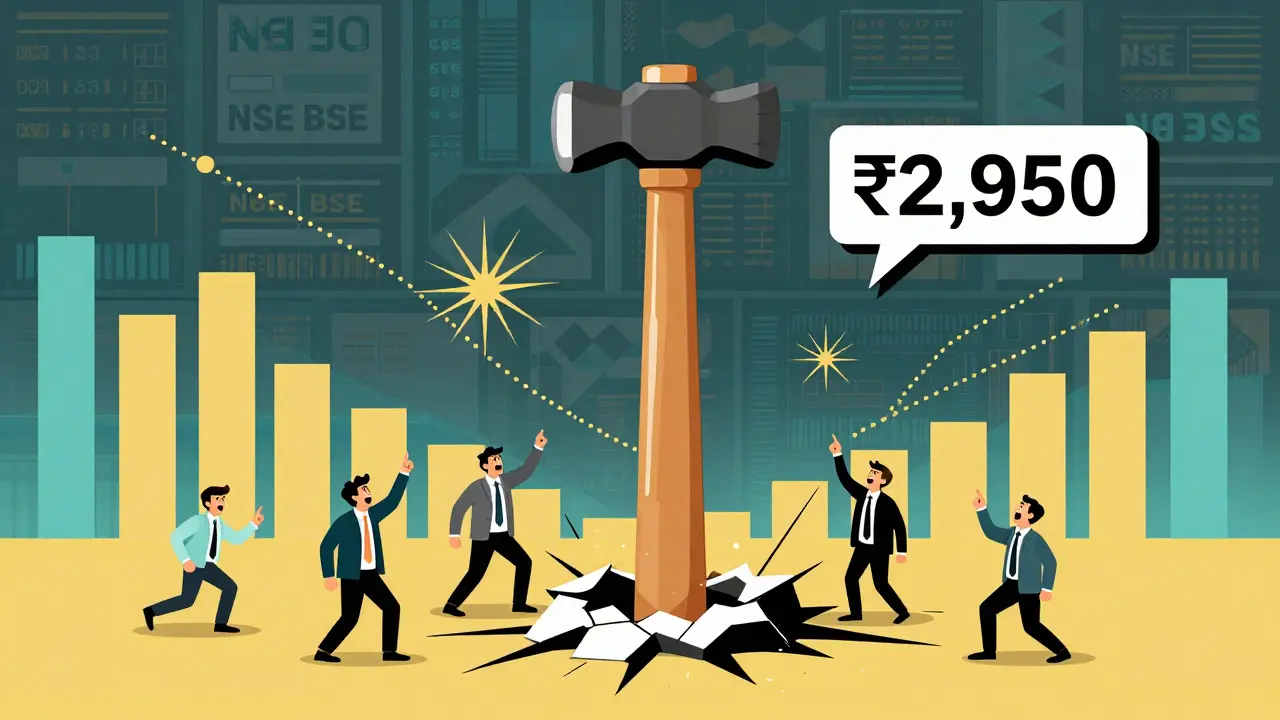
- Hammer and Hanging Man: Same shape - small body, long lower wick. If it appears after a drop, it’s a Hammer - potential reversal up. If it appears after a rise, it’s a Hanging Man - potential reversal down. Context matters.
These patterns don’t guarantee anything. But when they show up with high volume and align with support/resistance? That’s when you start paying attention. In early December 2025, Infosys formed a bullish engulfing pattern at ₹1,780 - a level it had held twice before. The next day, it rose 4%. Not because of news. Because the chart told you.
Volume: The Hidden Confirmation
Price moves without volume are illusions. In Indian markets, where manipulation is common, volume tells you if a move is real or fake.
When a stock jumps 8% on low volume? It’s likely a pump-and-dump. When it climbs 5% with 3x the average daily volume? That’s real demand. Look at Eicher Motors. In October 2025, it rose 12% on volume 2.5x higher than its 20-day average. That wasn’t speculation. That was institutional buying. A few days later, it kept climbing.
Always overlay volume below your price chart. If a breakout happens without volume, ignore it. If a breakdown happens with heavy volume, get out. Volume is the heartbeat of the market.
Trend Lines and Channels
A trend is just a series of higher highs and higher lows (uptrend) or lower highs and lower lows (downtrend). Draw a line connecting the lows in an uptrend. That’s your trendline. Price usually bounces off it.
Break the trendline? That’s a warning. Not a death sentence. But it means the momentum is shifting. In February 2025, HDFC Bank broke below its 6-month uptrend line after three failed attempts to hold ₹1,650. Within three weeks, it fell 11%. If you were watching the trendline, you had time to exit.
Channels are just two parallel trendlines - one for highs, one for lows. When price stays inside, it’s trading. When it breaks out? That’s when big moves start. Many Indian small-cap stocks trade in channels for months before exploding. Spotting them early gives you an edge.

Indicators: Use Them Wisely
RSI, MACD, Bollinger Bands - they’re tools, not crystal balls. Most Indian traders overuse them. They watch RSI like a religion. But RSI can stay overbought for weeks in a strong uptrend.
Here’s what actually works: Use RSI to spot divergence. If price makes a new high but RSI doesn’t? That’s a warning. Sellers are weakening the rally. In September 2025, ICICI Bank made a new high at ₹1,220, but RSI peaked lower than the previous high. Two weeks later, it dropped 9%. That divergence told you before the news even broke.
Don’t stack indicators. Pick one or two. Learn them deeply. A simple 20-day moving average is enough to start. When price closes above it? Trend is up. Below it? Trend is down. That’s it.
What to Avoid
Don’t chase stocks that have run up 30% in a week. That’s not a signal - it’s a trap. Most Indian retail investors lose money buying the news. The smart ones buy the chart setup before the news.
Don’t trade on tips from WhatsApp groups. Don’t assume a stock is cheap because it’s down 50%. Price doesn’t care about your cost basis. It only cares about what buyers and sellers do right now.
Don’t ignore the broader market. If the Nifty 50 is in a clear downtrend, most individual stocks will follow. Technical analysis works best when you’re trading with the trend - not against it.
Start Simple. Build From Here.
You don’t need to master 20 indicators. You don’t need to watch charts all day. Start with three things:
- Learn to read candlesticks - open, close, wicks.
- Draw support and resistance lines on your top 5 stocks.
- Check volume on every big move.
Use free tools: TradingView, Zerodha Kite, or Upstox. Practice on historical charts. Pick a stock you own. Look back six months. See where it reversed. See where volume spiked. See how patterns played out.
Technical analysis isn’t about being right every time. It’s about having a system that gives you an edge. In India’s noisy, emotional market, that edge is everything.
Do I need to learn fundamental analysis if I’m using technical analysis?
No, you don’t need to learn fundamentals to trade using charts. But if you’re holding stocks for more than a few weeks, you should. Technical analysis tells you when to enter or exit. Fundamental analysis tells you if the company is worth owning at all. A stock can have a perfect chart but be going bankrupt. Use technicals for timing, fundamentals for selection.
Can I use technical analysis for intraday trading in India?
Yes, and many Indian traders do. Intraday traders use 5-minute or 15-minute charts. The same rules apply - support, resistance, candlestick patterns, volume. But intraday trading is riskier. You need discipline. Most beginners lose money because they overtrade. Start with daily charts. Master the bigger moves before jumping to minutes.
Are candlestick patterns reliable in Indian markets?
Yes, if you use them correctly. Indian markets are driven by retail sentiment, which makes them more emotional - and therefore, more predictable in patterns. A bullish engulfing at support in a stock like Asian Paints or TCS has worked more than 60% of the time over the last five years, based on NSE data. But only when combined with volume and trend context.
How long does it take to get good at reading stock charts?
You can learn the basics in 30 days. Recognizing candles, drawing support/resistance, spotting volume spikes - that’s doable. But becoming consistently profitable? That takes 6 to 12 months of practice. Track every trade. Write down why you entered. What did the chart show? Review your mistakes. Most people quit before they get there.
What’s the best time frame for a beginner in India?
Daily charts. Weekly charts even better. Daily charts filter out the noise. You’ll see real trends, not random spikes from afternoon trading or news rumors. Most Indian retail traders lose money because they watch 1-minute charts and react to every tick. Slow down. The best moves take days, not minutes.
If you’re serious about trading in India, stop guessing. Start reading. The charts are always telling you something. You just need to learn the language.