
How to Start Staking Crypto: A Beginner’s Walkthrough
 Nov, 24 2026
You’ve probably heard the buzzwords floating around Twitter and Reddit: "staking," "passive income," and "proof-of-stake." Maybe you saw a friend post about earning interest on their Ethereum without lifting a finger. It sounds like magic money, right? But here’s the reality check: crypto staking is simply locking up your digital assets to help secure a blockchain network, and in return, the network pays you. It’s not free money, but it is a legitimate way to grow your holdings if you understand the mechanics.
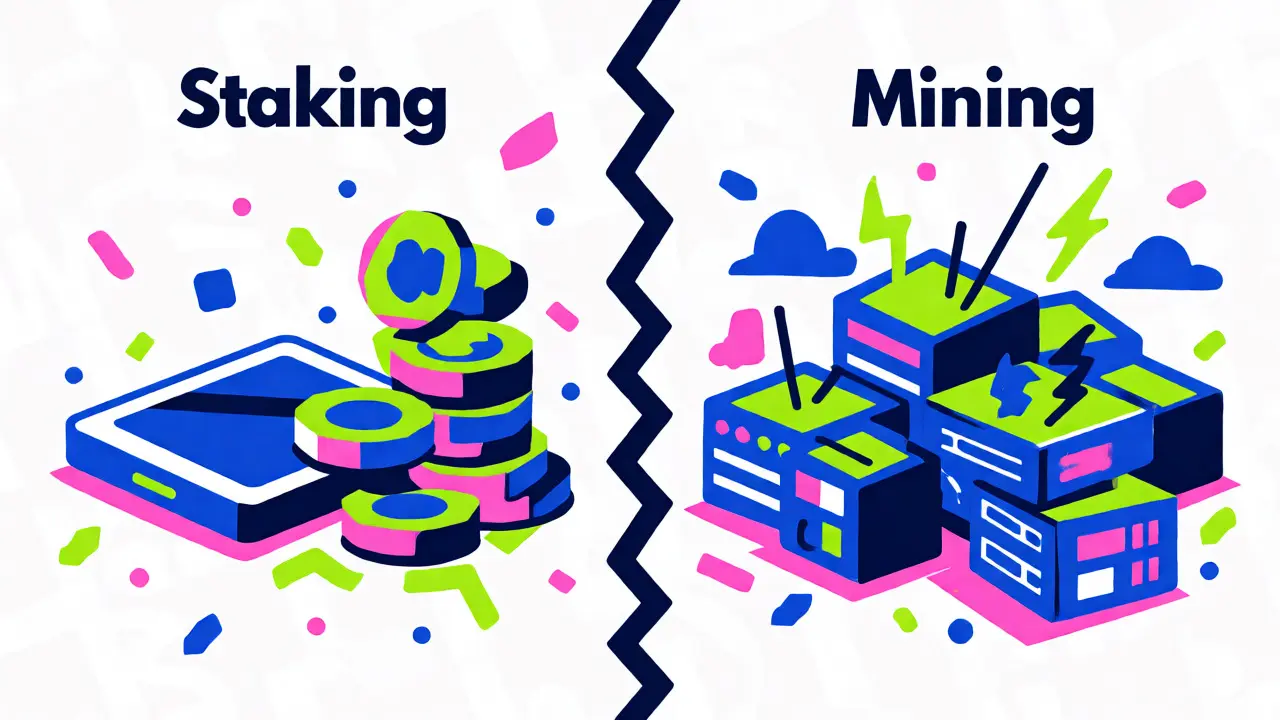
The confusion usually starts because people mix up staking with mining. Mining requires massive energy and expensive hardware. Staking just requires you to hold coins. Since Ethereum switched to Proof-of-Stake (PoS) in 2022, over $145 billion worth of assets have been staked across major networks. That’s a lot of people trying to figure out how to get in. If you’re wondering where to start, what risks exist, and whether you need thousands of dollars to begin, this guide breaks it down step-by-step.
What Exactly Is Crypto Staking?
To stake, you need to understand what you’re buying into. At its core, staking is the process of participating in transaction validation on a Proof-of-Stake blockchain by locking up cryptocurrency. Think of it like depositing money in a high-yield savings account, but instead of a bank using your cash to lend to others, the blockchain uses your locked coins to verify transactions and create new blocks.
This system replaced the older Proof-of-Work (PoW) model used by Bitcoin, which burns huge amounts of electricity. PoS is greener and more efficient. When you stake, you become a "validator" or delegate to one. If the network operates correctly, you earn rewards. If validators act maliciously or go offline, they can lose some of their staked funds-a penalty known as "slashing."
| Feature | Crypto Staking | Crypto Mining |
|---|---|---|
| Hardware Needed | Minimal (Computer/Phone) | Specialized ASICs/GPUs |
| Energy Use | Low | Very High |
| Entry Cost | As low as $1-$10 | $1,000+ for setup |
| Technical Skill | Low to Medium | High |
| Risk Type | Slashing/Lock-up | Hardware failure/Energy costs |
Choosing Your First Coin to Stake
Not all cryptocurrencies can be staked. You need a coin that runs on a Proof-of-Stake consensus mechanism. As of late 2026, three networks dominate the landscape: Ethereum, Solana, and Cardano. Together, they account for nearly 80% of all staked value.
Ethereum offers lower yields (3.5-5.5% APR) but is considered the safest bet due to its massive developer community and institutional adoption. Solana provides higher returns (6-8% APR) but comes with higher volatility and occasional network congestion issues. Cardano is unique because it has no minimum stake requirement-you can stake as little as 10 ADA (cents). For beginners, starting with a smaller position in a volatile asset like Solana might feel rewarding, but Ethereum remains the gold standard for stability.
Check the current Annual Percentage Rate (APR) before you commit. Rates fluctuate based on network participation. In 2021, average APRs were over 14%. By 2026, they’ve stabilized closer to 6-7% as more users joined the race. Don’t chase the highest number blindly; look at the network’s health and liquidity.
Picking Your Staking Method: The Three Paths
You have three main ways to stake, each with different trade-offs between ease of use, control, and reward size. This decision dictates your technical workload.
1. Centralized Exchange Staking: Platforms like Coinbase, Kraken, or Binance let you click a button to stake. They handle the technical heavy lifting. The downside? They take a cut. Expect fees between 15% and 25% of your rewards. If you earn $100, you might only keep $75. However, for someone with less than $1,000 invested, the convenience outweighs the fee.
2. Liquid Staking Pools: Services like Lido or Rocket Pool allow you to pool resources with others. You don’t need the full 32 ETH required for an independent Ethereum validator. You receive a token representing your stake (like stETH), which you can still trade while it earns yield. Fees are lower (5-10%), but you’re trusting the protocol’s smart contracts.
3. Direct Validator Staking: This is running your own node. You lock up the full minimum (e.g., 32 ETH for Ethereum) and run software on a dedicated server. You keep 100% of rewards, minus gas fees. But you also bear the risk of slashing if your server goes offline. This path is for tech-savvy users with significant capital ($90k+).
Step-by-Step: How to Set Up Your Stake
Let’s walk through the actual process. We’ll assume you’re using a centralized exchange for simplicity, as it’s the most common entry point for beginners.
- Select a Reputable Exchange: Choose a platform that supports your chosen coin and has a good security track record. Coinbase and Kraken are top choices in North America and Europe. Ensure they offer "native" staking rather than just lending products.
- Fund Your Account: Buy the cryptocurrency via bank transfer or card. Remember, you need to hold the asset first. Minimum purchases often start at $2-$10.
- Navigate to the Staking Section: Most exchanges have a dedicated "Earn" or "Staking" tab. Search for your coin (e.g., SOL for Solana).
- Review Terms: Read the fine print. Look for two things: the unbonding period (how long until you can withdraw) and the reward frequency (daily, weekly, or monthly).
- Confirm Stake: Click "Stake." The exchange will move your coins into a validator pool. You’ll see your balance change from "Available" to "Staked."
If you prefer self-custody, you’ll need a wallet like MetaMask or Trust Wallet. Connect the wallet to a staking interface (like Lido.fi), approve the transaction, and pay the gas fee. The coins leave your wallet and enter the smart contract. You’ll receive a receipt token in return.

The Hidden Risks: Lock-Ups and Slashing
Staking isn't risk-free. The biggest surprise for newbies is the "unbonding period." When you decide to unstake, you can’t access your funds instantly. On Solana, it takes 4-6 days. On Ethereum, it can vary but often takes several days to weeks depending on exit queues. During this time, the market could crash, and you’d be stuck holding a falling knife.
Then there’s slashing. If a validator misbehaves-double-signing transactions or going offline for too long-the network penalizes them by taking a portion of their stake. While exchanges absorb small penalties, large-scale failures can impact your principal. Andreas Antonopoulos, a prominent blockchain educator, warns that centralization is a risk: when a few big exchanges control 30% of the staked supply, a coordinated outage could hurt the whole network.
Taxes are another headache. In many jurisdictions, including the US, staking rewards are taxed as ordinary income at the fair market value when received. If you stake $1,000 and earn $50, you owe tax on that $50 immediately, even if you haven’t sold the coin. Keep detailed records from day one.
Maximizing Your Returns
Once you’re staked, how do you make it work harder? Auto-compounding is your best friend. Some platforms automatically reinvest your rewards back into the stake. This creates a snowball effect. Over five years, compounding can increase your total yield by 10-15% compared to simple interest.
Diversification matters too. Don’t put all your eggs in one basket. Split your portfolio: 50% in Ethereum for stability, 30% in Solana for growth, and 20% in a newer PoS chain like Polkadot or Avalanche. This hedges against specific network failures.
Keep an eye on regulatory news. The SEC and EU’s MiCA regulations are shaping how staking services operate. Changes in law could affect tax treatment or platform availability. Staying informed prevents nasty surprises.
Do I need to keep my computer on to stake?
No, not if you use a centralized exchange or liquid staking protocol. These services run the validator nodes for you. You only need to keep your device on if you are running a direct validator node yourself, which requires 24/7 uptime to avoid penalties.
Can I lose money staking crypto?
Yes. There are two main ways. First, the price of the underlying cryptocurrency can drop faster than you earn rewards. Second, if you are running a validator directly, you can be "slashed" (lose part of your stake) for downtime or errors. Exchanges usually protect you from slashing, but you still face market risk.
What is the minimum amount needed to start?
It depends on the method. On exchanges like Coinbase or Kraken, you can often start with as little as $10. For direct Ethereum staking, you need 32 ETH (tens of thousands of dollars). For Cardano, you can stake with less than $1.
Are staking rewards taxable?
In most countries, yes. The IRS in the US treats staking rewards as ordinary income at the time of receipt. You must report the value of the rewards in USD on the day you received them. Consult a tax professional for your specific jurisdiction.
Is staking better than saving in a bank?
Potentially, yes. Traditional savings accounts average under 1% APY. Staking often yields 3-8%. However, crypto is far more volatile. Bank deposits are insured (up to limits); crypto stakes are not. Only stake money you can afford to hold long-term.