
How to Track Mutual Fund Performance in India and Evaluate Your Portfolio
 Feb, 2 2026
Tracking mutual fund performance in India isn’t just about checking if your balance went up last month. It’s about understanding whether your money is working as hard as it should be. With over 2,500 mutual funds available in India, picking one and forgetting it is a recipe for missing out-or worse, losing ground to inflation. If you’re investing in mutual funds, you need to know how to read the numbers, spot red flags, and make smart adjustments. This isn’t about becoming a finance expert. It’s about taking control of your money without the jargon.
Start with Your Goal
Before you look at any return numbers, ask yourself: why did you invest? Were you saving for your child’s education in five years? Building a retirement fund for 2035? Or just trying to beat bank FD rates? Your goal determines what good performance looks like. A fund that returns 12% a year might sound great, but if your goal requires 15% to reach your target on time, you’re falling behind. Many investors skip this step and end up comparing apples to oranges. A debt fund isn’t supposed to grow like an equity fund. Don’t judge them the same way.Use the Right Benchmarks
Mutual funds in India are grouped by category-large-cap, mid-cap, flexi-cap, sectoral, debt, hybrid, and more. Each has its own benchmark. For example, if you’re in a large-cap fund, compare it to the Nifty 50, not the Nifty Midcap 100. The fund house will tell you the benchmark on the factsheet, but don’t just take their word for it. Go to AMFI (Association of Mutual Funds in India) or Value Research and check the category average. If your fund is consistently underperforming its category by more than 2% over three years, it’s time to ask why. A single bad year isn’t a reason to panic. But three years? That’s a pattern.Look Beyond Returns
Returns are easy to see. But they don’t tell the whole story. Two funds might both return 14% over five years, but one did it with wild swings while the other crept up steadily. That’s where risk metrics matter. Check the standard deviation-it tells you how much the fund’s returns jump around. A high number means more stress during market drops. Then look at the Sharpe ratio. It measures return per unit of risk. A Sharpe ratio above 1 is good. Above 1.5 is excellent. You want a fund that gives you solid returns without making you lose sleep. Also, check the maximum drawdown. That’s the biggest drop the fund ever had. If your fund lost 30% in a crash and took two years to recover, ask yourself: could you have handled that?Check Expense Ratios Like a Pro
Every rupee you pay in fees is a rupee that doesn’t compound for you. In India, the average expense ratio for equity funds is around 2.2%. But you can easily find funds charging 1.1% or even less. Over 10 years, that 1.1% difference can cost you over ₹2 lakh on a ₹10 lakh investment. Look at the total expense ratio (TER) on the fund’s factsheet. Don’t be fooled by “no entry load” ads. TER includes everything-management fees, admin costs, marketing. A fund with a 1.8% TER and 15% returns is worse than one with 1.2% TER and 14.5% returns. Lower fees often mean better long-term results.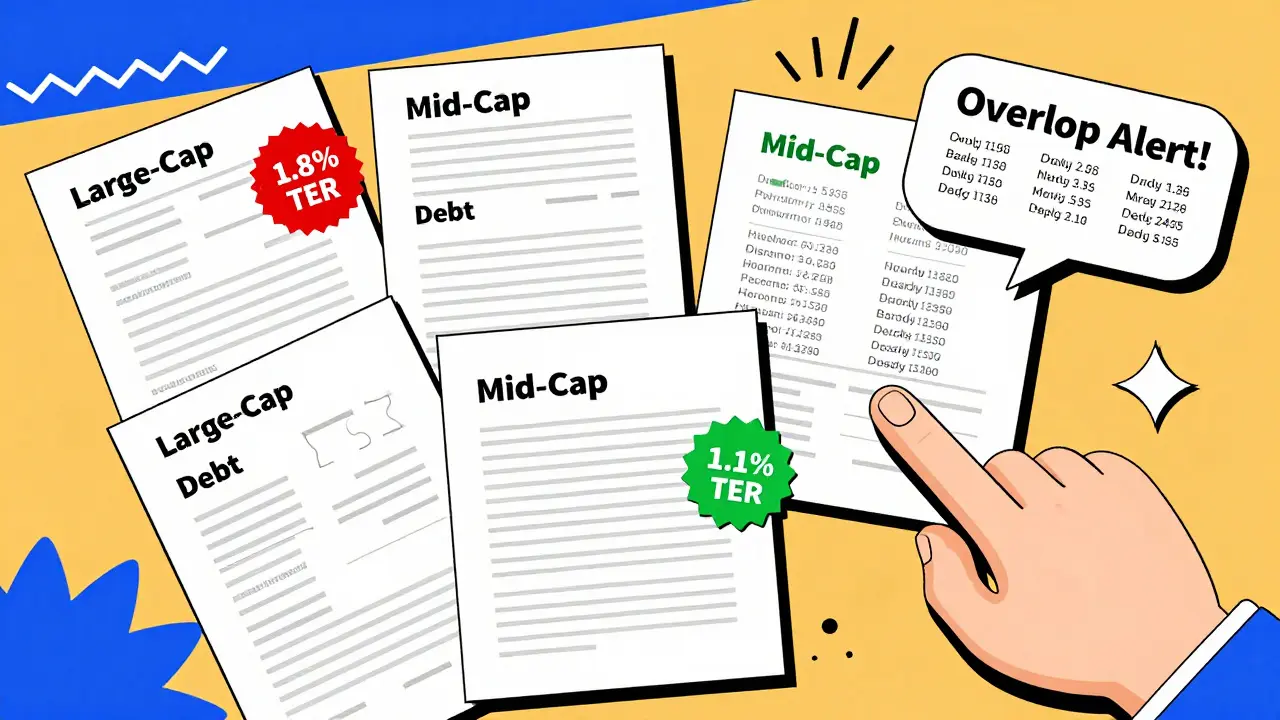
Track Your Portfolio, Not Just One Fund
Most people track each fund separately. That’s a mistake. You need to see your whole portfolio. If you have five funds, all in large-cap stocks, you’re not diversified-you’re overexposed. Use a free tool like Groww, Zerodha Coin, or Moneycontrol to import all your funds and get a snapshot. These tools show you asset allocation, sector exposure, and overlap between funds. You might be surprised to find you own three different funds that hold the same 10 stocks. That’s not diversification. That’s paying extra for the same thing twice. Fix that before you add anything new.Rebalance Every Year
Markets move. Your portfolio drifts. A fund that was 20% of your portfolio might become 30% after a big rally. That’s fine until the market crashes and you lose more than you planned. Rebalancing means selling some of what grew too much and buying more of what fell. Do it once a year. Set a reminder. Don’t wait for panic. If your equity allocation was meant to be 70% and now it’s 85%, sell 15% of your equity funds and move that money into debt or cash. It’s not timing the market. It’s sticking to your plan. Rebalancing forces you to sell high and buy low-without emotion.Watch for Fund Manager Changes
A fund’s performance is often tied to its manager. When a star manager leaves, the fund can change overnight. Check the fund’s factsheet every quarter. Look for the “Fund Manager” section. If the same person has been managing it for five years and the returns are steady, that’s a good sign. But if the manager changed six months ago and returns dropped 10% in the next quarter, it’s not a coincidence. Don’t assume the new manager will be as good. Give them a year, but keep watching. If performance doesn’t recover, it’s time to move on.Compare with Inflation
India’s inflation rate has averaged 5.5% over the last decade. If your fund returns 8% a year, you’re only gaining 2.5% in real terms. That’s not enough to grow wealth. You need returns that beat inflation by at least 4-5%. That’s why equity funds are still the best long-term option for most Indians. Debt funds might feel safe, but after tax and inflation, they often deliver less than 3% real returns. That’s barely better than keeping cash under the mattress. Always ask: “Is this fund helping me outpace inflation?” If not, you’re losing.
Know When to Exit
Holding a fund forever sounds wise-but it’s not always right. You should exit if: (1) the fund consistently underperforms its category for three years, (2) the fund manager changed and performance dropped, (3) the fund’s strategy changed (e.g., from large-cap to mid-cap without telling you), or (4) you’ve reached your goal. Don’t hold a fund because you’re attached to it. Don’t wait for it to “break even.” That’s a trap. If you invested ₹5 lakh and it’s now worth ₹4.2 lakh, don’t wait for it to return to ₹5 lakh. Ask: “Would I buy this fund today at ₹4.2 lakh?” If the answer is no, sell it. Reinvest the money where it makes sense now.Use SIPs Wisely
Systematic Investment Plans (SIPs) are great for discipline. But they’re not magic. If you’re putting ₹5,000 a month into a fund that’s been underperforming for years, you’re just adding more money to a losing bet. Review your SIPs every 12 months. Are they still aligned with your goal? Are the funds still top performers in their category? If not, switch the SIP to a better fund. You can change the fund without stopping the SIP. Most platforms let you swap funds in seconds. Don’t let inertia keep you stuck.Final Check: Your Portfolio Health Score
Here’s a simple 10-point checklist to rate your portfolio every six months:- Are all my funds aligned with my goals? (Yes/No)
- Do I know the benchmark for each fund? (Yes/No)
- Are my funds outperforming their category average over 3 years? (Yes/No)
- Is my total expense ratio below 1.5% for equity funds? (Yes/No)
- Do I have overlapping holdings across funds? (Yes/No)
- Has my asset allocation drifted more than 10% from my target? (Yes/No)
- Did any fund manager change in the last year? (Yes/No)
- Do my returns beat inflation by at least 4%? (Yes/No)
- Have I rebalanced in the last 12 months? (Yes/No)
- Would I buy each fund today if I didn’t own it? (Yes/No)
If you answered “No” to three or more, it’s time to take action. Don’t wait. Don’t overthink. Fix one thing at a time. Start with the highest expense fund. Then rebalance. Then switch underperformers. Small steps add up.
Tools You Can Use Right Now
You don’t need expensive software. Here are free, reliable tools for Indian investors:- AMFI (amfiindia.com) - Official data on fund performance and category rankings
- Value Research Online - Detailed ratings, risk metrics, and fund comparisons
- Moneycontrol - Real-time NAVs, portfolio analysis, and news
- Groww and Zerodha Coin - Easy portfolio tracking and SIP management
- Morningstar India - In-depth analysis and star ratings
Use one. Get comfortable. Check your portfolio every quarter. That’s it. No need for daily checking. No need for complex formulas. Just consistency.
How often should I check my mutual fund performance?
Check your portfolio every three months for updates, but don’t make decisions based on short-term moves. Review your funds thoroughly once a year. Look at returns, expenses, manager changes, and whether your asset allocation is still on track. Daily or weekly checking leads to emotional decisions and unnecessary trading.
What’s a good return for mutual funds in India?
There’s no single number. For large-cap equity funds, 12-15% annual returns over 5-10 years are solid. Mid-cap and small-cap funds can deliver 15-18%, but with more risk. Debt funds should aim for 6-8% after tax. The real test is whether your fund beats its category average and inflation by at least 4%. If it does, it’s performing well.
Should I switch funds if one underperforms for a year?
Not necessarily. One bad year happens-even top funds have off years. Wait for three consecutive years of underperformance compared to the category average. Also, check if the fund manager changed or if the strategy shifted. If both are true, then it’s time to consider switching. Don’t chase past performance. Look at consistency and risk-adjusted returns instead.
Can I track mutual funds on my phone?
Yes. Apps like Groww, Zerodha Coin, and PhonePe let you link all your mutual funds-even those bought through different platforms. They show your total value, daily NAV changes, portfolio breakdown, and performance graphs. You can set alerts for big drops or gains. Just make sure you’re using a trusted app with SEBI registration.
Are direct mutual funds better than regular ones?
Yes, for most investors. Direct plans have lower expense ratios because they don’t pay commissions to distributors. On average, direct plans save you 0.5-1% per year. Over 10 years, that can mean an extra ₹1-2 lakh on a ₹10 lakh investment. Switching from regular to direct is simple-just log in to your fund house’s website or app and change the plan type. No need to redeem and reinvest.
What if I invested in a fund that’s now closed to new investors?
That’s actually a good sign. Funds close when they’re too big to manage well or when the fund house wants to protect existing investors from dilution. You can still hold your units. You can even add more through SIPs in most cases. Don’t panic. Just monitor performance like you would any other fund. The closure doesn’t mean your investment is at risk.