
Index Funds vs Active Funds in India: Costs, Tracking Error, and Performance
 Jun, 23 2026
You have money to invest. You want it to grow. But standing between you and that growth is a wall of jargon, fees, and conflicting advice. Should you pick an active fund, where a manager tries to beat the market? Or should you go with an index fund, which simply copies the market? In India, this isn't just a theoretical debate anymore. With the rise of low-cost passive products and changing tax rules, the answer has shifted dramatically.
This guide cuts through the noise. We will look at real costs, explain what tracking error actually means for your pocket, and break down performance data from the last decade. By the end, you will know exactly which bucket fits your financial goals.
The Core Difference: Trying to Win vs. Playing the Game
To understand why one might be better than the other, you first need to see how they work under the hood. An Active Fund relies on human judgment. A fund manager analyzes balance sheets, talks to company executives, and tries to time the market. They buy stocks they think will outperform and sell those they think will lag. The goal? To generate "alpha," or excess return over the benchmark index.
In contrast, an Index Fund is robotic. It doesn't try to beat the market; it aims to mirror it. If the Nifty 50 goes up by 10%, the fund aims to go up by roughly 10% minus its tiny fees. There is no stock picker guessing the next big thing. There is only a computer algorithm ensuring the fund holds the same stocks as the index, in the same proportions.
Think of it like transportation. An active fund is a taxi driver who thinks he knows a shortcut to avoid traffic. Sometimes he does. Often, he gets stuck anyway, and you still pay for his fuel and his time. An index fund is a train. It follows a set track. It won't surprise you with a faster route, but it’s reliable, cheap, and rarely breaks down.
The Cost Factor: Where Index Funds Shine
If there is one area where the debate is settled, it is cost. Money you pay in fees is money you never get to compound. This is the single biggest advantage of passive investing.
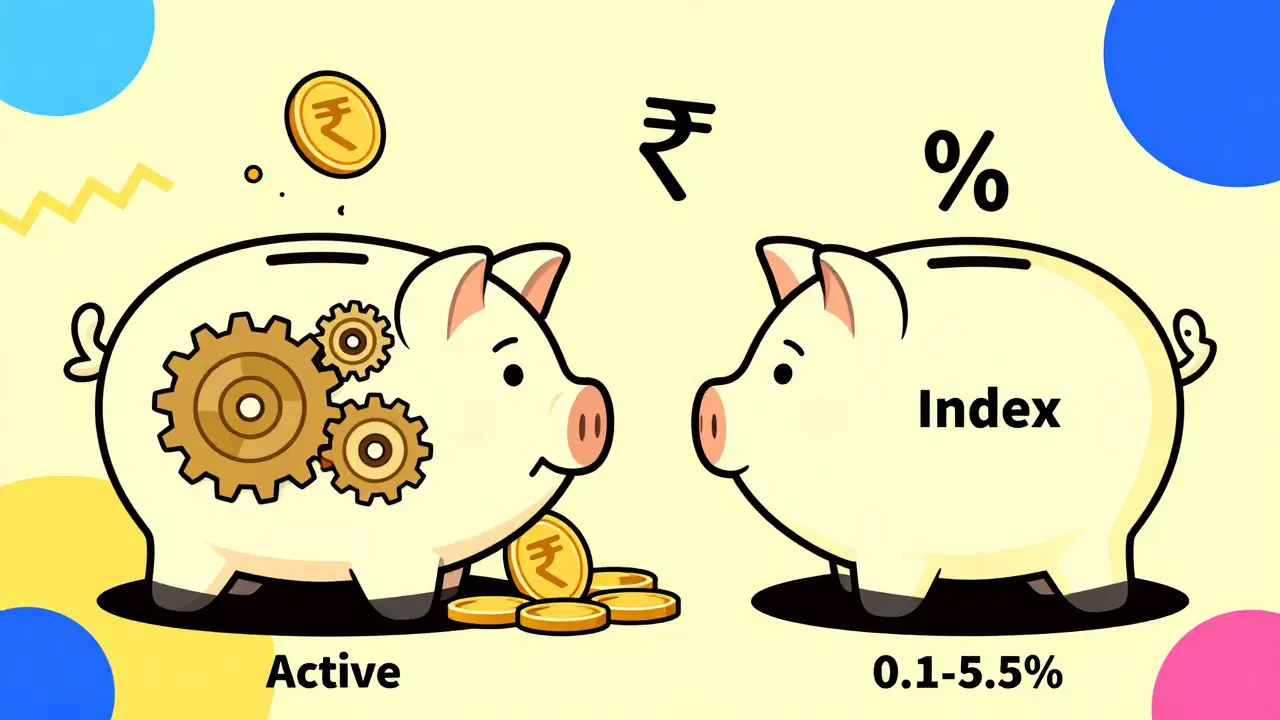
Active funds are expensive. The average expense ratio for an equity active fund in India hovers around 1.5% to 2.0%. This covers the salaries of research teams, marketing costs, and administrative overhead. Index funds, on the other hand, have minimal operational needs. Their expense ratios typically range from 0.1% to 0.5%. Some even offer zero-expense options for direct plans.
| Feature | Active Equity Fund | Nifty 50 Index Fund |
|---|---|---|
| Average Expense Ratio | 1.5% - 2.0% | 0.1% - 0.5% |
| Management Style | Discretionary Stock Picking | Passive Replication |
| Turnover Ratio | High (30% - 60%) | Low (< 10%) |
| Impact on Returns | Significant drag | Negligible drag |
Let’s put this in perspective. If you invest ₹1 lakh for 20 years and the market returns 12% annually, a 1.5% fee difference can cost you lakhs in absolute terms. That is not just a number on a screen; that is a down payment on a house or a year of college tuition disappearing into management fees.
Understanding Tracking Error: The Silent Risk
You might hear the term "tracking error" and assume it sounds bad. It isn’t necessarily. Tracking error measures how closely an index fund follows its benchmark. A low tracking error (e.g., 0.5%) means the fund is doing its job perfectly-it’s moving almost exactly with the index. A high tracking error suggests the fund manager is deviating from the index, perhaps due to cash holdings or replication issues.
For an investor, low tracking error is usually good because it means predictability. However, if the tracking error is negative (the fund consistently underperforms the index), that is a red flag. It indicates inefficiency. In India, top-tier index funds from providers like HDFC, ICICI Prudential, and UTI have mastered this art, keeping tracking errors below 1% annually. When choosing an index fund, check this metric. If it’s creeping up above 2%, ask yourself if the cost is worth the deviation.
Performance: The Data Doesn’t Lie
Here is the uncomfortable truth for active managers: most of them fail to beat their benchmarks over the long term. According to data from the Association of Mutual Funds in India (AMFI) and various independent studies, over a 10-year period, nearly 80-90% of active large-cap funds in India have underperformed the Nifty 50 TR (Total Return Index).
Why? Because the Indian market has become more efficient. Information travels fast. Retail participation is at an all-time high. It is harder to find hidden gems that everyone else misses. Meanwhile, index funds capture the full market return without the drag of high fees and frequent trading losses.
However, there is a nuance. In mid-cap and small-cap segments, active funds have historically had a better chance of outperforming. These markets are less researched, less liquid, and more volatile. A skilled manager can add value here by avoiding junk companies and navigating liquidity crunches. But even here, the gap is narrowing. As of 2025, several index funds focused on Nifty Midcap 150 and Smallcap 250 have started showing competitive results, especially when adjusted for risk.
Tax Implications: The 2023 Shift
Investment decisions in India are heavily influenced by taxation. The budget changes in February 2023 altered the landscape significantly. Previously, equity mutual fund gains held for more than one year were taxed at 10% without indexation. Now, the Long Term Capital Gains (LTCG) tax rate is 12.5% for gains exceeding ₹1.25 lakh per financial year. Short-term gains are taxed at 20%.
Does this change the index vs. active debate? Not really. Both equity-oriented index funds and active funds fall under the same tax regime. Since index funds generally have lower turnover, they might trigger fewer short-term capital gains events during rebalancing, but for the end investor, the tax treatment is identical. Don’t let tax myths steer you away from low-cost options.
When to Choose Which?
So, which one do you pick? It depends on your profile and the specific market segment.
- Choose Index Funds if: You are investing in large-cap or broad-market indices (like Nifty 50, Nifty Next 50). You want transparency, low costs, and consistent market-matching returns. You don’t have time to analyze fund manager consistency.
- Choose Active Funds if: You are looking at mid-cap, small-cap, or thematic sectors (like IT, Pharma, Infrastructure). You believe a specific manager has a proven edge in navigating volatility. You are willing to pay higher fees for the possibility of alpha.
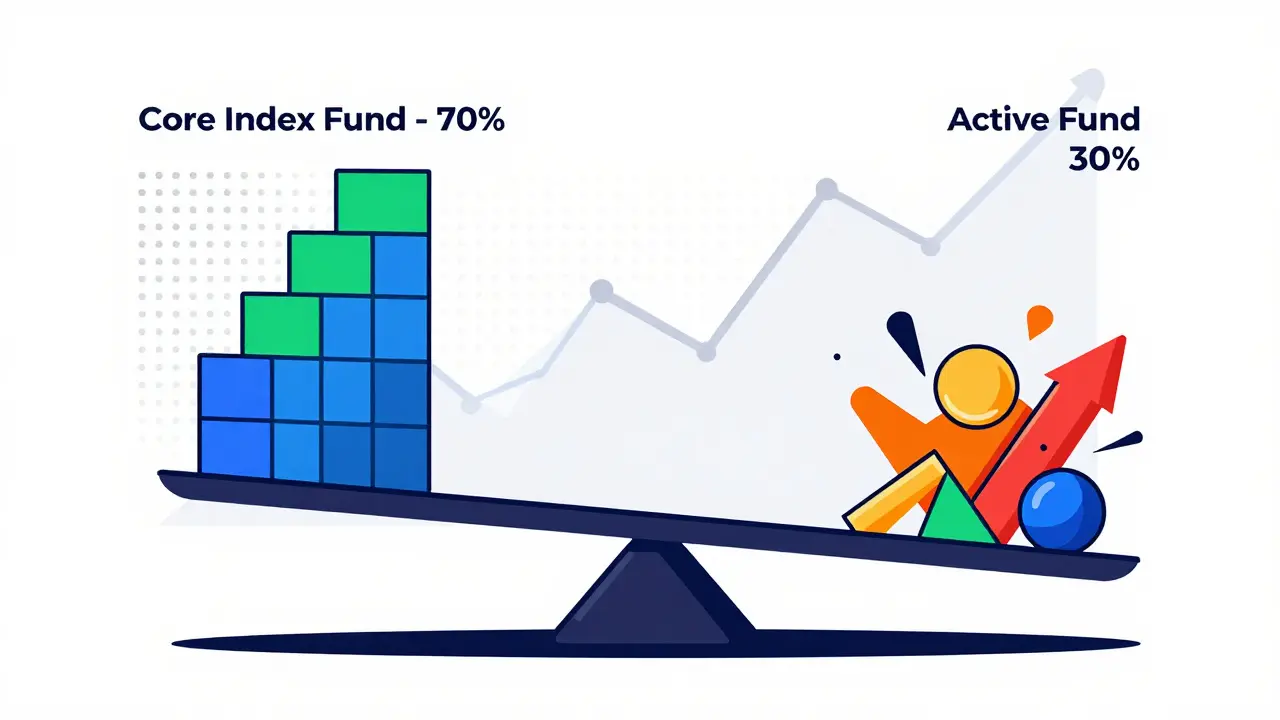
A balanced portfolio often uses both. You might keep 70% of your equity allocation in low-cost index funds for stability and market exposure, and 30% in carefully selected active funds for potential outperformance. This hybrid approach gives you the best of both worlds: low baseline costs and targeted growth opportunities.
Common Pitfalls to Avoid
Even smart investors make mistakes. Here are three traps to watch out for:
- Past Performance Chasing: Just because an active fund topped the charts last year doesn’t mean it will do so again. Styles rotate. Managers leave. Stick to process, not past glory.
- Ignoring Exit Loads: Some active funds have high exit loads if you redeem within a year. Check these before buying. Index funds usually have lower or no exit loads after a short period.
- Mixing Direct and Regular Plans: Always choose the Direct plan unless you have a specific reason to use a distributor. Regular plans include commissions that eat into your returns, adding another layer of cost on top of the already higher active fees.
Final Thoughts
Investing is not about finding the perfect product. It’s about minimizing regret. High fees are a guaranteed regret. Underperformance is a probable one. Index funds offer a simple, cheap, and effective way to participate in India’s economic growth. Active funds require skill, patience, and luck. For most retail investors, starting with a core of index funds and sprinkling in active bets only where justified is the wisest path forward.
Are index funds safer than active funds?
Not necessarily safer, but more predictable. Index funds hold a diversified basket of stocks, reducing single-stock risk. Active funds can concentrate bets, leading to higher volatility-both up and down. Index funds match market risk; active funds add manager-specific risk.
What is the ideal asset allocation for a beginner in India?
A common rule is age-based. Subtract your age from 100 to get the percentage in equities. For a 30-year-old, that’s 70% equity, 30% debt. Within equity, start with 80% index funds (Nifty 50) and 20% active mid/small cap funds.
Can I switch from an active fund to an index fund?
Yes, but be mindful of taxes. If you redeem an active fund held for less than a year, you pay 20% STCG tax. If held longer, LTCG rules apply. Switching involves selling the old unit and buying the new one, triggering tax events. Plan accordingly.
Which index is best for beginners in India?
The Nifty 50 is the gold standard for beginners. It represents the top 50 companies by market cap, offering stability and broad exposure. Nifty Next 50 is also popular for slightly higher growth potential but comes with more volatility.
Do index funds pay dividends?
Yes, if the underlying stocks pay dividends. You can choose a Dividend Distribution Plan (DDP) option, though experts recommend the Growth option for tax efficiency and compounding benefits. Reinvesting dividends manually or letting them grow internally yields better long-term results.