
Institutional Cold Storage: Custody Controls and Physical Security for Crypto
 Jun, 28 2026
Imagine holding billions of dollars in assets that exist only as lines of code. Now imagine the keys to those assets sitting on a laptop connected to Wi-Fi. That is the nightmare scenario that institutional investors work tirelessly to avoid. For large funds, pension plans, and corporate treasuries, keeping cryptocurrency safe isn't just about buying a USB drive; it is about building a fortress. This is where institutional cold storage comes in.
We are no longer in the Wild West days of crypto. We have entered what industry analysts call the 'Custody 2.0' era. In this new landscape, security is not an optional feature-it is the entire product. The difference between a retail user storing Bitcoin on their phone and a bank holding digital assets for clients is massive. It involves hardened bunkers, multi-person authorization protocols, and strict adherence to evolving government regulations. If you are looking to understand how institutions protect these volatile assets, you need to look at the intersection of cryptography, physical security, and law.
The Core Principle: Air-Gapped Security
At its simplest, cold storage means keeping private keys offline. But for institutions, 'offline' has a very specific technical definition. It means the hardware containing the cryptographic keys never touches an internet-connected device during the signing process. This is often referred to as being 'air-gapped.'
Consider the role of Hardware Security Modules (HSMs). These are specialized devices designed to safeguard and manage digital keys for strong authentication. Unlike a standard computer, an HSM prevents unauthorized access even if someone physically steals the device. According to technical documentation from providers like Gemini, these modules maintain keys in perpetuity without allowing copies to be made. You cannot simply plug an HSM into a laptop and extract the key file. The math happens inside the secure chip, and only the transaction signature exits the device.
This approach eliminates the biggest threat vector: remote hacking. When keys are online (hot storage), they are vulnerable to malware, phishing attacks, and server breaches. By moving to cold storage, institutions accept a trade-off. They sacrifice speed for safety. A hot wallet can execute a trade in seconds. A cold storage system might take two to four hours to generate, sign, and broadcast a transaction. For long-term holders, this delay is a small price to pay for reducing the probability of a successful breach to less than 0.05%, according to State Street's 2025 analysis.
Physical Fortresses and Access Protocols
Cryptography is only half the battle. What happens when someone tries to break down the door? Institutional custodians treat physical security with the same rigor as cybersecurity. Fidelity Digital Assets, for example, operates hardened room structures staffed by 24/7 on-site security personnel. These aren't just office buildings; they are facilities designed to withstand natural disasters and physical intrusion.
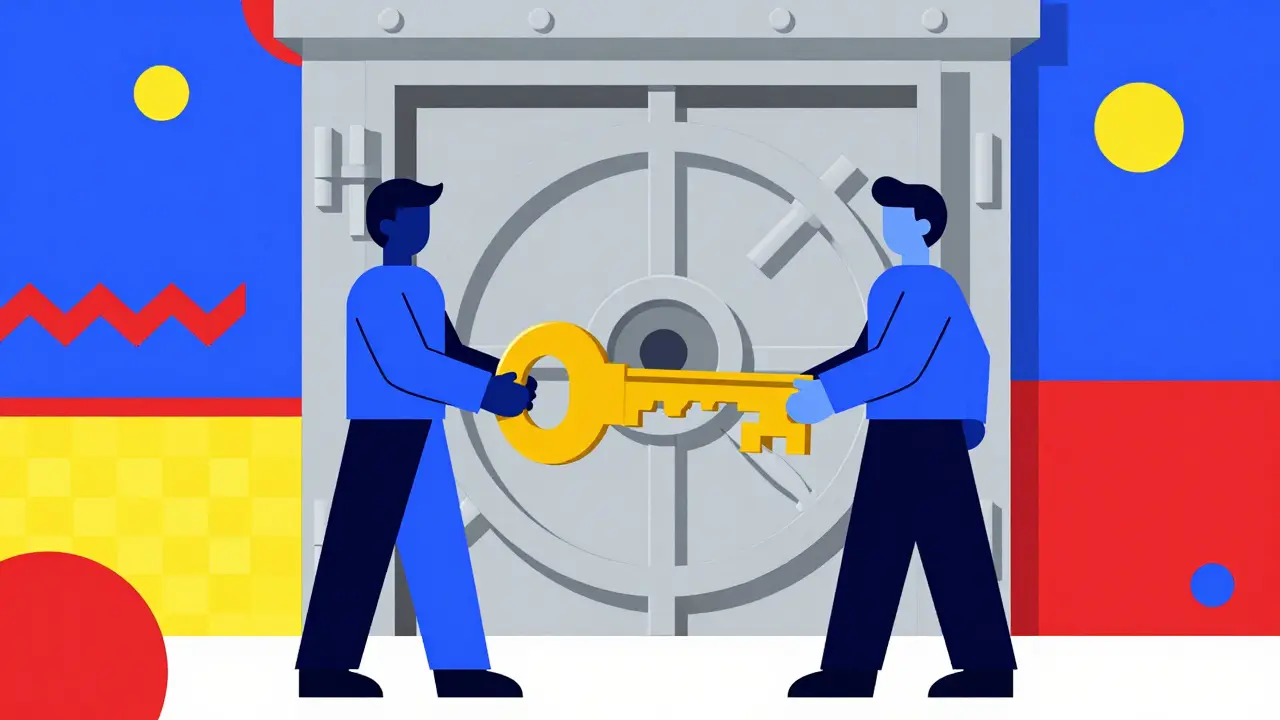
A critical component here is the 'dual-control' principle. No single individual ever has full access to the assets. To authorize a withdrawal or interact with the storage hardware, at least two authorized individuals must be present simultaneously. This prevents insider fraud. Even if one employee is bribed or coerced, they cannot move funds alone. Biometric scanners, retina checks, and multi-factor authentication systems add layers of verification before anyone even steps foot in the server room.
Geographic distribution is another key strategy. Institutions don't keep all their eggs in one basket. They use geographically dispersed storage locations with redundant backup sites. If a hurricane hits New York, the assets stored in a bunker in Zurich remain accessible. This redundancy was proven vital during the March 2024 incident where a regional power outage disabled a European custodian’s primary facility for 11 hours. Because of failover protocols and secondary sites, no assets were lost, though access was temporarily delayed.
| Feature | Exchange-Based Custody | Dedicated Institutional Custody |
|---|---|---|
| Security Model | Partially cold, high risk concentration | Fully air-gapped, segregated assets |
| Asset Segregation | Omnibus (mixed with other users) | Book-and-record level separation |
| Cost (Annual) | Low (often free with trading volume) | 0.10% - 0.45% of Assets Under Custody |
| Regulatory Oversight | Variable, often lighter | Strict (SOC 2 Type II, SEC/FDIC compliant) |
| Transaction Speed | Near-instantaneous | 2-4 hours due to dual-control checks |
Regulatory Landscape: The New Rules of Engagement
In 2025, the regulatory environment for crypto custody shifted dramatically. The U.S. Securities and Exchange Commission (SEC) established Special Purpose Broker-Dealer (SPBD) regulations, which finally opened the door for traditional broker-dealers to offer crypto custody services. Simultaneously, the Office of the Comptroller of the Currency (OCC) clarified that national banks could hold digital assets without needing prior special approval. This was a watershed moment.
These changes didn't lower the bar; they raised it. The FDIC issued an interagency statement specifying that banking organizations must demonstrate that 'no other party-including the customer-has access to information sufficient to unilaterally transfer the crypto-asset.' This means the custodian must have absolute control over the keys, yet also provide transparent audit trails. It sounds contradictory, but it ensures that neither the bank nor the client can steal from the other without detection.
Internationally, standards are tightening too. In Switzerland, the Anti-Money Laundering Act mandates strict Know Your Customer (KYC) obligations and adherence to the FATF Travel Rule for all crypto custodians. Auditors now play a crucial role. PwC’s June 2025 report highlights that auditors must verify that only approved employees can initiate sales and often participate in 'key ceremonies'-the ritualistic generation of private keys-to ensure procedural integrity.
Choosing the Right Custodian: Costs and Trade-offs
Not all custodians are created equal. The market has segmented into three main tiers: pure-play crypto custodians (like BitGo and Fireblocks), traditional financial institutions (like Fidelity and State Street), and exchanges (like Coinbase Prime).
Pure-play custodians often charge between 0.10% and 0.25% annually based on assets under custody (AUC), with minimum account sizes usually starting at $1 million. They specialize in crypto-specific workflows and offer faster integration with blockchain networks. Traditional banks command a premium, charging 0.30% to 0.45%, but they offer seamless integration with existing treasury management systems. For a corporation already using State Street for its equity portfolio, adding crypto to the same dashboard simplifies reporting significantly.
Exchanges sit in a tricky spot. While convenient for traders, they pose higher risks. The collapse of FTX in November 2022, which involved approximately $600 million in missing funds, demonstrated the danger of conflating trading and custody functions. State Street’s Michael Venuto criticized exchange models for lacking proper segregation. Most institutional clients now view exchange custody as suitable only for short-term trading capital, not for long-term balance sheet holdings.
Implementation is also complex. Onboarding typically takes 4 to 8 weeks. It involves legal agreements, technical API integrations, and staff training. A May 2025 survey found that 68% of institutions required custom API development to connect the custodian to their internal systems, averaging $125,000 in integration costs. Staff members often need Certified Cryptocurrency Security Professional (CCSP) certification to manage these relationships effectively.

Real-World Performance and User Feedback
How does this work in practice? Institutional feedback reveals a consistent pattern: praise for security, frustration with bureaucracy. On investment forums, users report zero security incidents with major custodians like BitGo, even amid targeted phishing campaigns. However, the operational friction is real. During the March 2025 Bitcoin ETF approval surge, some traders missed opportunities because the 4-hour transaction processing time prevented them from reacting quickly to market volatility.
Trustpilot reviews for Fidelity Digital Assets highlight 'impeccable security protocols' but note 'bureaucratic hurdles for emergency transactions.' Similarly, Gemini receives high marks for integration but criticism for rigid access protocols. The lesson here is clear: cold storage is designed for stability, not agility. If your strategy requires rapid entry and exit, cold storage may hinder performance. If your goal is preservation of capital over years, it is indispensable.
Future Outlook: Bank-Grade Standards Become Norm
The trajectory is clear. Gartner predicts that by 2027, 85% of institutional digital asset custody will utilize bank-grade frameworks with integrated physical and cryptographic controls. Standalone exchange custody solutions are expected to disappear from institutional portfolios entirely. As regulatory clarity improves and technology matures, the distinction between traditional securities custody and crypto custody will blur. We are moving toward a unified platform where stocks, bonds, and tokens are managed under the same rigorous security umbrella.
For institutions, the choice is no longer whether to use cold storage, but how to implement it most efficiently. The winners will be those who balance robust security with streamlined operations, ensuring that while the keys are locked away safely, the business can still move when it matters.
What is the difference between hot and cold storage for institutions?
Hot storage keeps private keys online, allowing for instant transactions but exposing assets to cyber threats like hacking and malware. Cold storage keeps keys offline in air-gapped hardware, such as Hardware Security Modules (HSMs). While cold storage introduces delays of 2-4 hours for transactions, it reduces the risk of external breaches to less than 0.05%, making it the standard for long-term institutional holding.
How much does institutional crypto custody cost?
Costs vary by provider type. Pure-play crypto custodians typically charge 0.10% to 0.25% annually based on assets under custody (AUC). Traditional banks and integrated financial institutions charge a premium of 0.30% to 0.45%. Minimum account sizes are usually around $1 million. Additional costs include implementation fees, which can average $125,000 for custom API integrations.
What are the key regulatory requirements for crypto custody in 2025?
Key regulations include the SEC's Special Purpose Broker-Dealer (SPBD) framework, which sets minimum standards for asset segregation and insurance. The FDIC requires proof that no single party can unilaterally transfer assets. Additionally, SOC 2 Type II compliance is mandatory for most providers, requiring quarterly third-party audits and rigorous business continuity planning.
Why is dual-control important in cold storage?
Dual-control requires at least two authorized individuals to approve any transaction or access the storage hardware. This prevents insider fraud, ensuring that even if one employee is compromised or acts maliciously, they cannot move funds alone. It is a fundamental layer of both physical and procedural security.
Is exchange-based custody safe for institutional assets?
Generally, no. Exchange-based custody poses higher risks due to the conflation of trading and custody functions, as seen in the FTX collapse. Institutions are advised to use dedicated custodians or bank-integrated solutions that offer book-and-record level asset segregation and independent verification, rather than relying on exchanges for long-term storage.