
L2 Tokenomics: How Fees, Revenue, and User Incentives Drive Layer 2 Blockchain Economics
 Mar, 20 2026
When you send a transaction on Ethereum, you pay gas fees. But what if you could send that same transaction for 10x less - and still have it secured by Ethereum? That’s the promise of Layer 2 (L2) networks like Arbitrum and Optimism. But behind the scenes, there’s a hidden economic engine driving these systems: L2 tokenomics. It’s not just about cheaper fees. It’s about who gets paid, how profits are split, and why tokens like ARB and OP might one day earn real revenue - not just speculation.
How L2 Fees Actually Work
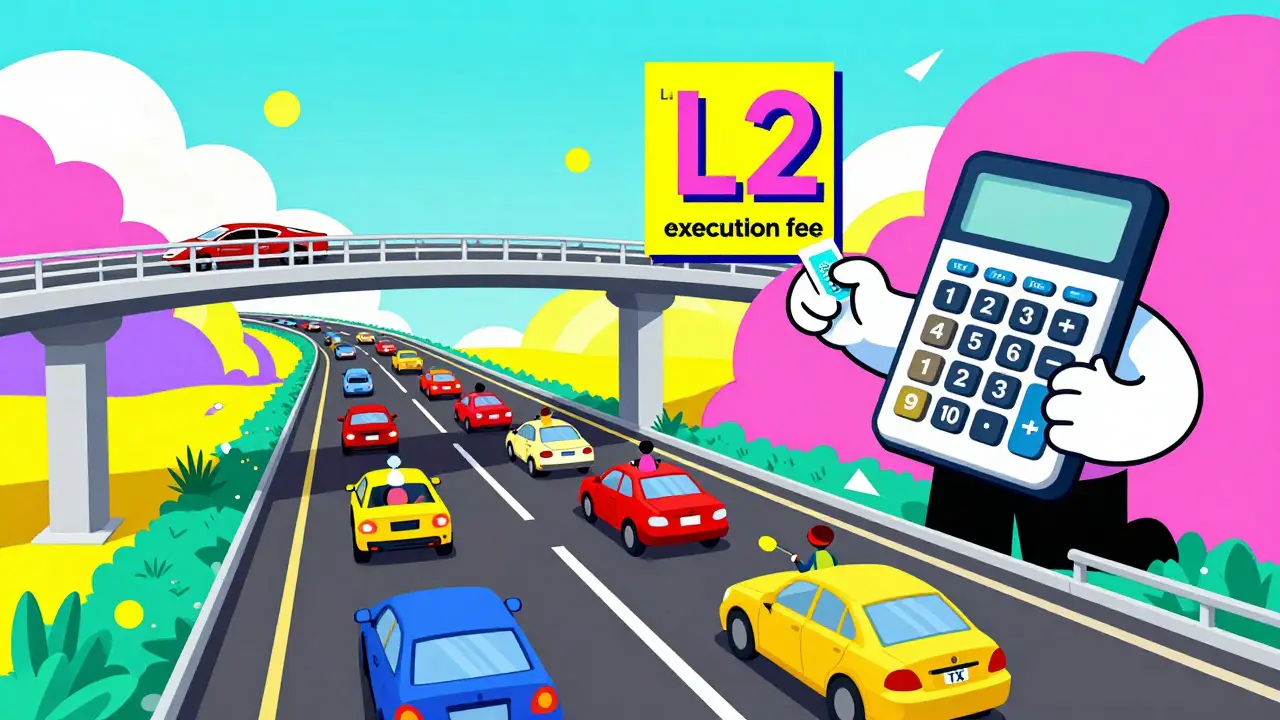
Layer 2 networks don’t create their own blockchain from scratch. They ride on top of Ethereum. Think of them like a high-speed express lane built on top of a busy highway. You pay to use the express lane, but the highway still needs to be maintained. That’s the core of L2 economics.
Every transaction on an L2 has two costs:
- L2 execution fee: This covers the computational work done on the Layer 2 network itself - like running a smart contract or moving tokens. It’s similar to Ethereum’s gas fee, but much cheaper because the network is optimized for speed and efficiency.
- L1 rollup fee: This is the real kicker. Even though your transaction happens on the L2, the network must prove to Ethereum that everything was done correctly. To do that, it publishes a compressed batch of transaction data back to Ethereum. This publishing cost is what makes up 80-90% of your total fee right now.
The formula looks like this: L2 Fees = L1_gas_price × (data size + buffer) + L2_gas_price × gas_used. So if Ethereum’s gas price spikes, your L2 fee spikes - even if you never touched Ethereum directly. That’s why L2s are stuck in a strange position: they’re supposed to save you money, but they’re still at the mercy of Ethereum’s volatility.
Who Makes Money on L2s?
Right now, the profits from L2 networks aren’t going to users or token holders. They’re going to a handful of centralized operators - the sequencers.
Sequencers are the engines behind L2s. They collect transactions from users, bundle them up, and send them to Ethereum. In return, they earn the difference between what users pay and what it costs to publish data on Ethereum. This difference is called the fee scalar. Optimism, for example, targets a 10% profit margin on every transaction. That might sound small, but when you’re handling millions of transactions a day, it adds up fast.
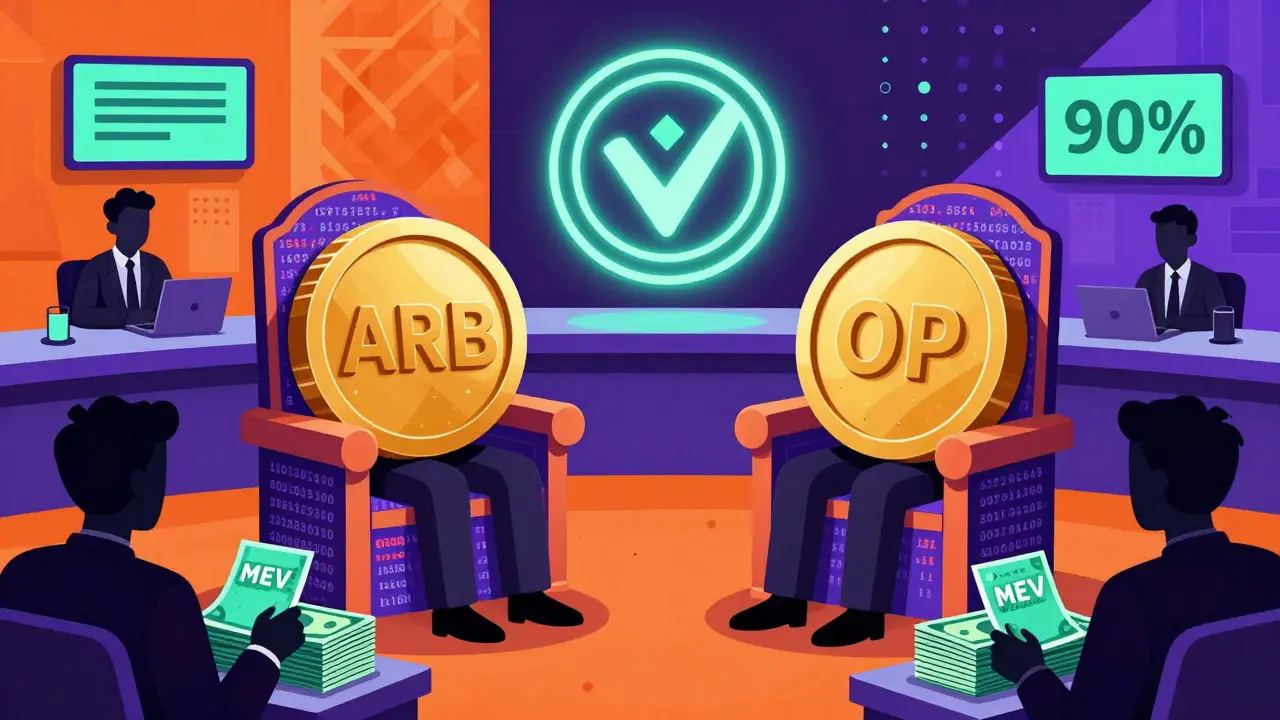
There’s another source of revenue: Maximal Extractable Value (MEV). Sequencers can reorder transactions in their blocks to profit from arbitrage opportunities - like front-running trades on decentralized exchanges. Right now, all of this MEV goes straight to the sequencer operators. For Arbitrum and Optimism, that means the Arbitrum Foundation and Optimism Foundation are quietly sitting on millions in profits.
Here’s the problem: users aren’t seeing any of this. The tokens - ARB and OP - currently only give you voting rights. You can vote on protocol upgrades, but you don’t get a cut of the fees. That’s why many experts call today’s L2 tokenomics a “governance-only” model. It’s not really value accrual. It’s more like a promise.
The Big Change Coming: EIP-4844
Everything changes with Ethereum’s EIP-4844 - also known as proto-danksharding. This upgrade, expected to go live in late 2026, will radically lower the cost of publishing data to Ethereum.
Right now, sequencers use Ethereum’s expensive calldata to post transaction batches. EIP-4844 introduces a new type of data blob that’s 10 to 100 times cheaper to publish. That means the L1 rollup fee - the biggest chunk of your L2 cost - could drop by over 90%.
Here’s what that means in real numbers: if transaction volume grows by 40% and protocols pass along 90% of the savings to users, one analysis suggests ARB could hit $2.10. That’s not speculation - it’s a direct economic link between lower Ethereum costs and higher token value.
But here’s the catch: if L2s keep all the savings for themselves, users won’t see the benefit. If they pass it on, their profit margins shrink. That’s the tension at the heart of L2 economics. The smartest protocols will find a balance - lowering fees enough to attract more users, while keeping enough to fund development and reward token holders.
How L2 Tokens Could Start Earning Real Revenue
The real future of L2 tokenomics isn’t about voting. It’s about revenue sharing.
Imagine a future where:
- Sequencers are no longer controlled by a single foundation. Instead, hundreds of independent operators compete to build blocks.
- To become a sequencer, you must stake ARB or OP tokens.
- You earn a share of transaction fees and MEV based on how much you staked and how reliably you performed.
This isn’t science fiction. Both Arbitrum and Optimism have said they’re working toward this. It’s called decentralized sequencing. And when it happens, L2 tokens stop being governance tokens - they become revenue-generating assets.
Think of it like Uniswap’s fee switch. In 2023, Uniswap voted to redirect a portion of trading fees to UNI holders. L2s could do the same. A simple governance vote could redirect 50% of sequencer profits to token stakers. That would turn ARB and OP from speculative assets into income-generating investments.
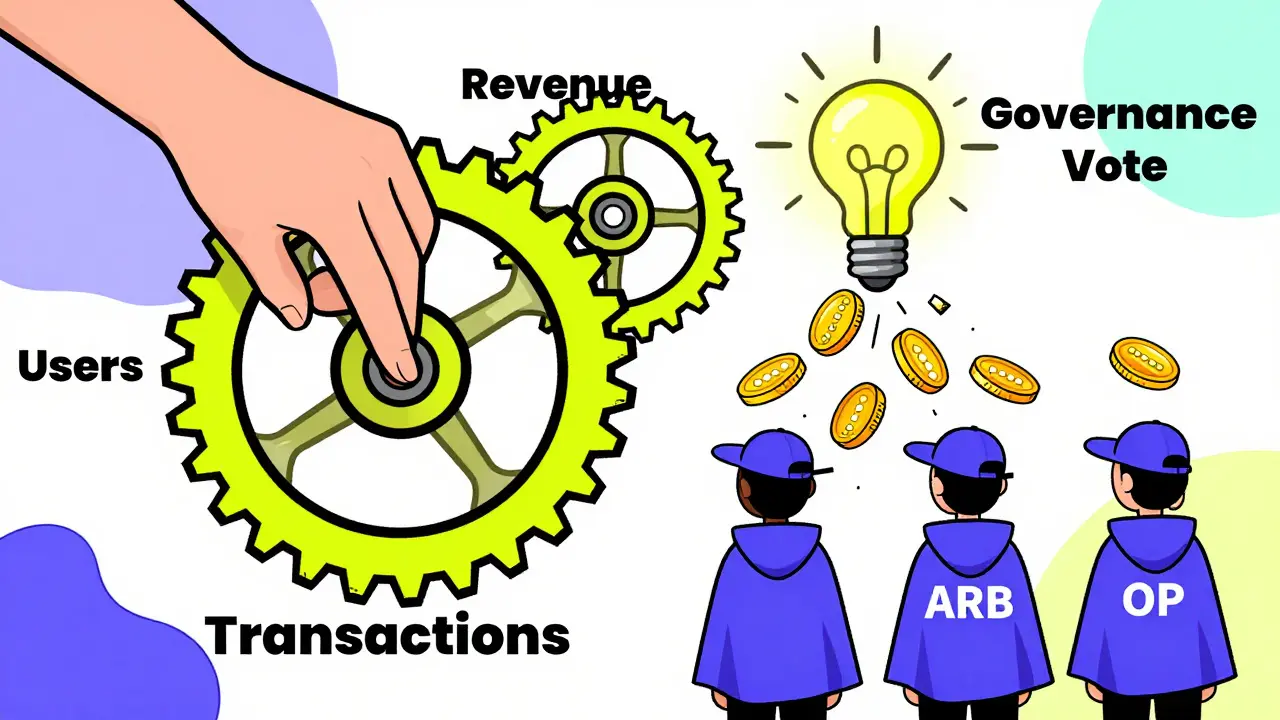
And it’s not just about fees. As more apps build on L2s, network effects kick in. More users → more transactions → more revenue → more demand for the token. It’s a flywheel. The more successful the L2 becomes, the more value its token captures - not because it’s scarce, but because it’s useful.
Why This Matters for You
If you’re using Arbitrum or Optimism right now, you’re already benefiting from lower fees. But you’re not sharing in the upside. That’s changing.
Here’s what to watch for in the next 12-18 months:
- Fee switch proposals: Look for governance votes that redirect sequencer profits to token holders.
- Decentralized sequencer rollouts: If you see multiple independent sequencers running on Arbitrum or Optimism, that’s a major milestone.
- MEV redistribution: If protocols start auctioning off MEV opportunities to stakers, that’s a sign they’re serious about value accrual.
Don’t just hold ARB or OP because you think it’ll go up. Hold it because you believe the network will start paying you - not just giving you a vote.
What’s Holding L2s Back?
There’s one big obstacle: Ethereum’s monetary policy.
Unlike traditional companies, L2s can’t just raise prices to cover costs. They’re forced to pay Ethereum in ETH. If Ethereum’s gas fees rise, L2s have to raise fees - or eat the loss. That makes profitability unstable.
And Ethereum itself isn’t profitable right now. Validator rewards cost more than gas fees bring in. So Ethereum is essentially subsidizing Layer 2s. That’s not a long-term model.
The only way L2s become truly independent is if they capture enough value from their own ecosystems - through fees, MEV, and user adoption - to fund their own security and growth. That’s the ultimate goal. And it’s why tokenomics isn’t just a side topic. It’s the make-or-break factor for Layer 2s.
Final Thought: Tokenomics Is the Next Frontier
Layer 2s solved the scaling problem. Now they need to solve the incentive problem.
The best blockchains don’t just move data - they create value for everyone involved. Right now, L2s are giving users cheaper transactions. The next step is giving them a stake in the system.
When that happens, you won’t just be using Arbitrum or Optimism. You’ll be invested in them. And that’s when L2 tokenomics becomes something real - not just theory, but a working economic engine that rewards participation, not just speculation.