
Last-Minute Tax Saving in India: Best 80C Options Before March 31
 Mar, 24 2026
It’s March 24, 2026. You just checked your bank account and realized you haven’t made any tax-saving investments this financial year. Your salary slip shows you’ve paid more than ₹50,000 in taxes already. You still have seven days to cut that bill - and Section 80C is your best shot.
What Is Section 80C and Why Does It Matter?
Section 80C of the Indian Income Tax Act lets you reduce your taxable income by up to ₹1.5 lakh per year. That’s not a deduction on your tax - it’s a reduction in the amount you’re taxed on. If you’re in the 30% tax bracket, that ₹1.5 lakh cut saves you ₹45,000 in taxes. And you still get your money back - just in a different form.
The catch? You have to invest in specific instruments approved by the government. And most people wait too long. By March 20, over 60% of 80C investments are made, according to data from the National Securities Depository Limited (NSDL). You’re not late - you’re in the final window.
Best 80C Options Left Before March 31
Not all 80C options are created equal. Some lock your money for 15 years. Others give you quick access. Here are the eight best options you can still use - ranked by speed, safety, and return.
1. Public Provident Fund (PPF)
PPF is still the gold standard. It offers 7.1% interest (as of Q1 2026), tax-free growth, and full exemption under 80C. You can open a PPF account at any post office or bank. The minimum deposit is ₹500. The maximum? ₹1.5 lakh.
Here’s the trick: deposit the full ₹1.5 lakh by March 31. Even if you’re late, the bank will accept it - as long as the transaction clears before midnight. You’ll get the full deduction for FY 2025-26. Your money stays locked for 15 years, but you can withdraw partial amounts after year 7.
2. Employee Provident Fund (EPF)
If you’re salaried, your employer already deducts 12% of your basic salary for EPF. But here’s the secret: you can make voluntary contributions on top. That extra amount counts toward your ₹1.5 lakh limit.
For example, if your monthly EPF contribution is ₹8,000, you’ve already used ₹96,000 this year. You can still add ₹54,000 more before March 31. Just ask your HR to process a one-time voluntary deposit. It’s processed within 48 hours. No paperwork. No delays.
3. Tax-Saving Fixed Deposits (FDs)
These are special FDs with a 5-year lock-in. Banks like SBI, HDFC, and ICICI offer them at 6.5% to 6.8% interest. You can open one in under 10 minutes online. Deposit ₹1.5 lakh now, and you’ll get the full deduction.
Unlike regular FDs, you can’t break this early. But if you don’t need the cash, it’s safe, simple, and gives you a guaranteed return. No market risk. No surprises.
4. National Savings Certificate (NSC)
NSC is a government-backed savings bond. You can buy it at any post office. Current rate: 6.8% (compounded annually). The maturity period is 5 years. Minimum investment: ₹1,000. No upper limit.
It’s not the highest return, but it’s 100% secure. And since it’s sold in post offices, you can walk in tomorrow, pay with cash or card, and get your receipt instantly. It counts toward 80C the moment you pay.
5. Life Insurance Premiums
If you don’t have life insurance, now’s the time. Any policy with a term of at least 10 years qualifies. Premiums paid toward term plans, ULIPs, or endowment policies count under 80C - up to ₹1.5 lakh total.
Don’t buy a whole life policy. Just get a basic term plan. A ₹50 lakh cover for 25 years costs under ₹10,000/year. Pay ₹50,000 now - it’s fully deductible. You’ll get a policy number and premium receipt immediately. No waiting.
6. Sukanya Samriddhi Yojana (SSY)
SSY is for parents of girls under 10. If you have a daughter, you can open an SSY account in her name. Interest rate: 7.6% (as of 2026). You can deposit up to ₹1.5 lakh per year. The account locks for 21 years - but you can withdraw partial amounts after 18 for education.
If you qualify, this is the best return on 80C. Even if you’re late, you can still open the account and deposit the full amount. Just bring your daughter’s birth certificate and your ID. Done in one visit.
7. Equity-Linked Savings Scheme (ELSS)
ELSS mutual funds are the only 80C option with market-linked returns. They lock in for 3 years - the shortest lock-in of all 80C instruments. Returns average 10-12% over 5 years.
Many fund houses allow lump-sum investments until March 31. If you invest by 3 PM on March 31, you’ll get the day’s NAV. Platforms like Groww, Zerodha, and Paytm Money process this instantly. You’ll get your 80C receipt via email within minutes.
Best for: People who can handle some risk and want higher returns. Don’t panic if markets dip. Hold for 3 years. You’ll beat inflation.
8. Tuition Fees for Children
This one is often forgotten. You can claim up to ₹1.5 lakh for tuition fees paid to any recognized Indian school or university. Only for two children. No limit per child.
If you paid ₹40,000 in fees this year, you can pay another ₹1.1 lakh before March 31. Pay for next year’s fees now. Get a receipt. Submit it with your tax return. No lock-in. No risk. Just paperwork.

What Not to Do
Don’t buy gold. Don’t buy real estate. Don’t invest in non-80C mutual funds. None of these qualify.
Don’t wait until the last hour. Banks and mutual fund platforms get flooded on March 30-31. Transactions may delay. Settle by March 28 if you can.
Don’t invest more than ₹1.5 lakh. The excess won’t count. Track your total: EPF + PPF + FDs + Insurance + Fees = your total 80C claim.
How to Track Your 80C Usage
Use this simple formula:
- EPF (employee + voluntary): ₹______
- PPF deposit: ₹______
- Tax-saving FD: ₹______
- NSC: ₹______
- Life insurance premiums: ₹______
- SSY: ₹______
- ELSS: ₹______
- Tuition fees: ₹______
Add them up. If you’re under ₹1.5 lakh, pick the fastest option from above. If you’re over, stop. You’re done.
What Happens After March 31?
After March 31, the financial year closes. You can’t go back. The tax department doesn’t allow retroactive claims.
But here’s the good part: once you invest, you don’t need to do anything else. Your employer’s payroll team will update your Form 16. If you file your own return, keep receipts. The government doesn’t ask for proof upfront - but they can ask later. Keep everything for 6 years.
Pro Tip: Combine Two Options
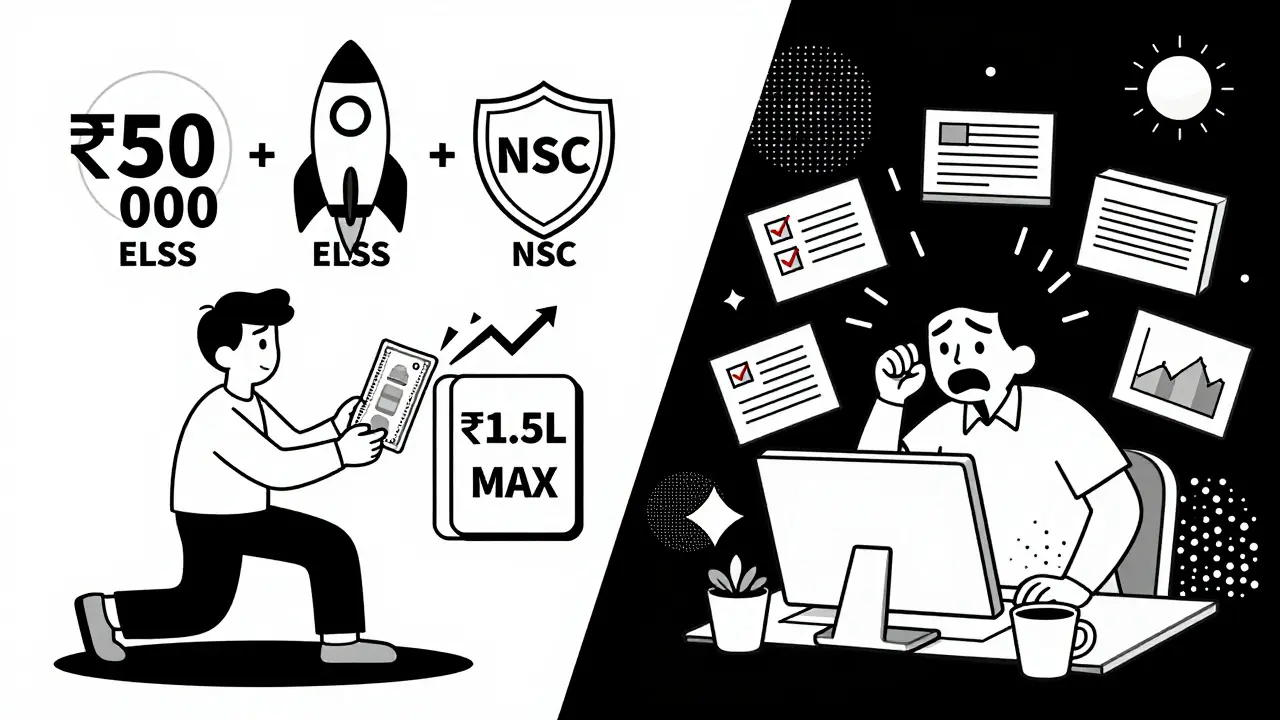
If you’ve used ₹1 lakh already, don’t just pick one option. Split the remaining ₹50,000. Put ₹30,000 in ELSS for growth. Put ₹20,000 in NSC for safety. You reduce risk. You maximize returns. You sleep better.
And if you’re unsure? Go with PPF. It’s simple. It’s safe. It’s guaranteed. You can’t go wrong.
Can I claim 80C deduction if I’m self-employed?
Yes. Self-employed individuals can claim Section 80C deductions by investing in PPF, NSC, tax-saving FDs, life insurance, ELSS, or tuition fees. You don’t need an employer to process it. Just keep your investment receipts and claim them while filing your income tax return.
Is it too late to invest in ELSS on March 30?
No. Most mutual fund platforms allow investments until 3 PM on March 31. The cut-off is based on the date the transaction is processed, not when you click ‘pay’. If you invest by 3 PM, you’ll get the day’s NAV and qualify for the full deduction. Don’t wait until midnight - systems get overloaded.
Can I invest ₹1.5 lakh in multiple 80C options?
Yes. The ₹1.5 lakh limit is cumulative across all 80C instruments. You can split it - say ₹50,000 in PPF, ₹40,000 in ELSS, ₹30,000 in insurance, and ₹30,000 in tuition fees. As long as the total doesn’t exceed ₹1.5 lakh, you’re eligible for the full deduction.
Do I need to submit proof to my employer?
If you’re salaried, yes - you must submit investment proofs to your HR before March 15 to adjust your TDS. But if you miss that, you can still claim the deduction while filing your ITR. Keep all receipts, bank statements, and policy documents. The tax department will accept them during assessment.
What if I invest ₹2 lakh in PPF?
Only ₹1.5 lakh will count toward 80C. The extra ₹50,000 will earn interest and grow tax-free, but you won’t get a tax deduction on it. The limit is strict. Don’t over-invest hoping for more benefit - you’ll just lock more money without extra savings.