
Layer 3 Solutions: How Appchains Scale Layer 2 Blockchains
 May, 13 2026
Blockchain scaling is no longer just about making transactions faster on the mainnet. We have moved past the era where Layer 1 upgrades were enough, and even Layer 2 rollups are hitting their own limits for specialized applications. Enter Layer 3 solutions, which are specialized blockchains built on top of Layer 2 networks to provide dedicated block space and extreme cost reduction for specific use cases. If you are building a high-frequency trading bot, a complex gaming ecosystem, or a private enterprise ledger, Layer 3 offers the customization that general-purpose chains simply cannot match.
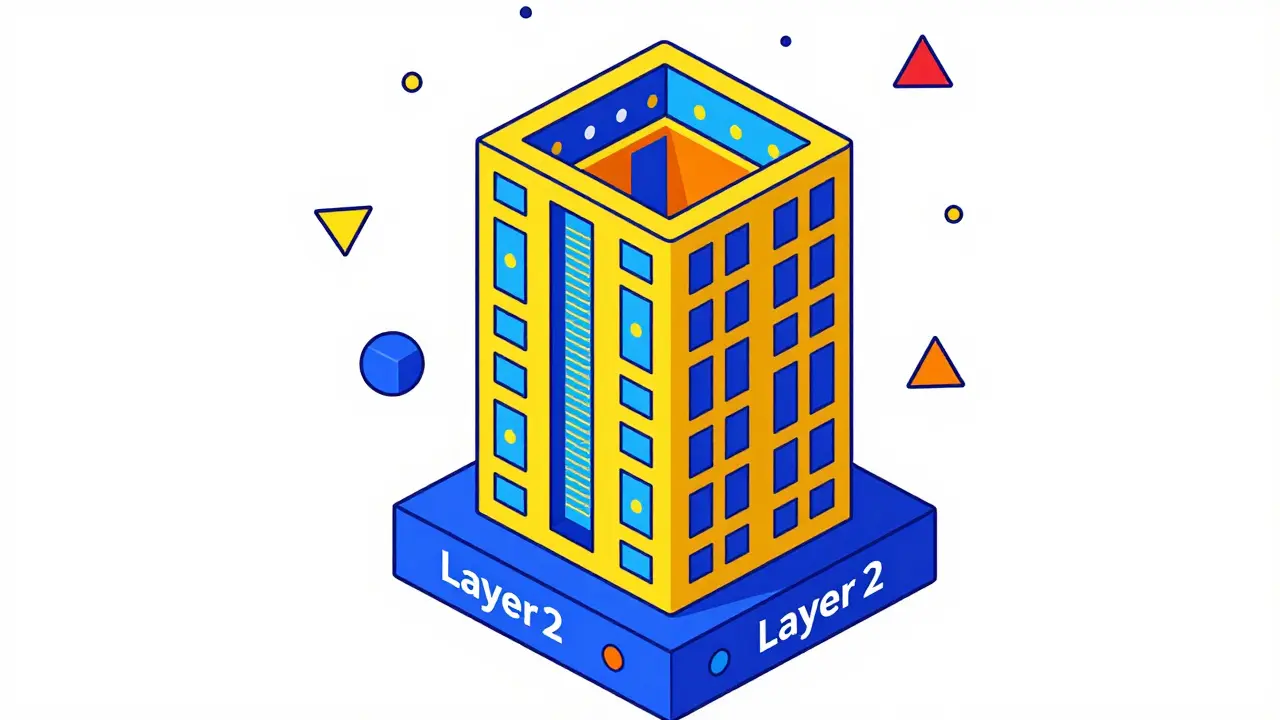
Think of it this way: Layer 1 (like Ethereum) is the foundation of a skyscraper. Layer 2 (like Arbitrum or Optimism) is the framework that supports many floors. Layer 3 is your custom office suite within that building, tailored exactly to your needs, with its own layout, utilities, and security protocols, while still relying on the building’s structural integrity.
What Are Layer 3 Solutions?
At their core, Layer 3 solutions are not a replacement for Layer 2; they are an extension. According to industry leaders like StarkWare, L3s are typically developed as appchains, meaning they are chains tailored for a single application or purpose. They sit directly on top of public Layer 2 infrastructure.
The primary job of a Layer 3 network is to offload transaction execution from the Layer 2. Just as L2s move computation off Ethereum Mainnet to reduce congestion, L3s move computation off the L2. They execute transactions locally, batch them together, and then send a cryptographic proof attesting to their validity back to the Layer 2. This hierarchical approach creates a multi-tiered scaling architecture where each layer adds compression and cost efficiency.
Unlike Layer 2s, which aim to scale the entire Ethereum network for everyone, Layer 3s focus on connecting various blockchains and facilitating seamless communication between them for specific ecosystems. They allow developers to host one decentralized application per network, ensuring high performance without the risk of network congestion caused by unrelated projects competing for the same blockspace.
How Layer 3 Architecture Works
To understand why Layer 3 is revolutionary, you need to look at the data flow. The architecture relies on a distinct execution and settlement model:
- Execution on L3: Transactions happen on the Layer 3 appchain. This is where the smart contracts run and the user interacts with the dApp.
- Batching and Proving: The L3 batches these transactions and generates a validity proof (such as a ZK-proof or optimistic fraud proof).
- Settlement on L2: Instead of posting data to expensive Layer 1, the L3 posts its data and proofs to the Layer 2. This is the critical difference. Because L2 data availability is much cheaper than L1, the base cost for the L3 is significantly lower.
- Anchoring to L1: The Layer 2 eventually settles its state to Ethereum Mainnet, inheriting Ethereum’s security guarantees. The L3 benefits from this indirect security.
This structure allows for dramatic cost reductions. Since L3s settle on a cheaper layer (L2) and their transaction data is further compressed by the L2 before being passed onward to Ethereum, L3s add another layer of cost reduction onto L2s. For users, this means fees that can be fractions of a cent, enabling micro-transactions that were previously impossible.

Key Benefits of Layer 3 Appchains
Why would a developer choose to build a Layer 3 instead of deploying on a popular Layer 2? The answer lies in specialization and control.
| Feature | Layer 1 (e.g., Ethereum) | Layer 2 (e.g., Arbitrum) | Layer 3 (Appchain) |
|---|---|---|---|
| Purpose | Security & Settlement | General Scaling | Specialized Application Logic |
| Customizability | Low (Fixed Rules) | Medium (EVM Compatible) | High (Custom Consensus/Logic) |
| Transaction Cost | High ($5-$50+) | Low ($0.10-$1.00) | Ultra-Low (<$0.01) |
| Congestion Risk | d>High | Medium | None (Dedicated Space) |
| Interoperability | Native | Cross-Chain Bridges | Advanced Cross-Chain Protocols |
Application-Specific Optimization: On a Layer 3, you control the logic. You can optimize the consensus mechanism for your specific transaction patterns. For example, a gaming chain might prioritize instant finality and low latency, while a DeFi chain might prioritize throughput and atomic swaps. StarkWare notes that L3 appchains enable greater customizability for builders seeking to fully control the logic of their decentralized application.
No Network Congestion: When you deploy on a shared Layer 2, you compete with every other project for blockspace. If a meme coin goes viral, gas prices spike, and your serious financial application slows down. On a Layer 3, you have dedicated blockspace. Your performance is predictable because you are not sharing resources with unrelated traffic.
Cross-Chain Communication: Layer 3 solutions often feature advanced cross-chain communication protocols. They facilitate seamless interaction between different blockchains without intermediaries. This is crucial for interoperability, allowing a dApp on an L3 to interact with assets on Ethereum, Solana, or other L2s smoothly.
Who Should Use Layer 3?
Not every project needs a Layer 3. In fact, for most small-scale applications, Layer 2 is sufficient and more liquid. Layer 3 is designed for specific scenarios:
- High-Frequency Trading Bots: These require sub-second finality and negligible fees. A general L2 cannot guarantee the consistent low latency needed for arbitrage bots.
- Complex Gaming Ecosystems: Games with thousands of transactions per second (TPS) for in-game actions, asset transfers, and social interactions benefit from the dedicated compute power of an L3.
- Enterprise Private Ledgers: Companies may want the security of Ethereum but need privacy features or custom compliance rules that public L2s do not support. An L3 allows for private state transitions that only reveal proofs to the L2.
- Micro-Payment Systems: Applications involving streaming payments, pay-per-click models, or IoT device transactions need fees so low that they are effectively free. L3s achieve this through aggressive data compression.
If your application has unique requirements that differ significantly from general-purpose blockchain usage, Layer 3 is the right choice. However, if you rely heavily on existing liquidity pools and network effects, staying on Layer 2 might be better until your volume justifies the complexity of an L3.
Challenges and Considerations
While Layer 3 offers immense benefits, it is not without challenges. The primary issue is complexity management. Building and maintaining an appchain requires significant technical expertise. You are responsible for node operations, validator sets, and cross-chain bridge security.
Another consideration is liquidity fragmentation. By creating a separate chain, you isolate your liquidity from the broader Ethereum ecosystem. Users must bridge assets to your L3, which introduces friction. To mitigate this, many L3 projects are integrating automated bridging solutions and leveraging the underlying L2’s liquidity layers.
Security dependency is also a factor. While L3s inherit security from L2s and ultimately L1s, they introduce new attack vectors at the cross-chain communication layer. Developers must ensure that the protocols used to communicate between L3, L2, and L1 are robust against replay attacks and fraudulent proofs.
The Future of Modular Blockchains
The blockchain industry is shifting toward modular architectures. As noted by analysts at Block3Finance, the focus is moving toward Layer 3 solutions and modular blockchains that stack specialized scaling layers for further optimization. This trend suggests that Layer 3 will become the standard for sophisticated dApps.
We are likely to see a rise in "Layer 3 factories"-platforms that allow developers to spin up customized appchains with minimal code. Infrastructure providers like StarkWare and Coinbase are already positioning themselves to support this ecosystem. As these tools mature, the barrier to entry for launching an L3 will drop, leading to an explosion of specialized blockchains tailored for niche markets.
In summary, Layer 3 solutions represent the next logical step in blockchain evolution. They solve the limitations of both Layer 1 and Layer 2 by providing customized, scalable, and cost-effective environments for decentralized applications. For developers aiming to build the next generation of high-performance dApps, Layer 3 is not just an option-it is a necessity.
Is Layer 3 safer than Layer 2?
Layer 3 inherits security from Layer 2 and ultimately Layer 1 (Ethereum). However, it introduces additional complexity due to cross-chain communication. While the economic security is strong, the technical risk depends on the implementation of the L3's bridges and proving mechanisms. It is generally considered safe if built on reputable L2 infrastructure.
Can I use my Ethereum wallet on Layer 3?
Yes, most Layer 3 solutions are EVM-compatible, meaning you can use wallets like MetaMask. However, you will need to add the Layer 3 network details to your wallet and bridge assets from Layer 2 or Layer 1 to access funds on the L3.
What is the difference between an appchain and a Layer 3?
In practice, they are often the same thing. An appchain is a blockchain tailored for a specific application. Layer 3 refers to the architectural position of this chain-built on top of Layer 2. So, a Layer 3 solution is typically implemented as an appchain.
Are Layer 3 solutions live yet?
Yes, several Layer 3 networks are currently live and operational, particularly those built on StarkNet and Arbitrum. However, the technology is still in its early stages of widespread adoption, with many projects in the testing or mainnet launch phases.
Do I need to run a node to use Layer 3?
No, end-users do not need to run nodes. You interact with Layer 3 through standard web interfaces or mobile apps. Only validators, developers, and infrastructure providers need to run nodes to secure the network and process transactions.