
Morning Routines for Crypto Traders: How to Master Focus and Preparation
 Apr, 5 2026
Most people wake up, check their phone, see a massive red candle on a Bitcoin chart, and instantly spiral into a state of panic. They start their day reacting to the market instead of commanding it. This is the fastest way to blow an account. Professional trading isn't just about reading charts; it's about managing the biological machine-your brain-that makes the decisions. If you start your day in a state of chaos, your trades will reflect that chaos.
The secret weapon of consistent traders isn't a magic indicator or a private Discord group; it's a rigid morning routine. By creating a predictable sequence of events, you signal to your brain that it's time to move from "sleep mode" to "execution mode." This process removes the emotional friction that leads to impulsive entries and revenge trading.
The Psychology of the Pre-Market State
Before you ever touch a trading terminal, you need to audit your internal state. Trading Psychology is the mental and emotional framework that governs how a trader handles risk, stress, and decision-making under pressure. As Mark Douglas famously pointed out, consistency in trading comes from your mindset, not the market conditions. If you're exhausted or stressed by a fight with your partner, your risk tolerance changes, even if you aren't aware of it.
Start your morning with a biological check-in. Ask yourself: Did I sleep enough? Am I hydrated? If you're running on four hours of sleep and three espressos, your prefrontal cortex-the part of the brain responsible for logical decisions-is compromised. Acknowledging this prevents you from forcing trades just to "make the day happen."
Physical Priming for Cognitive Edge
You can't expect a high-performance mind in a stagnant body. Physical activity isn't about fitness for the sake of aesthetics; it's about blood flow to the brain. Research shows that even a brief 10-minute burst of movement improves memory and attention. Whether it's a brisk walk around the block or a quick yoga session, getting your heart rate up clears the mental fog that leads to "fat-finger" mistakes.
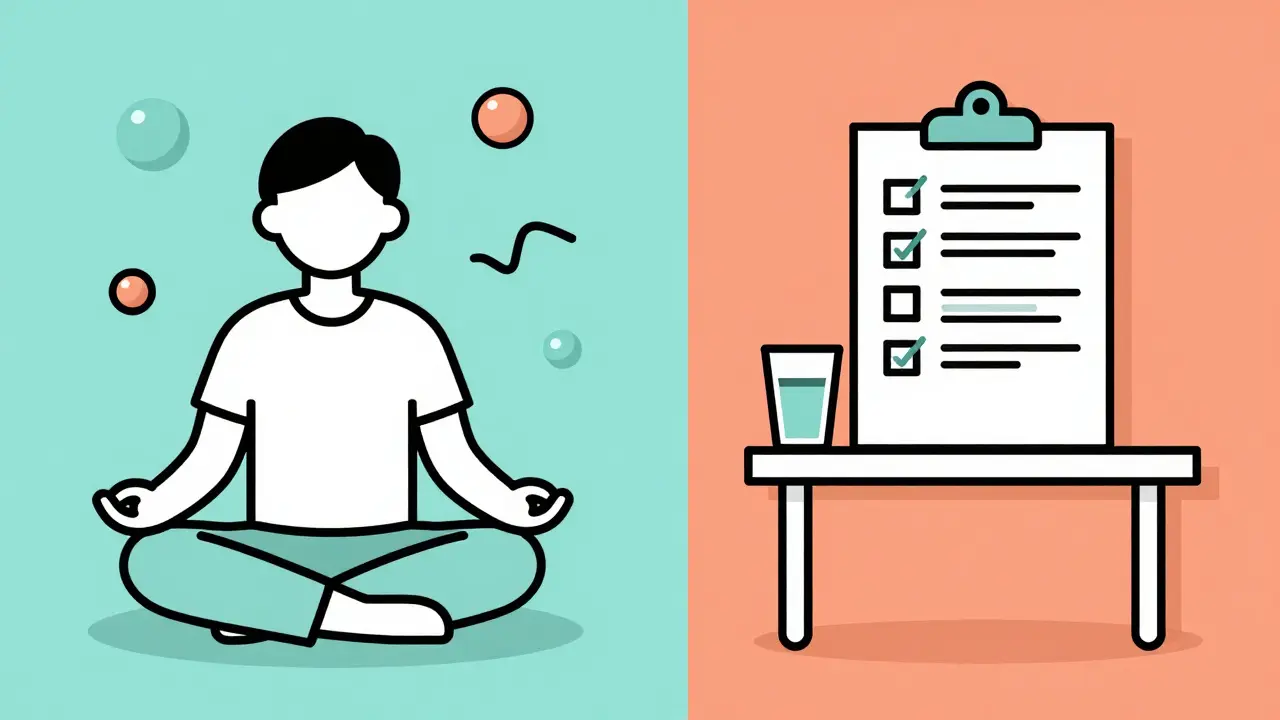
Combine this with Mindfulness is the practice of maintaining a non-judgmental state of heightened or complete awareness of one's thoughts, emotions, or experience on a moment-to-moment basis. Spending ten minutes with a guided meditation from sources like Headspace can literally change your brain's physical structure. Studies in Psychiatry Research: Neuroimaging indicate that regular meditation increases gray matter in areas tied to emotion regulation. For a crypto trader, this means the difference between calmly hitting a stop-loss and panic-selling at the bottom.
Organizing Your Digital and Physical Space
A cluttered desk is a cluttered mind. If your workspace is littered with old coffee mugs and random papers, you're adding to your cognitive load. Before you open your browser, clear your space. This physical act of organizing acts as a proxy for mental preparation, telling your subconscious that you are now entering a professional environment.
Next, move into your digital organization. This is where you transition from "person" to "trader." Review your Trading Plan is a detailed document outlining the specific rules for entry, exit, risk management, and strategy execution for a trader. Read your rules out loud. Remind yourself that losing days are a normal cost of doing business. By explicitly stating your risk limits before the volatility hits, you build a mental fence that prevents you from over-leveraging when the adrenaline kicks in.
| Trader Type | Daily Time Commitment | Core Focus | Key Activity |
|---|---|---|---|
| Full-Time | 3-5 Hours | Intraday precision | Hourly breaks & EOD review |
| Part-Time | 45-60 Minutes | Efficient execution | Lunch break check & evening plan |
| Swing Trader | 20-30 Minutes | Macro trends | Weekend deep technical analysis |
The Crypto-Specific Execution Framework
Cryptocurrency markets never sleep, which makes them uniquely dangerous. You can't analyze every single coin, or you'll succumb to analysis paralysis. A morning routine for traders in the crypto space should be lean and focused. Spend 10 minutes on X (Twitter) scanning for new narratives or project updates. Don't get bogged down in arguments; look for the flow of attention.
Follow this with a 7-10 minute deep dive into on-chain data. Check On-Chain Analysis is the process of analyzing the data written directly to the blockchain to track wallet movements and exchange flows. Are whales moving assets to exchanges? Is the stablecoin supply increasing? This gives you a factual foundation that social media hype cannot provide. Finally, spend 5 minutes confirming your trading thesis. If the market has shifted overnight, your plan must shift with it.
The Loop: Post-Market and Weekend Review
The routine doesn't end when you close your positions. To actually improve, you need a feedback loop. Spend 20 minutes at the end of your day logging every trade in a journal. Note not just the price, but how you felt. Were you greedy? Were you scared? This is where you spot the behavioral patterns that are costing you money.
On weekends, shift from execution to strategy. Spend 1-2 hours performing a deep dive. This is the time to evaluate if your strategy is still working or if the market regime has changed from trending to ranging. This high-level perspective ensures that when Monday morning hits, you aren't guessing-you're executing a proven plan.
What happens if I miss a day of my routine?
Missing one day won't ruin your career, but don't let it become a habit. If you're short on time, use a "compressed' version of your routine-5 minutes of deep breathing and a 2-minute check of your risk rules. The goal is to maintain the habit of preparation, even if the duration is shorter.
Is it better to wake up early or just trade when I feel ready?
Consistency beats timing. It's less about the specific hour you wake up and more about the sequence of actions you take before trading. Whether it's 5 AM or 11 AM, the ritual of moving from physical activity to mental centering to market analysis is what creates the professional edge.
How do I handle a morning where I've already lost money on an overnight trade?
This is where the routine is most critical. When you're in a loss, the urge to "make it back" (revenge trading) is highest. Use your mindfulness and gratitude practice to detach your self-worth from the PnL. If your emotional state is too volatile, the best trading decision is to stay out of the market for the day.
Do I really need to exercise to trade better?
Yes. Trading is a cognitive endurance sport. Exercise regulates cortisol (the stress hormone) and boosts dopamine and norepinephrine, which are essential for focus and alertness. You don't need a gym membership-stretching or a quick walk is enough to wake up your brain.
What is the most important part of the routine for a beginner?
Reviewing your risk management rules. Beginners often focus on where the price is going, but professionals focus on how much they can afford to lose. Reading your risk limits every morning prevents the catastrophic mistakes that wipe out new accounts.
Next Steps for Your Trading Day
If you're a beginner, don't try to implement this entire framework tomorrow. Start with one thing: a 10-minute pre-market rule review. Once that's a habit, add a physical element like a walk or stretching. If you're a seasoned trader struggling with consistency, focus on the end-of-day review and journaling; the data in your journal will tell you exactly which part of your morning routine is missing.