
Multi-Chain Wallets: How to Manage Crypto Assets Across Networks
 Nov, 12 2026
You have Bitcoin sitting in one app, Ethereum tokens in another, and a shiny new Solana NFT stuck in a third interface. It feels like juggling water balloons while riding a unicycle. This is the reality for many crypto users who started with a single coin and slowly expanded their horizons. The solution isn't more apps; it's a multi-chain wallet. Think of it as a universal remote control for your digital assets. Instead of switching between five different browser extensions or mobile apps, you view, send, and swap assets across dozens of blockchains from one dashboard. But how do they actually work? Are they safe? And which ones fit your needs? Let's break down how to manage your crypto life without losing your mind.
What Exactly Is a Multi-Chain Wallet?
A multi-chain wallet is a cryptographic tool that lets you store, send, receive, and manage digital assets on multiple blockchain networks within a single interface. Unlike traditional wallets tied to one specific chain-like MetaMask being primarily for Ethereum-compatible chains-a multi-chain wallet abstracts away the technical differences between networks. You don't need to know if a token lives on Bitcoin, Ethereum, Solana, or Avalanche to see its value. The wallet handles the address formats, gas fee calculations, and network protocols behind the scenes.
The core innovation here is identity unification. In the early days of crypto, every network required its own private key and seed phrase. If you wanted to hold BTC, ETH, and SOL, you needed three separate backups. Lose one, and you lose access to that specific asset forever. Modern multi-chain wallets often use a single recovery phrase to derive keys for multiple chains, or they allow you to import existing keys into a unified view. This reduces the cognitive load significantly. You aren't managing ten different security models anymore; you're managing one secure vault with many compartments.
Why Single-Chain Wallets Are Becoming Obsolete
Remember when checking your portfolio meant opening four tabs and refreshing each one manually? That friction kills productivity. Single-chain wallets force you to act like a database administrator rather than an investor. You have to remember which chain holds which asset, what the current gas price is on that specific network, and whether your hardware wallet supports the latest Layer 2 solution.
The fragmentation problem is real. According to recent industry data, users engaging with diverse digital assets were previously forced to maintain separate wallets for each network. This created two major issues: user experience friction and security vulnerabilities. When you have five different seed phrases written on paper slips, the chance of mixing them up or losing one increases exponentially. A multi-chain wallet consolidates this risk. Instead of five points of failure, you have one robust security protocol to manage.
Furthermore, the rise of DeFi (Decentralized Finance) has made cross-chain interaction essential. You might want to lend stablecoins on Arbitrum, stake SOL on Solana, and hold long-term Bitcoin-all at once. Doing this with single-chain wallets requires constant bridging, which is slow, expensive, and prone to errors. A good multi-chain wallet integrates these functions, letting you move assets where the yield is highest without leaving the app.
How Cross-Chain Transfers Actually Work
Moving money from Ethereum to Solana isn't like sending an email. The chains don't talk to each other natively. They speak different languages and use different consensus mechanisms. So, how does your wallet make it look so easy? It relies on complex backend infrastructure known as bridges and messaging layers.
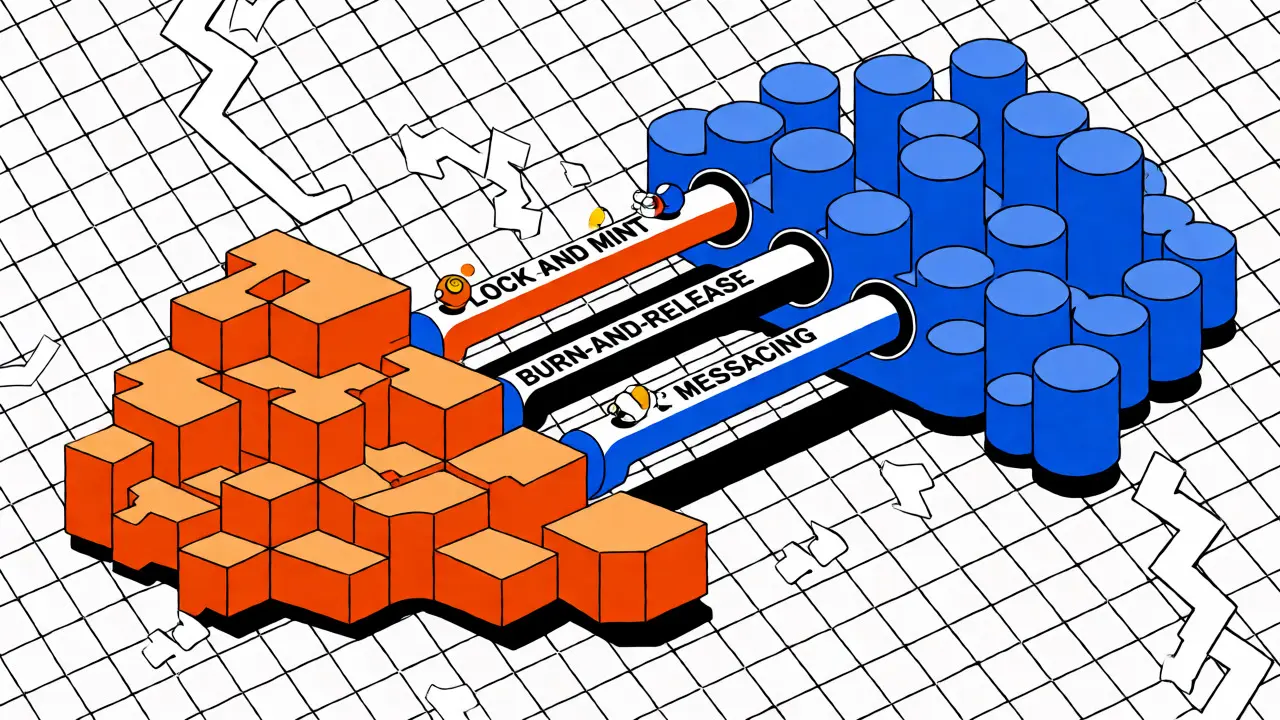
There are three main methods these wallets use to facilitate cross-chain movement:
- Lock-and-Mint: Your original asset is locked in a smart contract on the source chain. The bridge then "mints" a wrapped version of that asset on the destination chain. For example, locking USDC on Ethereum creates wUSDC on Polygon. When you send it back, the wrapped token is burned, and the original is released.
- Burn-and-Release: Similar to lock-and-mint but often used for native tokens. The token is destroyed on one chain and recreated on another.
- Messaging-First Systems: Protocols like LayerZero or Wormhole pass verified instructions between chains. Instead of just moving tokens, they can move data and commands, allowing for more complex interactions like triggering a loan repayment on one chain by paying on another.
It’s crucial to understand that you aren't always holding the same physical token across chains. Often, you hold a synthetic representation. Always verify the token contract address on the destination chain to ensure you aren't receiving a fake or poorly backed wrapped asset.
Top Features to Look For in a Multi-Chain Wallet
Not all multi-chain wallets are created equal. Some support only EVM (Ethereum Virtual Machine) compatible chains, while others handle non-EVM networks like Bitcoin, Solana, and Cosmos. Here is what you should prioritize:
| Feature | Why It Matters | Example Implementation |
|---|---|---|
| Network Support | Determines if you can hold BTC, SOL, or niche L1s alongside ETH. | Trust Wallet supports 100+ chains; MetaMask focuses on EVM. |
| Cross-Chain Swaps | Lets you trade Asset A on Chain X for Asset B on Chain Y instantly. | Integrated DEX aggregators like 1inch or Jupiter. |
| dApp Browser | Allows direct interaction with DeFi protocols and NFT marketplaces. | In-app browsers for Uniswap, OpenSea, or Raydium. |
| Hardware Compatibility | Adds cold storage security to your hot wallet convenience. | Ledger or Trezor integration via USB or Bluetooth. |
| Portfolio Tracking | Shows total net worth across all chains in real-time. | Unified dashboard with USD/Fiat conversion. |
Another critical feature is testnet access. If you are experimenting with new protocols, you want a wallet that lets you switch to test networks easily. This prevents you from wasting real money on failed transactions during learning phases.
Security Risks and Best Practices
Convenience often comes with security trade-offs. By connecting to multiple chains, you increase your attack surface. If you approve a malicious contract on a minor altcoin chain, could it affect your main holdings? Generally, no, because private keys are derived per chain, but poor UI design can lead to signing the wrong transaction.
Here are three rules to stay safe:
- Verify Token Contracts: Never assume a token name is unique. Scammers create fake versions of popular tokens. Always check the contract address against a trusted explorer like Etherscan or Solscan before swapping.
- Use Revoke Tools: Regularly check which contracts have permission to spend your tokens. Use tools like Revoke.cash to clean up old approvals, especially on EVM chains.
- Backup Properly: Even if your wallet uses one seed phrase, treat it like gold. Store it offline in fireproof storage. Avoid taking screenshots. Consider using Shamir Secret Sharing for high-value portfolios, which splits your backup into multiple parts requiring a threshold to reconstruct.
Also, be wary of custodial features. Some wallets offer "easy" staking or lending through third-party partners. Ensure you understand if you retain self-custody of your keys or if you are entrusting them to a centralized entity.
Practical Workflow for Managing Assets
So, how do you actually organize this chaos? Don't just dump everything into one folder. Treat your multi-chain wallet like a well-organized filing cabinet.
Start by naming your accounts or wallets based on purpose, not just chain. Instead of "Account 1," label it "ETH-L2-Trading" or "SOL-NFTs." This reduces context switching. When you open your wallet, you immediately know what that balance represents.
Next, automate your rebalancing. Many advanced wallets now include built-in swap features that route liquidity through optimal paths. If you see a high-yield opportunity on Arbitrum, use the integrated bridge to move funds there quickly. Keep a small reserve of native gas tokens (like ETH for Ethereum, MATIC for Polygon, SOL for Solana) on each active chain. Running out of gas is the most common beginner mistake, leaving you stuck with assets you can't move.
Finally, monitor your exposure. A unified dashboard shows your total net worth, but it doesn't always show risk concentration. If 80% of your portfolio is on one specific Layer 2 solution, you are exposed to that network's downtime or bugs. Diversify across consensus types (Proof of Work vs. Proof of Stake) and ecosystem maturity.
Frequently Asked Questions
Do I lose my coins if I switch from a single-chain to a multi-chain wallet?
No, your coins live on the blockchain, not in the wallet app itself. The wallet is just a keychain. As long as you correctly import your existing private keys or seed phrases into the new multi-chain wallet, you retain full access to your assets. Always test with a small amount first to ensure compatibility.
Are multi-chain wallets safer than using separate wallets for each chain?
It depends on implementation. Technically, isolating keys per chain limits blast radius-if one key is compromised, only that chain's assets are at risk. However, human error is a bigger threat. Managing multiple seed phrases leads to mistakes. A reputable multi-chain wallet with strong security audits and optional hardware wallet integration offers better practical security for most users due to reduced operational complexity.
Can I use a hardware wallet with any multi-chain software wallet?
Most leading multi-chain wallets (like Trust Wallet, Ledger Live, or Rabby) support hardware devices like Ledger and Trezor. However, support varies by chain. While Ledger supports Bitcoin and Ethereum universally, support for newer chains like Sui or Aptos may require specific firmware updates or companion apps. Check the hardware manufacturer's supported asset list before committing.
What happens if a bridge fails during a cross-chain transfer?
If a bridge fails, your assets might get stuck in limbo-they are neither fully on the source chain nor minted on the destination. Most modern bridges have recovery mechanisms or dispute resolution processes. Always check the status of the bridge provider before large transfers. Using established protocols like LayerZero, Axelar, or Stargate reduces this risk compared to obscure, unaudited bridges.
Do multi-chain wallets charge extra fees for cross-chain swaps?
Yes, typically. You pay standard network gas fees on both the source and destination chains, plus a service fee charged by the wallet or the bridge aggregator. These fees can vary widely. Sometimes, doing a manual bridge and swap separately is cheaper than using the wallet's integrated one-click swap, though it takes longer. Compare quotes if the transaction size is significant.