
NPS Tax Benefits in India: Maximize Deductions and Build Tax-Efficient Retirement Savings
 Mar, 6 2026
When you think about retirement in India, most people picture a quiet life after decades of work. But the real question isn’t whether you’ll retire-it’s whether you’ll be able to live comfortably when you do. With inflation, rising healthcare costs, and no guaranteed pension for most private-sector workers, planning ahead isn’t optional. That’s where the NPS (National Pension System) comes in. It’s not just another investment. It’s one of the most powerful tools you have to cut your taxes today while building a secure retirement tomorrow.
How NPS Lowers Your Tax Bill
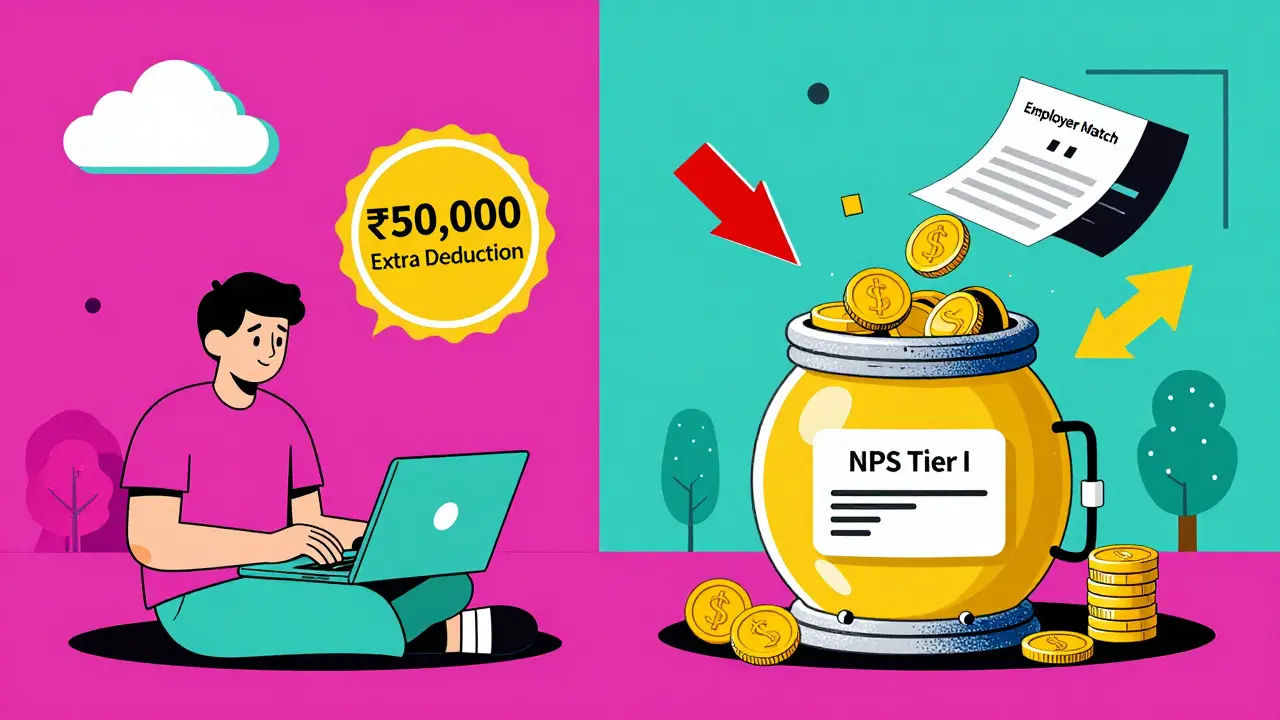
The Indian government doesn’t just encourage NPS-it gives you real money back for using it. Under Section 80C of the Income Tax Act, you can claim a deduction of up to ₹1.5 lakh per year for investments in eligible instruments like PPF, ELSS, and life insurance. But NPS gives you an extra push. On top of that ₹1.5 lakh limit, you can claim an additional ₹50,000 under Section 80CCD(1B). That’s a total of ₹2 lakh in tax deductions just from NPS contributions.
Let’s say you earn ₹12 lakh a year and invest ₹2 lakh in NPS. You’re not just saving for retirement-you’re reducing your taxable income by ₹2 lakh. If you’re in the 30% tax bracket, that’s ₹60,000 back in your pocket this year. No lottery. No windfall. Just smart tax planning.
Employers also contribute to your NPS account if you’re salaried. Those contributions are separate from your own and are deductible under Section 80CCD(2), up to 10% of your basic salary plus DA. That’s free money from your employer that also lowers your taxable income. For example, if your basic salary is ₹80,000 a month, your employer could be adding ₹8,000 monthly to your NPS-₹96,000 a year-without you spending a rupee.
The Three Tiers of NPS and What They Mean for You
NPS isn’t one product. It’s three tiers, each with different rules. Understanding them helps you maximize benefits and avoid penalties.
- Tier I is mandatory for government employees and the default for everyone else. You can’t withdraw money before 60, except in rare cases like critical illness or buying a home. But it’s the only tier that qualifies for the ₹50,000 extra deduction under 80CCD(1B).
- Tier II is flexible. You can deposit and withdraw anytime. But here’s the catch: contributions to Tier II don’t get any tax benefit. It’s good for emergency funds or short-term goals, but not for tax savings.
- Tier III doesn’t exist anymore. The government scrapped it in 2022. Don’t waste time looking for it.
So if you want tax deductions, focus on Tier I. And if you’re self-employed, you’re the one funding it. No employer match. No hand-holding. You’re in charge. That means you need to be disciplined. Set up auto-debits. Treat it like a utility bill you can’t skip.
How Much Can You Really Save?
Let’s break it down with a real example. Meet Priya, 32, a software engineer in Bengaluru. She earns ₹14 lakh annually, with a basic salary of ₹8.4 lakh. Her employer contributes 10% of her basic salary to her NPS Tier I account-₹84,000 a year. Priya adds another ₹1.16 lakh of her own money, hitting the ₹1.5 lakh limit under 80C and the extra ₹50,000 under 80CCD(1B).
Her total NPS contribution: ₹2 lakh. Her tax savings? At 30% slab, ₹60,000. That’s like getting a bonus just for saving for retirement. Plus, her employer’s ₹84,000 is tax-free income she didn’t have to earn. That’s an extra ₹25,200 in value (30% of ₹84,000) just from her job.
Over 25 years, if she earns 8% annual returns (a conservative estimate), her ₹2.84 lakh annual investment grows to over ₹2.1 crore by age 60. She’ll get 60% as a lump sum and 40% as a monthly pension. Even at ₹40,000 a month, that pension beats most government schemes.
What Happens When You Retire?
You can’t just cash out NPS like a bank account. There are rules.
- At 60, you must use at least 40% of your corpus to buy an annuity (a monthly pension plan). The rest is yours to withdraw as a lump sum.
- If you want to delay retirement, you can keep contributing until 70. The annuity purchase still kicks in at 70.
- If you die before retirement, your nominee gets the full corpus. No tax on the death benefit.
- If you withdraw before 60 (say, due to job loss or medical emergency), 80% of your corpus must go into an annuity. Only 20% is tax-free. The rest is taxed as income.
The annuity part trips up a lot of people. You’re not buying a product from a private insurer. You’re choosing from government-approved annuity providers like LIC, SBI Life, or HDFC Life. Rates vary. Compare them. Don’t just take the first offer. A 1% difference in annuity yield can mean ₹1,500 more per month for life.
Who Should Skip NPS?
NPS isn’t perfect. It’s not for everyone.
- If you’re in the 5% tax slab, the tax savings are too small to justify the lock-in.
- If you need liquidity, NPS is a bad fit. You can’t touch the money until 60.
- If you’re already maxing out your 80C investments and don’t have extra cash, NPS might strain your budget.
But if you’re in the 20% or 30% tax bracket, have steady income, and are okay with locking money away for decades, NPS is one of the few instruments that gives you tax savings today, market-linked growth, and a guaranteed pension. No other retirement product in India does all three.

How to Start or Optimize Your NPS
Getting started is simple:
- Visit the NPS website or use a registered Point of Presence (PoP) like ICICI Bank, HDFC, or SBI.
- Choose between Auto (default) or Active choice. Auto allocates your money across equity, corporate bonds, and government securities. Active lets you pick your own ratios. If you’re under 40, go active and put 75% in equity.
- Link your PAN and bank account. Complete KYC. It takes 2-3 days.
- Set up auto-debit. Even ₹5,000 a month adds up.
Check your NPS account twice a year. Rebalance if your risk profile changes. Don’t ignore it. Out of sight, out of mind leads to missed opportunities.
Common Mistakes to Avoid
- Thinking NPS is just for government employees. Private sector workers get the same benefits.
- Confusing Tier I and Tier II. Only Tier I gives tax deductions.
- Not claiming the ₹50,000 extra deduction. You have to declare it separately in your tax return under 80CCD(1B).
- Ignoring employer contributions. If your company offers NPS, don’t leave free money on the table.
- Withdrawing early. The tax penalty and annuity rule make it a losing move.
What’s Next?
NPS is one of the few tools that turns your savings into tax savings and long-term security. It’s not flashy. It doesn’t promise quick returns. But it’s built for the long game. If you’re serious about retirement, you don’t need more apps, more crypto, or more stock tips. You need consistency. You need discipline. And you need to start now.
Start with ₹5,000 a month. Increase it by 10% every year. Track your corpus. Rebalance when needed. Claim your deductions. And let time do the rest.
Can I claim NPS tax benefits if I’m self-employed?
Yes. Self-employed individuals can contribute up to ₹1.5 lakh under Section 80C and an additional ₹50,000 under Section 80CCD(1B). There’s no employer contribution, but you still get the full tax deduction on your own investments. You must file your return and declare the NPS contribution separately.
Is the pension from NPS taxable?
The lump sum withdrawal (60%) is completely tax-free. The monthly pension (40%) is taxable as income under the head "Income from Other Sources." The annuity payments you receive each month will be added to your total income and taxed at your slab rate.
Can I invest in NPS and PPF together?
Yes. Both are eligible under Section 80C, but the total limit is ₹1.5 lakh across all 80C instruments. NPS gives you an extra ₹50,000 deduction under 80CCD(1B), which is on top of the ₹1.5 lakh. So you can invest ₹1.5 lakh in PPF and another ₹50,000 in NPS and claim the full deduction.
What happens to my NPS if I change jobs?
Your NPS account is portable. You don’t need to close or reopen it. Just update your new employer’s details with your PRAN (Permanent Retirement Account Number). Your employer will start contributing to the same account. Your investments continue uninterrupted.
Can NRIs invest in NPS?
Yes, NRIs can open an NPS account, but only through an NRE or NRO bank account. They can contribute up to the same limits as residents. However, withdrawals and annuities are subject to Indian tax rules, and repatriation of funds may be restricted. Consult a tax advisor before investing.