
Post-Quantum Migration: How to Safely Upgrade Crypto Keys and Signatures
 Oct, 20 2026
Imagine waking up to find your Bitcoin wallet empty. Not because you forgot the password, but because a machine solved the math problem that was supposed to be impossible for humans to crack in less time than it takes to boil an egg. This isn't science fiction anymore; it's the looming reality of post-quantum cryptography a field dedicated to developing cryptographic algorithms secure against attacks by both classical and quantum computers. With Google Quantum AI estimating in 2026 that a fault-tolerant quantum computer could break current elliptic-curve encryption with fewer than 500,000 physical qubits, the window for safe migration is narrowing.
You might think this is a problem for engineers in white coats, but if you hold digital assets, it’s your problem too. The core issue is simple: today's dominant signature schemes, like ECDSA and Schnorr, rely on mathematical structures that large-scale quantum computers can unravel using Shor’s algorithm. Once that happens, anyone with access to such a machine can derive your private key from your public key and sign transactions as if they were you. The good news? We have standardized solutions ready to deploy. The bad news? Moving billions of dollars in assets without losing them requires careful planning, not just a software update.
The Immediate Threat: Exposure vs. Encryption
Before we talk about new algorithms, let’s look at why your coins are vulnerable right now. Cryptocurrency exposure comes in two flavors: short-term and long-term. Short-term exposure happens when you send a transaction. Your public key is revealed in the mempool (the waiting room for transactions) until it gets confirmed in a block. If a quantum attacker is fast enough, they can grab your public key, calculate your private key, and race their own transaction to the front of the line, stealing your funds before yours confirm.
Long-term exposure is trickier. Some older Bitcoin addresses, specifically Pay-to-Public-Key (P2PK) outputs, reveal the public key permanently on the blockchain. Even modern addresses can become exposed if you reuse them after spending. A Glassnode analysis noted that over 6 million BTC sits in these "long-exposure" categories. That’s billions of dollars sitting in plain sight, waiting for a sufficiently powerful quantum computer to walk by. Unlike encrypted data, which you can re-encrypt later, a public key on a blockchain is immutable. You can’t hide it once it’s there. This means moving those coins doesn’t retroactively protect them; it just moves the vulnerability to a new address. The only way to truly secure them is to move them to an address format that keeps the public key hidden until the moment of use, or to accept that those specific coins carry a higher risk profile.
NIST Standards: The New Toolkit
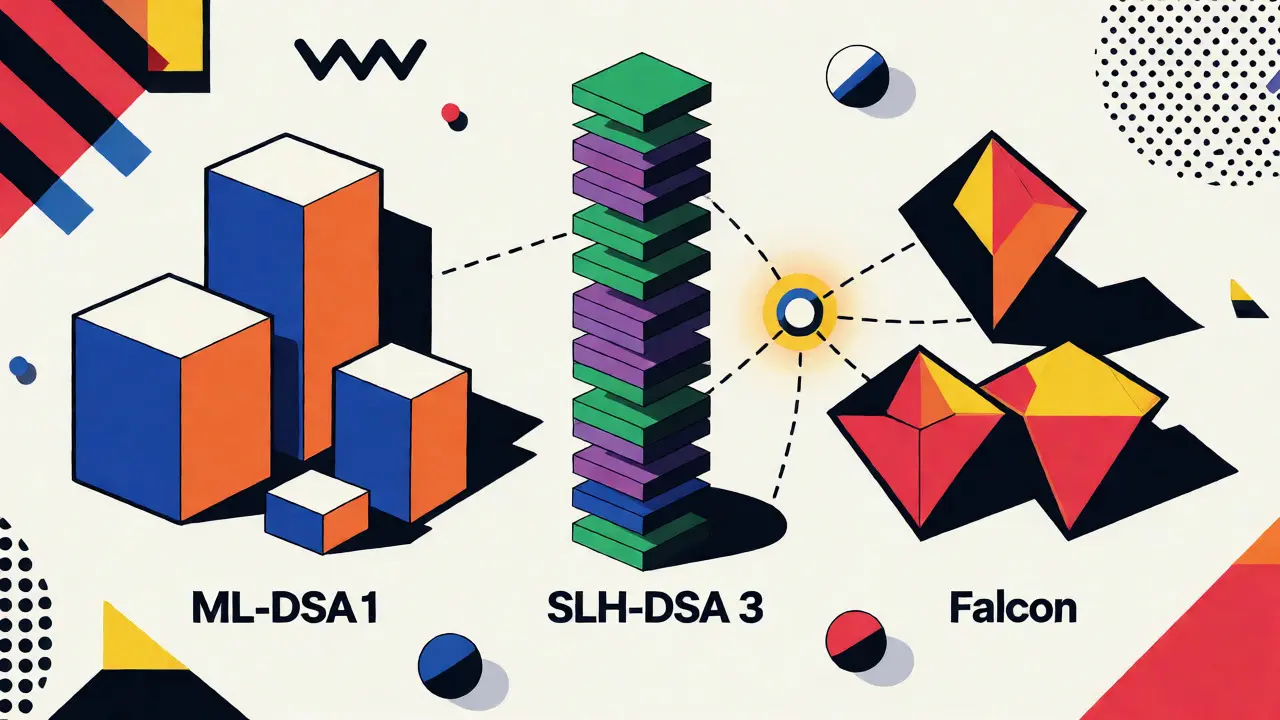
In August 2024, the National Institute of Standards and Technology (NIST) finalized three key standards that form the backbone of post-quantum security. These aren't theoretical concepts; they are production-ready algorithms designed to replace the vulnerable ones we use today. Understanding the trade-offs between them is crucial for choosing the right path for your assets.
| Algorithm | Type | Public Key Size | Signature Size | Best Use Case |
|---|---|---|---|---|
| ML-DSA | Lattice-based (FIPS 204) | 1,312 - 2,592 bytes | 2,420 - 4,627 bytes | General-purpose wallets, exchanges, smart contracts |
| SLH-DSA | Hash-based (FIPS 205) | 32 bytes | 7,856 - 49,856 bytes | High-assurance signing, conservative backups |
| Falcon | Lattice-based (Compact) | ~897 bytes | ~752 bytes | Blockchain layers where size/cost matters most |
| ECDSA/Schnorr | Elliptic Curve | ~33 bytes | ~64-70 bytes | Current standard (vulnerable to quantum) |
ML-DSA, formerly known as CRYSTALS-Dilithium, is the leading candidate for general use. It offers a balanced approach, though its keys and signatures are significantly larger than what we’re used to. For context, an Ed25519 public key is about 32 bytes. An ML-DSA-44 public key is 1,312 bytes-over 40 times larger. This sounds alarming for blockchains, where every byte costs money in fees and storage. However, for custody systems and high-value transfers, the security benefits outweigh the bandwidth costs.
SLH-DSA, based on SPHINCS+, takes a different route. It relies on hash functions rather than complex lattice math. Its strength lies in its conservatism; if one mathematical assumption fails, the other likely holds. But its weakness is size. Signatures can range from 7.8 KB to nearly 50 KB. While great for verifying a single important document, putting 50 KB signatures on every Bitcoin transaction would bloat the chain massively. It’s better suited for infrastructure components where speed and size are less critical than absolute certainty.
Falcon is the dark horse. It’s still finalizing standardization but offers much smaller signatures than ML-DSA, making it attractive for blockchains like Ethereum that care deeply about gas costs. Ethereum’s EIP-8052 proposal suggests adding precompiles to verify Falcon signatures efficiently. However, Falcon is harder to implement securely due to floating-point arithmetic issues. Don’t choose it just because it’s small; ensure your hardware wallets and libraries support it robustly first.
Bitcoin’s Path: Hygiene Before Protocol Changes
Bitcoin doesn’t have a central authority to force an upgrade. This decentralization is a feature, not a bug, but it makes migration slow. There is no agreed-upon deadline for switching to post-quantum signatures. Instead, the immediate strategy is behavioral hygiene. You need to stop reusing addresses. Every time you reuse an address, you expose your public key again. By rotating receiving addresses, you keep your public key hidden until you actually spend the coins, limiting the window for a short-term quantum attack.
For long-term safety, proposals like BIP-360 suggest new output types that hide the public key even further. But remember, moving coins doesn’t erase history. If your coins were in a P2PK address ten years ago, that public key is on the blockchain forever. The community is debating whether to eventually invalidate old, vulnerable transaction formats. This raises a tough question: should we freeze dormant Satoshi-era coins to protect the network’s integrity, or does that violate the principle of property rights? Most experts agree on a gradual approach. Opt-in upgrades, testnet validation, and long overlap periods allow users to migrate voluntarily without risking a chaotic "flag day" where old coins suddenly become unspendable.
Ethereum’s Complexity: Layers and Accounts
Ethereum faces a more complex challenge because it has more moving parts. It uses ECDSA for user accounts, BLS signatures for validator attestations, and pairing-based cryptography for zero-knowledge proofs. Each of these needs separate attention. You can’t just swap one algorithm and call it done.
A staged approach is emerging. First, enable account abstraction wallets to support hybrid signatures-requiring both a classical and a post-quantum signature. This ensures that if one system breaks, the other still protects you. Second, introduce verification precompiles for algorithms like Falcon so smart contracts can check PQ signatures without breaking the bank on gas. Third, tackle the validator layer. BLS signatures are efficient for aggregating thousands of validators, but they are vulnerable to quantum attacks. Replacing them requires consensus changes that affect the entire network’s throughput. Unlike Bitcoin, where you can mostly ignore protocol changes if you’re a holder, Ethereum users interact with the protocol constantly via DeFi and NFTs, making compatibility testing vital.

Your Step-by-Step Migration Plan
So, how do you actually move your funds safely? Follow this phased approach to avoid disaster.
- Inventory Everything: List every wallet, exchange account, and cold storage device. Note the address type, derivation path, and whether the public key has been reused. Identify which assets are in long-exposure states.
- Classify by Risk: Rank assets by value and urgency. High-value coins in reused addresses get priority. Small dust amounts can wait.
- Design the Destination: Choose a wallet that supports post-quantum algorithms or hybrid modes. Ensure it’s backed by reputable vendors who have audited their implementation. Do not trust a "quantum-safe" label without seeing the technical specs.
- Test on Testnet: Never move real money first. Send a small amount through your new workflow. Verify that you can recover the wallet from seed phrases and that the new address format works across all platforms you use.
- Controlled Migration: Move funds in batches. Start with low-risk assets. Keep the old wallet active for a while to monitor for any issues. Document every transaction ID.
- Monitor and Rotate: Keep an eye on NIST updates and vendor patches. Rehearse emergency recovery procedures. Remember, the goal is operational resilience, not just cryptographic correctness.
One critical rule: never disclose your seed phrase during this process. Scammers will exploit the confusion around "quantum upgrades" to ask for your keys. Legitimate migrations happen on-chain or within trusted apps, not via email links asking for your private key.
Hybrid Strategies and Custody Considerations
During the transition period, you’ll likely see hybrid models. These require either two signatures (one classical, one PQ) or accept either one. A "both required" model is safer against theft but doubles the complexity and cost. If one algorithm has a bug, your funds might get stuck. A "one-of-two" model is easier to use but leaves you vulnerable if either algorithm is compromised. For institutional custodians, separating classical and PQ keys across different vendors and requiring quorum approval is the gold standard. This diversification ensures that a failure in one supply chain doesn’t wipe out the client’s assets.
Costs will rise. Larger signatures mean bigger blocks and higher fees. Chains may need to adjust fee markets or implement signature aggregation techniques to keep things affordable. Budget for engineering audits, firmware updates for hardware wallets, and potential downtime during node upgrades. This isn’t free; it’s an insurance premium for the future of digital ownership.
Do I need to move my Bitcoin immediately?
Not necessarily. If your coins are in fresh, unused addresses and you haven't spent from them yet, your public key isn't exposed. However, if you've reused addresses or hold legacy P2PK coins, you should prioritize migration. Monitor news on quantum breakthroughs, but don't panic-sell. Plan a controlled migration over the next few years.
Which post-quantum algorithm is best for Bitcoin?
There is no single winner yet. ML-DSA is the NIST standard for general use, but its large size is challenging for Bitcoin's block space limits. Falcon is smaller and more efficient but is still finalizing standardization. The Bitcoin community is currently debating new output types like BIP-360 to mitigate exposure risks while waiting for a consensus on the signature scheme.
Will moving my coins protect already exposed public keys?
No. Once a public key is on the blockchain, it stays there forever. Moving coins to a new, quantum-safe address protects the *new* location, but the old public key remains visible. If a quantum computer becomes powerful enough, it can theoretically target those historical keys, though the economic incentive to do so depends on the remaining balance and the cost of computation.
Is Falcon safer than ML-DSA?
They offer similar levels of security based on current mathematical assumptions, but they differ in implementation risk. ML-DSA is fully standardized by NIST (FIPS 204), meaning it has undergone rigorous review. Falcon is compact but relies on floating-point arithmetic, which introduces side-channel risks if not implemented perfectly. For now, ML-DSA is the safer bet for broad adoption due to its standardization status.
What is the timeline for quantum computers breaking crypto?
Estimates vary widely. Google’s 2026 report suggests it could happen sooner than previously thought, potentially within this decade. However, building a fault-tolerant machine with 500,000 stable qubits is an immense engineering challenge. NIST recommends having systems migrated by 2030-2035. Treat this as a multi-year project, not an overnight switch.