
PPF vs EPF vs SSY: The Ultimate Guide to Section 80C Investments in India (2026)
 Jul, 12 2026
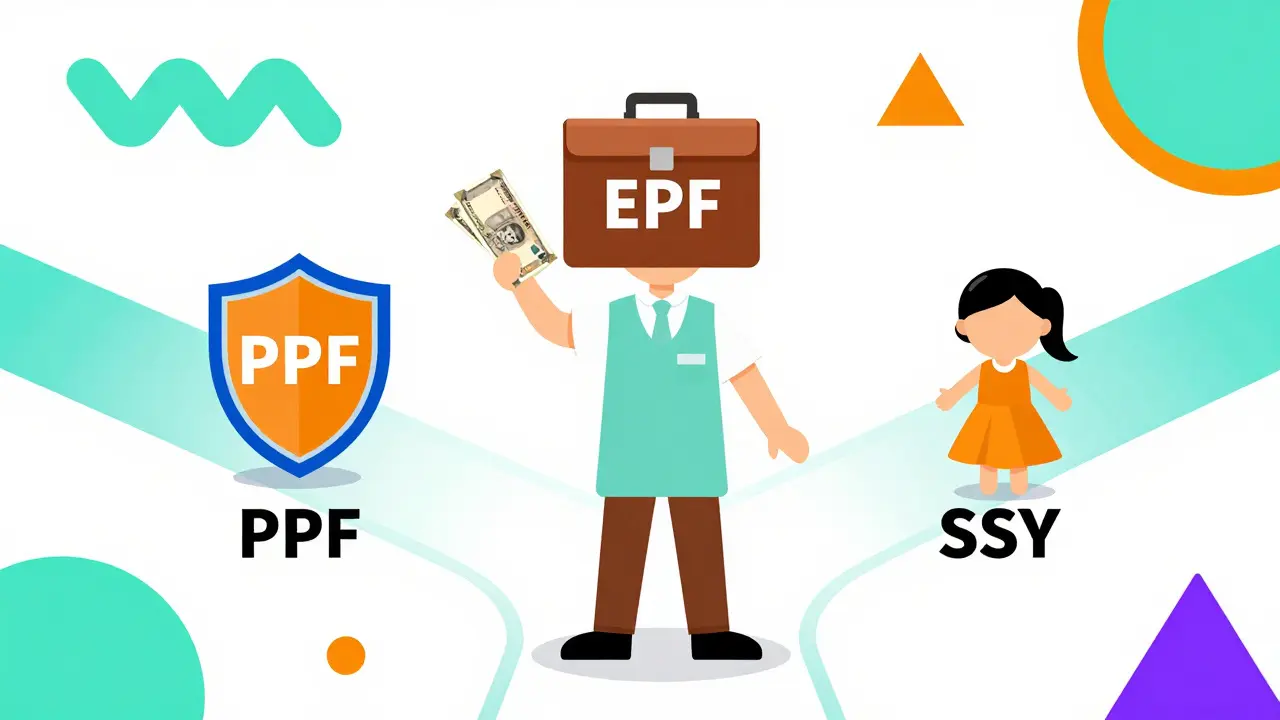
You have exactly ₹1.5 lakh left to invest before March 31st. You know this amount can slash your tax bill significantly under Section 80C of the Income Tax Act. But where should you put it? Should you lock it away for your daughter’s future, secure your own retirement, or build a safety net for your family? This is the classic dilemma facing millions of Indian taxpayers every financial year.
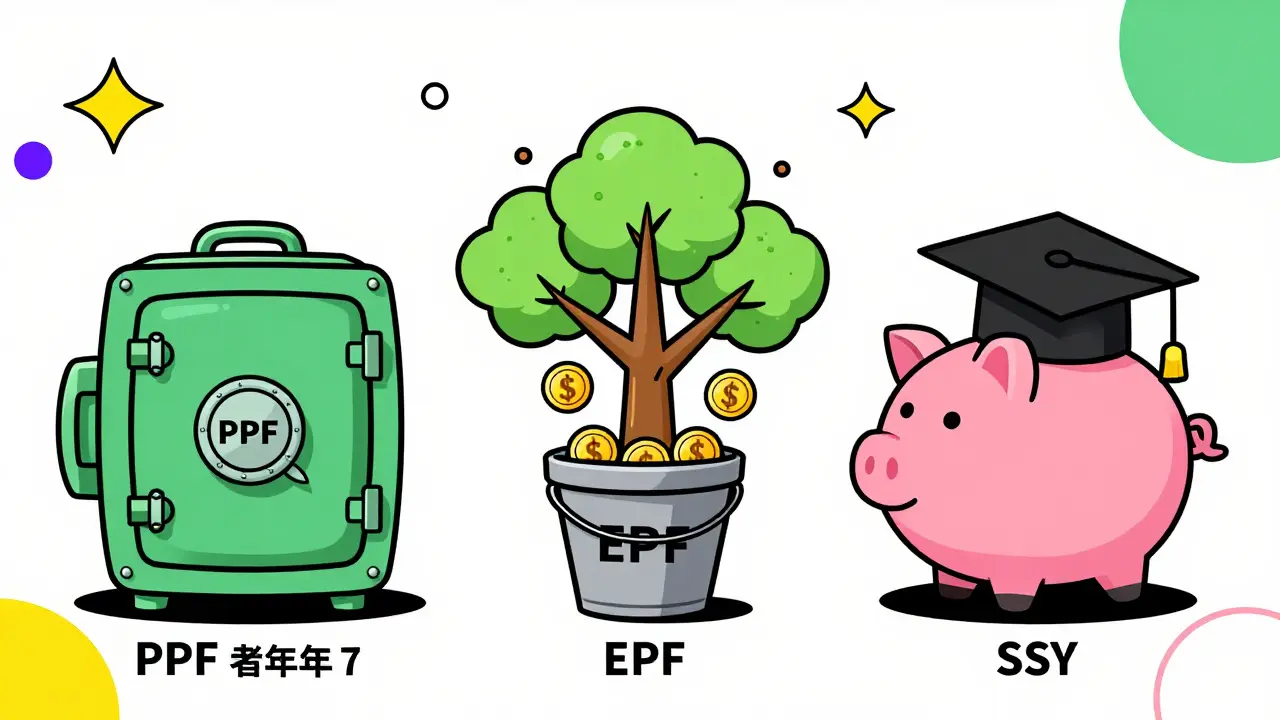
The choice between Public Provident Fund (PPF), Employees’ Provident Fund (EPF), and Sukanya Samriddhi Yojana (SSY) isn’t just about picking the highest interest rate. It’s about matching the investment’s rules with your life stage, liquidity needs, and family goals. Get it wrong, and you might face penalties or miss out on crucial funds when you need them most. Let’s break down these three giants of Indian tax-saving instruments so you can make a decision that actually fits your wallet.
Understanding the Core Mechanics of Section 80C
Before comparing the instruments, we need to understand the playing field. Section 80C allows you to deduct up to ₹1.5 lakh from your gross total income. This reduces your taxable income, not your tax liability directly. If you are in the 30% tax bracket, saving ₹1.5 lakh here saves you ₹45,000 in taxes. That is a guaranteed 30% return on your investment, which no market instrument can promise without risk.
However, all three options-PPF, EPF, and SSY-share two critical characteristics:
- EEE Status: They are Exempt-Exempt-Exempt. Your principal investment is tax-free, the interest earned is tax-free, and the final withdrawal is tax-free. This makes them incredibly powerful compared to equity mutual funds, where long-term capital gains over ₹1.25 lakh are taxed at 12%.
- Lock-in Periods: These are not savings accounts. You cannot withdraw money whenever you want. Each scheme has strict withdrawal rules designed to encourage long-term saving.
| Feature | Public Provident Fund (PPF) | Employees’ Provident Fund (EPF) | Sukanya Samriddhi Yojana (SSY) |
|---|---|---|---|
| Eligibility | Any Indian citizen | Salary employees (organized sector) | Parents/Guardians for girl child (below 10 years) |
| Interest Rate (Approx.) | 7.1% p.a. | 8.25% p.a. | 8.2% p.a. |
| Tenure | 15 years (extendable) | Until retirement | Until girl turns 21 |
| Min. Investment | ₹500/year | Linked to salary | ₹250/year |
| Max. Investment | ₹1.5 lakh/year | Linked to basic salary | ₹1.5 lakh/year |
| Liquidity | Partial withdrawal after Year 7 | Only on specific grounds/retirement | Partial withdrawal after age 18 |
Public Provident Fund (PPF): The Flexible Safety Net
Public Provident Fund (PPF) is a government-backed long-term savings scheme available to any Indian citizen. It is often considered the gold standard for conservative investors who want stability above all else.Why do people choose PPF? Because it offers a unique balance of security and partial liquidity. Unlike EPF, which is tied to your job, or SSY, which is tied to your daughter, PPF belongs solely to you. You can open an account at any post office or authorized bank.
The tenure is 15 years. After seven years, you can start making partial withdrawals for specific reasons like higher education or medical treatment. This feature is crucial. Imagine you need ₹2 lakh for a home repair in Year 9. With PPF, you can access part of your corpus. With EPF, you’d have to jump through hoops proving unemployment or house construction. With SSY, you simply can’t touch it until your daughter is 18.
The current interest rate hovers around 7.1%. While this isn’t flashy, remember that it compounds annually and is completely tax-free. Over 15 years, if you invest the maximum ₹1.5 lakh every year, you could accumulate close to ₹45-47 lakh. That is a solid, risk-free foundation for your retirement or your children’s future.
Employees’ Provident Fund (EPF): The Forced Retirement Savings
Employees’ Provident Fund (EPF) is a mandatory retirement benefit scheme for salaried employees in the organized sector. Managed by the Employees' Provident Fund Organisation (EPFO), it is not really a choice for most salaried individuals-it happens automatically.If you are working in a company with more than 20 employees, 12% of your basic salary plus dearness allowance is deducted from your paycheck and deposited into your EPF account. Your employer matches this contribution. This means you are getting free money every month. If you earn ₹50,000 as basic salary, both you and your employer contribute ₹6,000 each month. That ₹6,000 from your employer is essentially a 100% return on your investment, instantly.
The interest rate for EPF is typically higher than PPF, currently around 8.25%. However, the catch is liquidity. You generally cannot withdraw this money until you retire (usually age 58). There are exceptions-you can withdraw for marriage, buying a house, or treating serious illnesses-but the process involves paperwork and approvals.
For tax purposes, your employee contribution qualifies for Section 80C deduction. Your employer’s contribution does not count towards your ₹1.5 lakh limit, but it is taxable if it exceeds certain limits based on your salary structure. EPF is best viewed as your primary retirement bucket. Don’t try to use it for short-term goals.
Sukanya Samriddhi Yojana (SSY): The Daughter’s Future Fund
Sukanya Samriddhi Yojana (SSY) is a government-sponsored savings scheme specifically designed for the welfare of girl children. Launched under the Beti Bachao Beti Padhao campaign, it offers one of the highest interest rates among small savings schemes.SSY is only for parents or legal guardians opening an account for a girl child below the age of 10. The interest rate is attractive, currently at 8.2%, beating both PPF and fixed deposits. The lock-in period is long-the account matures when the girl turns 21. However, there is a provision for partial withdrawal when she turns 18, provided she has completed 55% of the course of her higher education or marriage. This makes it perfect for funding college fees or wedding expenses.
The maximum annual investment is ₹1.5 lakh per account. You can open two accounts for two different daughters, allowing you to save ₹3 lakh annually under Section 80C for their futures. This is a powerful tool for families with multiple girls. It forces discipline because the money is legally locked for the beneficiary’s benefit. You cannot use it for your own emergencies.
Which One Suits Your Family? A Decision Framework
Choosing between these three depends entirely on your profile. Here is how to decide:
Scenario 1: The Young Professional with No Dependents
If you are single and focused on your career, EPF is already handling your retirement via auto-deductions. You should maximize your PPF contributions. Why? Because PPF gives you control. You can decide how much to invest each month (up to ₹1.5 lakh) and access partial funds after Year 7 if you decide to buy a house or start a business. SSY is not relevant unless you plan to adopt or have a daughter soon.
Scenario 2: Parents with a Girl Child Under 10
This is the easiest decision. Prioritize SSY. The interest rate is higher than PPF, and the purpose is specific. Fill up the ₹1.5 lakh limit for your daughter first. If you still have room under Section 80C (e.g., you have another daughter or want to save for yourself), then move to PPF. Do not skip SSY for PPF; the specialized nature and higher yield make SSY superior for this demographic.
Scenario 3: High-Income Earners Maximizing Tax Benefits
If your EPF contribution alone doesn’t exhaust the ₹1.5 lakh limit, you need to top it up. Since EPF is capped by your salary, you must look elsewhere. PPF is the safest bet here. It complements EPF by offering a separate, controllable retirement pot. Avoid putting excess money into EPF via voluntary provident fund (VPF) unless you are sure you won’t need that liquidity for decades. VPF increases your taxable income base slightly due to higher pension fund deductions, whereas PPF is cleaner.

Common Pitfalls to Avoid
Many investors make mistakes that reduce the effectiveness of these schemes. Watch out for these:
- Missing the Deadline: Section 80C claims must be made by March 31. Last-minute rushes lead to errors. Set up automatic monthly transfers to your PPF or SSY account to spread the burden.
- Ignoring Compound Frequency: PPF and SSY compound annually. EPF also compounds annually. Make sure you are comparing Applicable Yield (APY) rather than simple interest rates when evaluating against other instruments like Fixed Deposits, which may compound quarterly.
- Overlooking Nominee Details: PPF and SSY require nominees. Ensure your nominee details are updated. In case of unforeseen events, this ensures smooth transfer of funds to your heirs without legal hassle.
- Confusing VPF with PPF: Voluntary Provident Fund (VPF) allows you to contribute more than 12% to your EPF. While it is tax-deductible under 80C, the withdrawal rules are as strict as EPF. If you value liquidity even slightly, PPF is better than VPF.
Final Thoughts on Building Your 80C Portfolio
There is no single "best" option. The ideal strategy often involves a mix. For example, a parent might max out SSY for their daughter, let EPF run automatically for their own retirement, and use the remaining 80C space for PPF as a flexible emergency-cum-retirement buffer. This diversification across lock-in periods and beneficiaries ensures that you always have some accessible funds while securing long-term goals.
Remember, the goal of Section 80C is not just tax saving; it is wealth creation. By choosing the right instrument, you align your tax benefits with your life’s milestones. Start early, stay consistent, and review your allocations annually to ensure they still match your changing family dynamics.
Can I invest in both PPF and SSY?
Yes, absolutely. You can invest up to ₹1.5 lakh in PPF and another ₹1.5 lakh in SSY (for a girl child). Both qualify for Section 80C deduction, but the total deduction across all eligible instruments cannot exceed ₹1.5 lakh in a single financial year. So, if you invest ₹1.5 lakh in SSY, you cannot claim additional deduction for PPF in the same year unless you split the amounts.
Is the interest earned on PPF taxable?
No. PPF follows the EEE (Exempt-Exempt-Exempt) tax status. The interest accrued every year is added to the balance and compounded, and it remains completely tax-free. The final maturity amount is also tax-free.
What happens if I stop contributing to my PPF account?
If you fail to deposit the minimum required amount (₹500) in a year, your account becomes dormant. You can revive it by paying a penalty of ₹50 for each default year along with the missed deposits. However, during the dormant period, you cannot make new deposits or withdrawals, though interest continues to accrue.
Can I withdraw money from EPF before retirement?
Yes, but only under specific conditions such as unemployment for more than two months, purchase or construction of a house, marriage of self/children, or treatment of specified diseases. Partial withdrawals are allowed after completing five years of continuous service for purposes like education or home renovation.
Who gets the money if the account holder dies?
In PPF and SSY, the nominee receives the entire corpus. If no nominee is appointed, the funds go to the legal heirs as per succession laws. It is crucial to update nominee details regularly to avoid delays in claiming the funds.