
Pre-Market and Post-Market Trading in India: A Complete Guide for Retail Investors
 Jun, 2 2026
Imagine you wake up at 7:00 AM in Mumbai, check your phone, and see that a major US tech giant announced record-breaking earnings overnight. The Indian market doesn't open until 9:15 AM. You want to react immediately, but the gates are locked. Or perhaps you hold shares in an Indian company, and breaking news hits at 4:30 PM, just as the market closes. You're stuck waiting until the next morning to sell or buy. This gap between global events and local trading hours is where pre-market and post-market trading comes into play.
For years, retail investors in India were told that trading only happens between 9:15 AM and 3:30 PM on weekdays. That’s no longer entirely true. While the National Stock Exchange (NSE) and Bombay Stock Exchange (BSE) have strict core hours, mechanisms exist for extended trading. However, these aren’t as simple as clicking ‘buy’ on an app at midnight. Understanding how pre-market and post-market sessions work in India is crucial for anyone looking to trade efficiently without getting caught off guard by volatility or missed opportunities.
Understanding the Core Trading Hours in India
Before diving into the ‘before’ and ‘after’, we need to anchor ourselves in the standard schedule. The primary trading session in India is governed by two main entities: the National Stock Exchange (NSE) and the Bombay Stock Exchange (BSE). Both operate from 9:15 AM to 3:30 PM Indian Standard Time (IST).
This window is when the majority of volume occurs. If you’re a beginner, this is your safe zone. Prices are transparent, liquidity is high, and execution is reliable. But why do we need anything outside these hours? Because markets don’t sleep. Global indices like the Dow Jones, Nasdaq, and European markets trade while India sleeps. When those markets crash or surge, Indian stocks often follow suit when they open. Pre-market and post-market mechanisms help bridge this information gap.
What Is Pre-Market Trading in India?
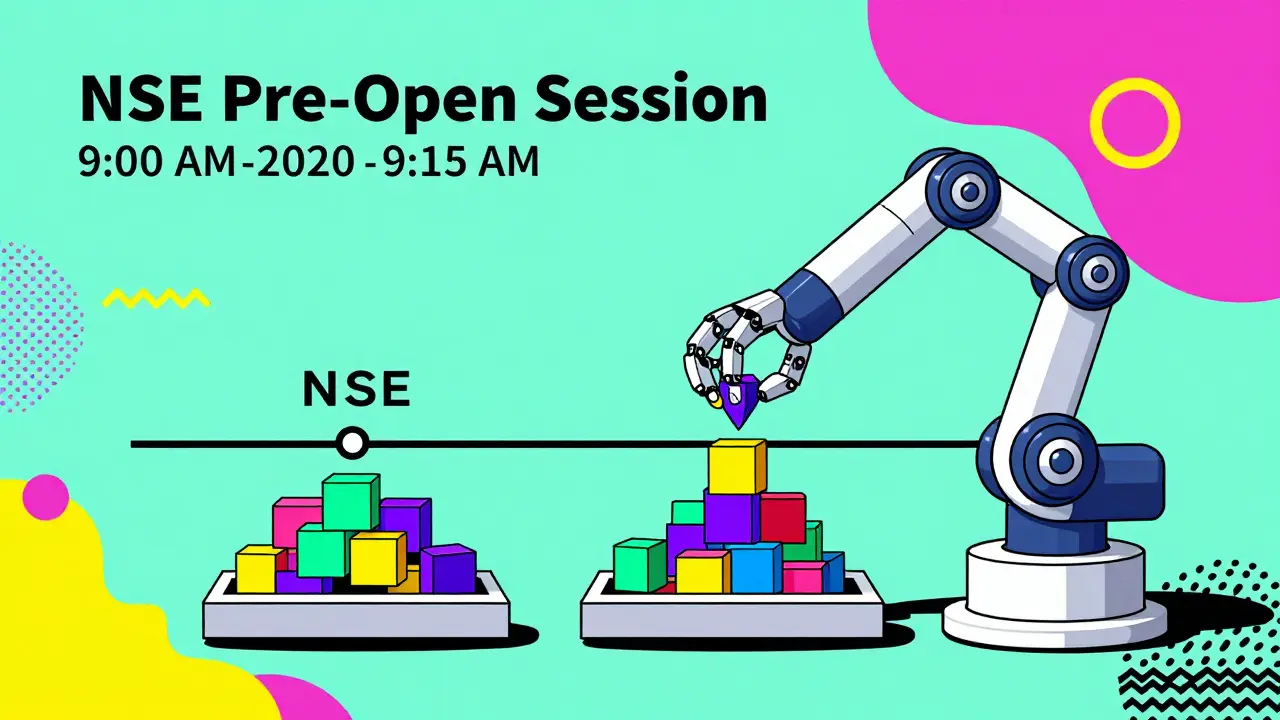
Pre-market trading isn’t a free-for-all auction starting at dawn. In India, it has a very specific, limited function. The NSE introduced a Pre-Open Session that runs from 9:00 AM to 9:15 AM. This is not continuous trading; it’s an order matching period designed to determine the opening price of stocks based on overnight demand and supply.
Here’s how it breaks down:
- 9:00 AM - 9:08 AM (Order Entry): Investors can place orders. These can be limit orders or market orders. You cannot modify or cancel orders during this phase.
- 9:08 AM - 9:12 AM (Matching Period): Orders are matched electronically. No new orders can be placed. The system calculates the equilibrium price-the price at which the maximum number of trades can occur.
- 9:12 AM - 9:15 AM (Buffer Period): Any unmatched orders are removed or carried forward. The final opening price is determined here.
The goal of this session is to reduce volatility at the open. Without it, prices could jump wildly from the previous close to the first trade. For retail investors, this means if you have strong views on how a stock will perform based on overnight news, you must act before 9:08 AM. If you miss this window, you’re forced to wait for the regular session, where prices may have already moved against you.
Does Post-Market Trading Exist in India?
This is where many international guides mislead Indian readers. In the United States, you can trade stocks until 8:00 PM ET through extended hours sessions. In India, there is no direct equivalent for individual equity stocks. Once the clock strikes 3:30 PM, the cash market closes. You cannot buy or sell Reliance Industries or Tata Motors shares at 4:00 PM on the NSE or BSE.
However, the story doesn’t end there. There are indirect ways to trade after hours, primarily through derivatives and currency markets.
The Role of Derivatives and Currency Markets
While equity cash markets shut down, other segments keep moving. The Forex Market operates nearly 24/7. Since the Indian Rupee (INR) is heavily traded against the US Dollar (USD), movements in currency rates directly impact Indian markets. If the dollar strengthens significantly after 3:30 PM, Indian export-oriented companies might see their stocks rise the next morning.
Additionally, Futures and Options (F&O) traders watch global cues closely. Although F&O contracts on Indian exchanges also close at 3:30 PM, the pricing of these instruments is influenced by global index futures. For example, if the S&P 500 Futures drop sharply in New York, Indian index futures (like Bank Nifty or Nifty 50) will reflect that sentiment in their pre-open session the next day.
How Global Markets Impact Your Indian Portfolio
You might wonder, "If I can’t trade after 3:30 PM, why should I care about post-market activity?" Because the world is interconnected. Here’s a practical example:
Suppose you own shares in an Indian IT company like Infosys or TCS. These companies earn a significant portion of their revenue in US Dollars. If Apple or Microsoft announces poor earnings after the US market closes, the entire tech sector may take a hit. By the time the NSE opens the next morning, your IT stocks might gap down. You didn’t have a chance to sell because the Indian market was closed. This is known as a Gap Down.
To mitigate this, savvy investors use hedging strategies. They might buy put options on the Nifty 50 index before the market closes if they anticipate negative global news. This way, even if the stock drops the next morning, the gain in the put option offsets the loss in the equity holding.
Key Differences: India vs. US Extended Hours
| Feature | India (NSE/BSE) | United States (NYSE/Nasdaq) |
|---|---|---|
| Core Session | 9:15 AM - 3:30 PM IST | 9:30 AM - 4:00 PM ET |
| Pre-Market Session | 9:00 AM - 9:15 AM (Order Matching Only) | 4:00 AM - 9:30 AM ET (Continuous Trading) |
| Post-Market Session | Not Available for Equities | 4:00 PM - 8:00 PM ET (Continuous Trading) |
| Liquidity | High during core hours, low/non-existent outside | Moderate in extended hours, lower than core |
| Risk Level | Low (regulated pre-open) | High (wider spreads, volatile prices) |
This table highlights a critical point: Indian retail investors have fewer tools to react to immediate news compared to their US counterparts. This isn’t necessarily bad-it reduces impulsive trading. But it requires more discipline and planning.

Practical Tips for Retail Investors
So, how do you navigate this landscape? Here are actionable steps:
- Set Alerts, Not Orders: Since you can’t trade continuously after hours, set price alerts on your broker’s app. If a stock moves significantly in the pre-open session, you’ll get notified and can decide whether to enter during the core session.
- Watch Global Cues: Keep an eye on Asian markets (Nikkei, Hang Seng) in the morning and US markets in the evening. Their closing trends often predict the direction of Indian markets.
- Use Limit Orders in Pre-Open: If you must trade in the pre-open session, always use limit orders. Market orders can execute at unfavorable prices if liquidity is thin.
- Hedge with Derivatives: If you hold a large portfolio and fear overnight volatility, consider buying protective puts on relevant indices. This acts as insurance.
- Avoid Panic Selling: Remember, gaps can fill. Just because a stock opens lower doesn’t mean it will stay there. Wait for the dust to settle in the first 15 minutes of the core session before making drastic moves.
Common Misconceptions About After-Hours Trading
Many beginners believe that because they can see real-time data on apps like Moneycontrol or TradingView after 3:30 PM, they can trade. This is false. The data you see is either delayed or from other global exchanges. Some brokers offer 'overnight orders,' but these are simply instructions to execute at the next available opportunity-usually the pre-open session. They are not executed instantly.
Another myth is that pre-market trading is risky. In reality, the NSE’s pre-open mechanism is highly regulated. It prevents extreme price swings by matching orders fairly. The risk lies in missing the window, not in the process itself.
Conclusion: Patience Is Your Best Strategy
In the fast-paced world of finance, the inability to trade instantly can feel frustrating. But for Indian retail investors, this structure offers protection. It forces you to think before you act. Instead of reacting emotionally to late-night news, you have time to analyze, plan, and execute during the pre-open or core session.
Mastering the pre-market session and understanding global correlations will give you an edge over those who simply chase daily fluctuations. Focus on quality entries, use hedging wisely, and remember that the market will always be there tomorrow. You don’t need to trade every second to succeed.
Can I trade stocks in India after 3:30 PM?
No, you cannot trade individual equity stocks on the NSE or BSE after 3:30 PM. The cash market closes completely. However, you can monitor global markets and currency rates, which will influence prices the next morning.
What is the purpose of the pre-open session?
The pre-open session (9:00 AM - 9:15 AM) is used to determine the opening price of stocks based on overnight demand and supply. It helps reduce volatility by matching orders electronically before the market officially opens.
Is pre-market trading risky for beginners?
It carries some risk due to potential price gaps, but the NSE's mechanism is designed to be fair. Beginners should use limit orders instead of market orders to control their entry price. Avoid placing orders if you are unsure about the overnight news.
How do US market closures affect Indian stocks?
US markets close while India is asleep. Significant moves in US indices (S&P 500, Nasdaq) or major corporate earnings announcements can cause Indian stocks to 'gap up' or 'gap down' when the NSE opens the next morning.
Can I place orders overnight on my trading app?
Yes, most brokers allow you to place 'overnight orders.' These are not executed immediately but are queued to be processed during the next available trading window, typically the pre-open session starting at 9:00 AM.