
Progressive Exposure to Risk: Scaling Position Size Safely in Trading
 Mar, 19 2026
Most traders blow up their accounts not because they’re bad at reading charts, but because they scale position size at the wrong time. They double down after a loss. They go all-in after one winning trade. They chase revenge. And they wonder why their equity curve looks like a rollercoaster ride through a thunderstorm.
There’s a better way. It’s called progressive exposure to risk. Not the kind where you risk more because you’re feeling lucky. But the kind where you risk more because the data says you should.
What Progressive Exposure Really Means
Progressive exposure is simple: trade bigger when you’re winning, trade smaller when you’re losing. Not because you’re greedy. Not because you’re desperate. But because your recent trades tell you what the market is doing.
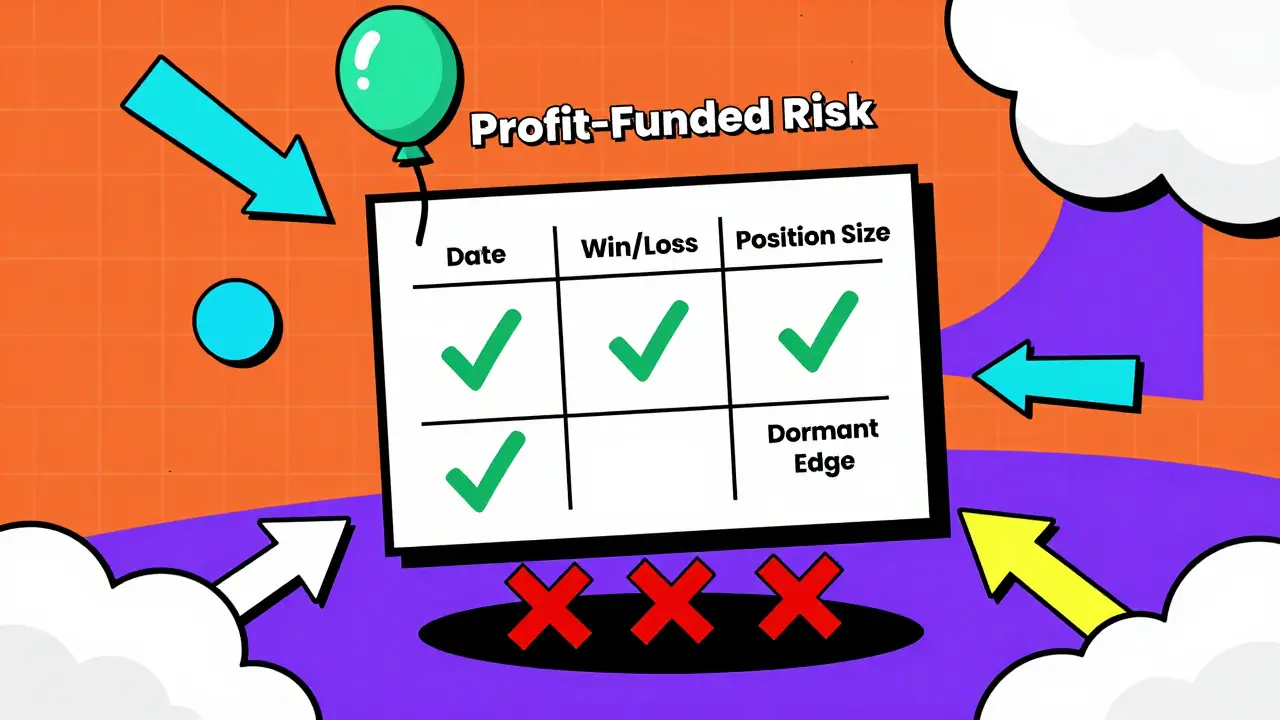
Think of it like this: if you’re hitting your targets consistently, your edge is active. If you’re getting stopped out repeatedly, your edge is dormant. Your position size should mirror that.
This isn’t about luck. It’s about feedback. You don’t increase risk because you "feel" the market is about to explode. You increase it because your last five trades were winners with clean entries and strong follow-through. You reduce it when your entries are messy, your stops keep getting hit, or your win rate drops below 40%.
It’s the opposite of what most new traders do. They lose $200, then trade $500 to get it back. They lose again, then trade $1,000. That’s negative progressive exposure. And it’s how accounts die.
How to Start: The Testing Phase
You don’t need to risk 5% of your account on your first trade. You don’t even need to risk 1%.
Start with two trades. Each at $500 position size. Risk $40 per trade. That’s 0.8% of a $5,000 account. Total risk? $80. Less than 2% of your account.
One trade hits its target: $80 profit. The other gets stopped: $40 loss. Net result? $40 profit.
Now here’s the key: the next trade risks only that $40 profit. Not your original capital. Not your savings. Just the money you made.
If you lose this trade, you’re back to even. No damage done. If you win, your profit grows. You’ve turned a $40 gain into a $80 gain. Then a $120 gain. Then $280.
At $120 in profit, you increase position size to 10% of your account. At $280, you go to 17.5%. All of it funded by profits. Your core capital? untouched.
This is how compounding works in real trading - not by betting big early, but by letting small wins build into bigger ones, safely.
When to Increase Exposure
Don’t increase position size because the market "feels" strong. Check your stats.
Look at your last 10 trades. What’s your win rate? What’s your average reward-to-risk ratio? If your win rate is above 60% and your reward-to-risk is 2:1 or better, you’re in a good environment. Time to scale up.
Also look at trade execution. Are your entries clean? Are your stops being hit by noise, or are you getting cleanly stopped on valid reversals? Are your winners holding through their targets? Strong follow-through on breakout trades? That’s a signal.
For example, if you’re trading breakout stocks and three out of your last five trades had price continue rising for 3% or more after entry, you’re in a favorable regime. Increase size. Not because you "have a hunch," but because the pattern confirms it.
Use simple filters too. If the 10-week EMA is above the 20-week EMA, and price is above both, you’re in a trending environment. That’s your green light to scale. If price is choppy between the EMAs? Stay small. Wait.
When to Reduce Exposure
When your last three trades were losers? Reduce. Not because you’re scared. Because you’re smart.
Losses aren’t just money. They’re signals. They tell you your edge isn’t working right now. Maybe the market is range-bound. Maybe your stock selection is off. Maybe you’re tired. Maybe news is distorting price action.
When losses pile up, go back to testing mode. Reduce position size to 1-2% of your account. Trade one contract. One lot. One share. Just to see if the setup still works. If you win, you’ve confirmed your edge is back. If you lose again? Step away. Take a day off. Reassess your strategy. Don’t trade until you have clarity.
Most traders don’t pause. They double down. That’s why they lose 50% of their account in three weeks. Progressive exposure stops that. It forces you to slow down when things go wrong. That’s not weakness. That’s discipline.
Why This Works for Beginners and Pros Alike
Beginners think they need to trade big to make big money. They’re wrong. Beginners need to survive. Progressive exposure lets them make mistakes without blowing up. A $40 loss on a $500 trade? That’s a lesson. A $400 loss on a $5,000 trade? That’s a trauma.
Pros use this too. Even if they have $500,000 accounts. They don’t trade 10% of their account on one setup unless their last 15 trades were winners with clean risk-reward profiles. They know that markets change. Their edge changes. Their exposure must change with it.
It’s not about being aggressive. It’s about being responsive. You’re not trying to catch every move. You’re trying to catch the ones where the odds are stacked in your favor.
How to Track It
You need a simple log. Just three columns:
- Date
- Trade outcome (win/loss)
- Position size (% of account)
Every Friday, look back. Did your win rate improve last week? Did your average profit per trade go up? If yes, next week you increase size. If not? Stay where you are. Or reduce.
Don’t overcomplicate it. No indicators. No algorithms. Just your own trading record. Your history is your best advisor.
The Psychological Shift
This strategy changes how you think about risk. You stop seeing risk as something to avoid. You start seeing it as something to earn.
When you win, you earn the right to take more risk. When you lose, you earn the right to take less. It’s not about control. It’s about adaptation.
You’re no longer gambling. You’re engineering your exposure. You’re using your own performance as the control system. And that’s powerful.
It removes emotion from position sizing. No more "I need to win this one." No more "I’m due for a winner." Just data. Just logic. Just your own track record.
Final Thought: Trade Your Best When You’re Best
The market doesn’t care if you had a bad day. It doesn’t care if you’re stressed. It doesn’t care if you’re broke. It only cares if your setup matches the environment.
Progressive exposure aligns your risk with your edge. It makes you trade your largest when the market is easiest. And your smallest when it’s hardest.
That’s not a strategy. That’s a survival mechanism. And in trading, survival isn’t optional. It’s the only thing that matters.