Quorum, Thresholds, and Turnout: Setting DAO Voting Rules
 Mar, 21 2026
When you hold tokens in a DAO, you’re not just an investor-you’re a voter. But what happens when only 3% of token holders show up to vote? Or when a single wallet controls enough votes to push through a risky change? Setting the right DAO voting rules isn’t about math alone-it’s about balancing power, participation, and protection.
What Quorum Really Means in a DAO
Quorum isn’t just a number. It’s the minimum percentage of tokens that must vote for a proposal to even be considered valid. Think of it like a meeting room: if fewer than half the people show up, the meeting doesn’t count. In DAOs, that rule is coded into the smart contract.Many early DAOs got this wrong. Yam Finance, for example, set its quorum as a percentage of total token supply-including tokens locked in treasury, staked, or held by founders who never vote. That meant the quorum was mathematically impossible to reach. No proposal could pass. Governance froze. The DAO became a ghost.
Today, the industry has learned. Most successful DAOs set quorum between 4% and 10% of circulating supply. Uniswap uses 4%. Compound started at 10%, saw proposals fail for months, then dropped it to 4%. Aave uses 2% for small changes and 6.5% for big ones. Why this range? Because below 4%, coordinated groups can hijack votes. Above 10%, you get gridlock.
Thresholds: How Much Approval Is Enough?
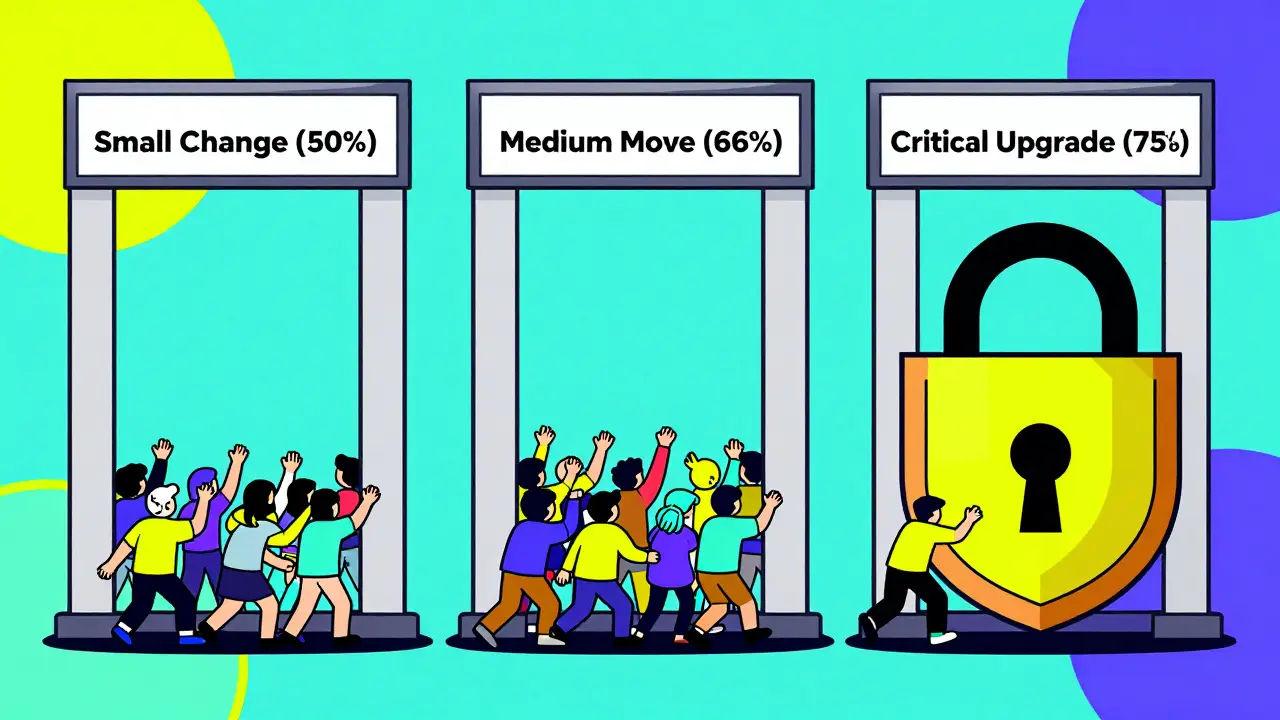
Even if a proposal reaches quorum, it still needs approval. That’s the threshold.Not all votes are equal. A $50,000 treasury spend doesn’t need the same level of consensus as a change to the core smart contract. That’s why smart DAOs use tiered thresholds:
- Simple majority (50%+): Routine treasury spending under $100,000, minor parameter tweaks.
- 66%+ supermajority: Large treasury moves ($1M+), tokenomics changes, new token launches.
- 75%+ supermajority: Critical upgrades, protocol overhauls, emergency fixes.
Why not always go for 75%? Because slow governance is dangerous too. If a security flaw is discovered and you need to patch it within 48 hours, waiting for 75% approval could mean millions lost. The trade-off is speed vs. safety. Most DAOs find a middle ground: fast for small things, slow for big ones.
Turnout Is the Hidden Problem
Here’s the uncomfortable truth: most token holders don’t vote. Ever.At Uniswap, even with a 4% quorum, voter turnout often hovers around 2-3%. That means proposals rarely even make it to the voting stage. Aave sees the same pattern. A proposal can get 90% approval from those who vote-but still fail because only 3% of total supply showed up.
This creates a strange dynamic: the most active voters-often whales or professional delegates-end up controlling outcomes. A small group with 5% of tokens can push through anything if everyone else is asleep. That’s not democracy. It’s oligarchy with a blockchain logo.
Some DAOs are trying to fix this. Arbitrum switched from a supply-based quorum to a delegated voting power (DVP) model. Instead of counting all ARB tokens ever created, it only counts the ones that are actively delegated to voters. This means quorum isn’t fixed-it adjusts as participation changes. If more people delegate, the quorum rises. If fewer do, it drops. It’s self-correcting.
How DAOs Avoid Governance Attacks
Low quorum isn’t just boring-it’s dangerous. A coordinated group with 5% of tokens can pass a proposal that drains the treasury, changes the token supply, or gives themselves unlimited voting power. This has happened before.In 2021, a DAO called SushiSwap faced a proposal that would have transferred control of its treasury to a single entity. It passed with 51% approval… but only 3% of total supply voted. The community erupted. A fork was created. The original team lost control.
That’s why thresholds matter. Even if a proposal clears quorum, a 66% or 75% approval requirement acts as a firewall. It forces broader consensus. It makes attacks expensive. If you need 66% approval and you only control 5% of tokens, you’re not winning-you’re just wasting gas.
Bancor takes it further. It uses a tiered quorum system: small co-investments (under 100,000 BNT) need 30% turnout and 80% approval. Big ones (over 100,000 BNT) need 40% turnout and 66.7% approval. It’s not arbitrary. It’s calibrated to risk. The bigger the change, the harder it is to pass.

Designing Rules for Your DAO
If you’re launching a DAO, here’s how to set your rules without repeating old mistakes:- Start with circulating supply: Never include locked, treasury, or unclaimed tokens in your quorum calculation. Only count what’s actively in play.
- Set quorum between 4% and 6%: This is the current sweet spot. Too low? You risk whale dominance. Too high? You get paralysis.
- Use tiered thresholds: 50% for small changes, 66% for medium, 75% for critical ones.
- Monitor turnout for 3 months: Track how often proposals reach quorum. If it’s under 2%, lower the quorum. If it’s over 8% and proposals pass too easily, raise it.
- Build in feedback loops: Like Arbitrum, design your system so thresholds adjust as participation changes. Don’t set it and forget it.
And remember: governance isn’t just about numbers. It’s about trust. If your community feels like their vote doesn’t matter, they’ll stop showing up. And then the whole system breaks.
The Future of DAO Voting
Quorum and thresholds are just the beginning. New models are emerging:- Quadratic voting: Lets voters distribute votes across proposals, not just yes/no.
- Conviction voting: The longer you support a proposal, the more weight your vote gains.
- Holographic consensus: Only those who care enough to vote get to decide-no quorum needed.
But until those systems are proven, the simple rules still work: set a reasonable quorum, tier your thresholds, and keep watching turnout. The best DAOs don’t have the most votes-they have the most engaged voters.
What happens if a DAO’s quorum is too high?
If quorum is too high-say, over 20%-most proposals never reach the voting stage. Even popular changes fail because voter turnout rarely hits that mark. This creates governance gridlock, where the status quo is locked in by default. DAOs like Compound learned this the hard way: they raised their quorum to 10% early on, then saw proposals stall for months. They later lowered it to 4% to fix the problem.
Can a single wallet control a DAO’s vote?
Yes-if quorum is too low and thresholds are weak. If a whale holds 15% of tokens and quorum is set at 3%, they only need to get 5% of the rest to pass any proposal. That’s why most DAOs use 4%+ quorum and 66%+ thresholds for major changes. These act as buffers. A single wallet would need to control over 30% of tokens to reliably hijack governance, which is rare and expensive.
Why do some DAOs use delegated voting power (DVP)?
DVP fixes a flaw in traditional quorum models. Most DAOs calculate quorum based on total token supply, even if many tokens are inactive. DVP only counts tokens that are actively delegated to voters. This means if fewer people vote, the quorum drops. If more do, it rises. Arbitrum adopted this to avoid gridlock as its token supply grew. It’s more adaptive and fair.
Is 50% approval enough for a DAO proposal?
It depends. For small treasury spends or minor parameter updates, yes. But for anything that changes the core protocol, token supply, or treasury structure, 50% is too weak. That’s why most DAOs use 66% or 75% for major changes. It ensures broader consensus and reduces the risk of divisive or malicious votes passing.
How often should DAOs adjust their voting rules?
DAOs should review their quorum and thresholds every 3 to 6 months, especially in the first year. Track how often proposals reach quorum and how many pass. If quorum is rarely met, lower it. If proposals pass too easily, raise thresholds. Uniswap and Compound both adjusted their rules within two years of launch based on real data-not guesswork.