
Risk Parity in Crypto: How to Balance Volatility Across Digital Asset Buckets
 Aug, 13 2026
Imagine building a house where the roof is made of glass and the foundation is made of steel. If a storm hits, you know exactly which part is going to fail first. Most cryptocurrency portfolios are built this way. You might split your money equally between Bitcoin, Ethereum, and a handful of smaller altcoins. On paper, it looks balanced. In reality, that single small-cap token could swing 50% in a week while Bitcoin moves 2%. Your "equal" investment isn't equal at all when it comes to risk.
This is where risk parity is a portfolio construction approach that allocates capital so each asset contributes an equal share of total volatility rather than equal dollars. Instead of asking how much money you put into each coin, risk parity asks how much danger each coin brings to the table. By balancing volatility across different digital asset buckets, you stop letting the wildest assets dominate your portfolio's performance. This guide breaks down how this strategy works, why it matters now more than ever, and how you can actually implement it without needing a PhD in mathematics.
Why Equal Money Doesn't Mean Equal Risk
The core problem with traditional crypto investing is volatility disparity. Let's look at a simple example. You have $10,000 to invest. You decide to put $5,000 into Bitcoin (BTC) and $5,000 into a newer, high-beta altcoin like Solana or a smaller DeFi token.
If Bitcoin drops 10%, you lose $500. If that altcoin drops 30%-which happens frequently in crypto-you lose $1,500. Even though your capital allocation was 50/50, your risk exposure was heavily skewed toward the volatile asset. The altcoin dictated the mood of your entire portfolio.
Risk parity flips this logic. It assumes that every bucket of assets should contribute roughly the same amount to the total portfolio variance. If one asset is twice as volatile as another, you only buy half as much of it. This concept originated in traditional finance with Edward Qian in 2005, but applying it to cryptocurrencies requires adjusting for the extreme swings unique to digital markets.
| Strategy | Focus | Vulnerability | Best For |
|---|---|---|---|
| Equal Weight | Dollar amount per asset | High-volatility assets dominate risk | Beginners wanting simplicity |
| Market Cap Weight | Size of the asset | Concentration in largest coins (BTC/ETH) | Passive index tracking |
| Risk Parity | Volatility contribution per asset | Requires frequent rebalancing | Risk-averse investors seeking stability |
Defining Your Digital Asset Buckets
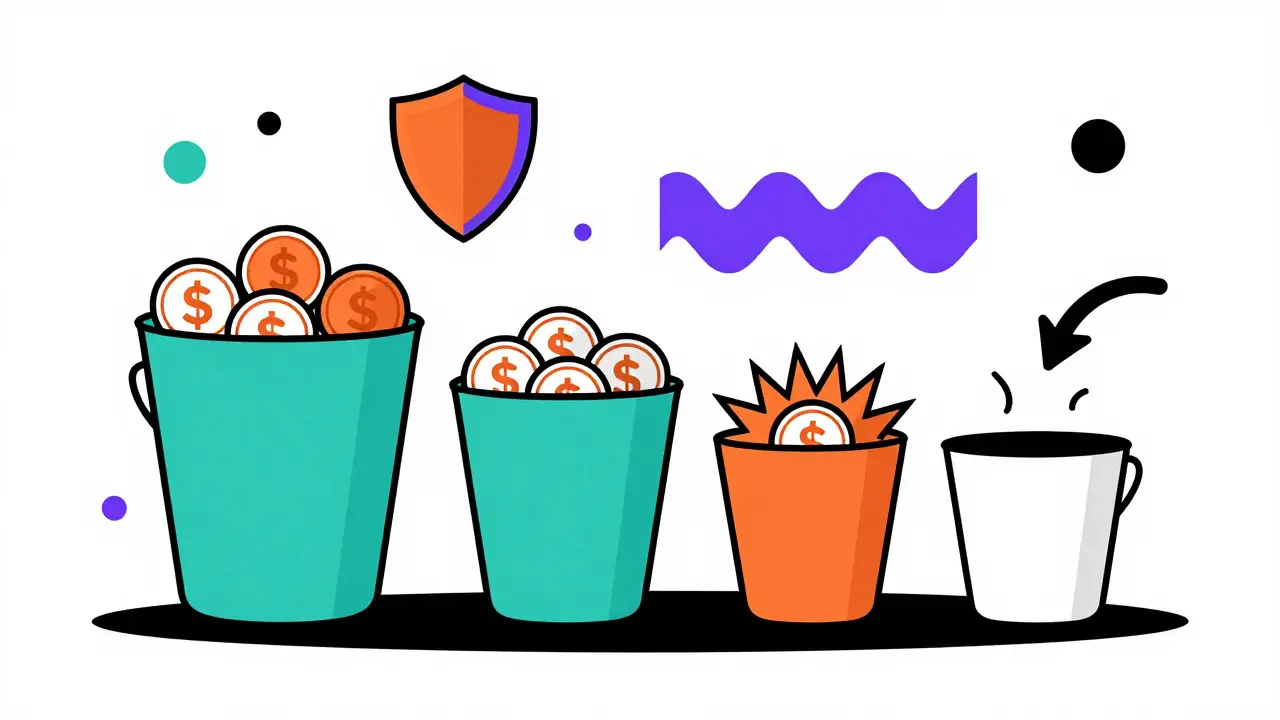
You don't treat every coin individually in a sophisticated risk parity model. Instead, you group them into "buckets" based on their behavior and correlation. This helps ensure that if one sector crashes, it doesn't drag everything else down with it.
- Large-Cap Layer-1s: Assets like Bitcoin and Ethereum. These have lower relative volatility compared to the rest of the market and act as the stabilizers.
- Mid-Cap Sector Tokens: Coins focused on specific niches like Decentralized Finance (DeFi), gaming, or infrastructure. These carry moderate risk.
- Small-Cap Speculative Tokens: Newer projects with high potential upside but massive downside risk. These need very small capital allocations to match the risk of large caps.
- Stablecoins & Yield Assets: USDC, DAI, or tokenized treasury bills. These provide yield with minimal price volatility, acting as the "safe" bucket.
The goal is to assign a risk budget to each bucket. For instance, you might decide that your speculative bucket should never contribute more than 20% of your total portfolio's daily volatility. To achieve this, you might only allocate 5% of your actual cash to that bucket, because its wild swings make up for the small size.
How to Calculate Risk Parity Weights
You don't need complex software to get started. The most common practical approximation for crypto risk parity is inverse-volatility weighting. Here is how you calculate it step-by-step:
- Gather Data: Collect daily closing prices for your chosen assets over a rolling window. A 30-to-90-day window is standard for short-term strategies, while institutional products like Binance Research’s Dynamic Crypto Risk Parity use a 24-month window for stability.
- Calculate Log Returns: Compute the daily percentage change for each asset.
- Measure Volatility: Find the standard deviation of those returns. Multiply by the square root of 365 to annualize the figure. For example, if Bitcoin has an annualized volatility of 40% and Altcoin X has 80%, Altcoin X is twice as risky.
- Invert the Volatility: Take the reciprocal of each volatility number. If BTC vol is 0.4, its inverse is 2.5. If Altcoin X vol is 0.8, its inverse is 1.25.
- Normalize: Add up all the inverses. Divide each individual inverse by that total sum. This gives you your target weight percentages.
In our example, the lower-volatility Bitcoin would receive a larger capital weight, while the higher-volatility Altcoin X receives a smaller one. The result? Both contribute roughly equal amounts of stress to your portfolio.
Real-World Examples and Institutional Adoption
This isn't just theory. As of mid-2026, several major players have operationalized these concepts. The Kaiko Hashdex Risk Parity Momentum Crypto Index (KHASHMOM), launched in July 2026, combines momentum signals with risk parity weighting. It screens for assets with positive trends and then weights them so each contributes equally to volatility.
Binance Research also published a detailed report on Dynamic Crypto Risk Parity (DRP). Their strategy uses five assets, calculates 24-month rolling volatility, and rebalances quarterly. This approach aims to perform well across all market conditions by automatically reducing exposure to assets whose volatility spikes.
On the academic side, the Econometric Society’s "Blockchain Risk Parity Line" proposes three distinct funds: Alpha (high risk), Beta (market-tracking), and Gamma (risk-free-like). Each fund internally uses inverse-risk weights. Investors can mix these buckets based on their personal comfort level, creating a customizable risk profile.

Challenges and Pitfalls to Avoid
Risk parity sounds perfect, but it has real-world friction. The biggest issue is correlation. In a true crisis, crypto assets tend to move together. If Bitcoin crashes, almost everything else crashes too. This breaks the diversification benefit temporarily. That’s why including stablecoins or uncorrelated assets like gold or bonds in your broader portfolio is crucial.
Another challenge is transaction costs. Rebalancing frequently to maintain equal risk contributions means buying and selling often. High trading fees can eat into your profits. Many practitioners suggest setting "tolerance bands." For example, only rebalance if an asset’s risk contribution drifts more than ±5% from its target. Alternatively, stick to a monthly or quarterly schedule rather than daily adjustments.
Finally, be wary of looking backward too long. Using a 24-month volatility window smooths out data but might react slowly to sudden regime changes. A coin that was calm six months ago might become wildly volatile today. Adjust your lookback period based on your trading horizon.
Getting Started: A Practical Checklist
If you want to try this yourself, start small. Don’t throw your entire net worth into a new strategy immediately.
- Start with 3-5 assets maximum to keep calculations manageable.
- Use a spreadsheet or a simple Python script to track volatility and weights.
- Set hard limits on maximum weight per asset (e.g., no single coin > 25%) to prevent over-concentration.
- Include a stablecoin bucket to absorb shocks and provide liquidity for rebalancing.
- Review your portfolio weekly, but only trade if necessary.
Risk parity won't make you rich overnight. It won't turn a bad coin into a good one. But it will help you sleep better at night. By ensuring that no single digital asset bucket dominates your risk profile, you build a portfolio designed to survive the inevitable storms of the crypto market.
What is the main difference between risk parity and equal-weighting?
Equal-weighting assigns the same dollar amount to each asset, ignoring how volatile they are. Risk parity assigns capital based on volatility, giving less money to riskier assets so that each asset contributes equally to the total portfolio risk.
Do I need programming skills to implement risk parity?
Not necessarily. While advanced users use Python or R for optimization, beginners can use spreadsheets to calculate inverse-volatility weights manually. The math involves basic standard deviation and normalization formulas.
How often should I rebalance a risk parity crypto portfolio?
It depends on your cost tolerance. Frequent rebalancing (weekly) keeps risk precise but increases fees. Quarterly rebalancing, as used by some institutional indices, reduces costs but allows risk to drift more between trades. Many retail investors find monthly reviews effective.
Can risk parity protect against a total crypto market crash?
No strategy fully protects against systemic crashes where all correlations go to 1. However, risk parity minimizes the impact of any single asset's failure. Including stablecoins or non-crypto assets in your broader portfolio enhances this protection.
What is the best time window for calculating volatility?
Short-term traders often use 30-to-90-day windows to capture recent trends. Long-term investors and index providers may use 12-to-24-month windows to smooth out noise and avoid overreacting to temporary spikes.