
Section 80C Proofs for Employers in India: How to Submit and Avoid TDS
 Jun, 24 2026
You file your income tax return every year, but have you ever stopped to think about why your employer might be deducting more tax from your monthly salary than necessary? It usually comes down to one thing: they don't know about your tax-saving investments. In India, the government allows you to reduce your taxable income by up to ₹1.5 lakh under Section 80C, which is a clause in the Income Tax Act that permits deductions for specific investments and expenses. However, this benefit doesn't happen automatically. Your employer needs proof of these investments to recalculate your Tax Deducted at Source (TDS) correctly.
If you fail to submit these proofs on time, your employer will calculate tax based on your gross salary alone. This means you'll pay more tax upfront, reducing your monthly take-home pay. While you can claim a refund when filing your annual returns, waiting months for money back isn't ideal. Knowing exactly what documents to submit, when to submit them, and how to handle common errors can save you significant cash flow issues throughout the financial year.
Understanding the Section 80C Limit and Eligibility
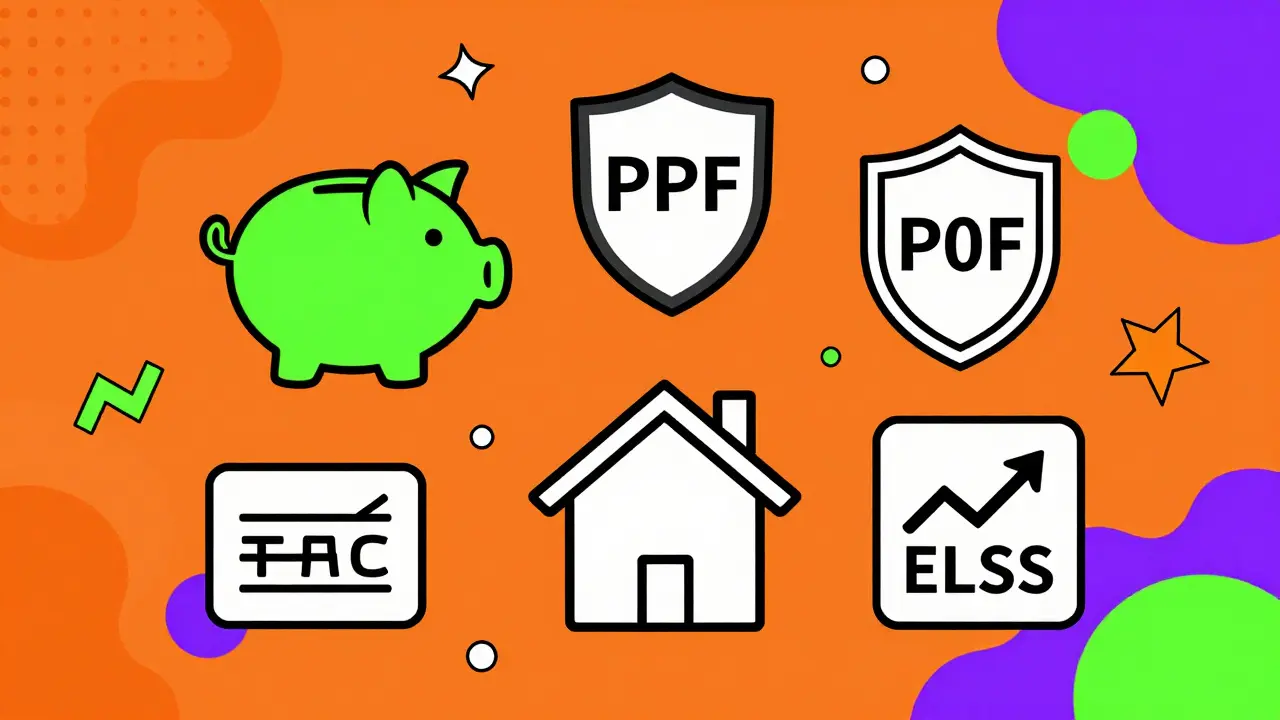
Before gathering documents, it helps to understand the scope of the deduction. The maximum deduction allowed under Section 80C is ₹1.5 lakh per financial year. This limit applies to the aggregate of all eligible investments and expenses. You cannot claim ₹1.5 lakh for Public Provident Fund (PPF) and another ₹1.5 lakh for Life Insurance Premiums separately; they are pooled together.
Eligible instruments include:
- Public Provident Fund (PPF): A long-term savings scheme with tax-free interest.
- National Pension System (NPS): Note that contributions here fall under Section 80CCD(1B) for an additional ₹50,000 deduction, but the basic contribution also counts toward the 80C limit.
- Equity Linked Savings Scheme (ELSS): Mutual funds with a three-year lock-in period.
- Tax-Saving Fixed Deposits: FDs with a five-year lock-in.
- Life Insurance Premiums: For policies issued after April 1, 2012, the deduction is limited to 10% of the sum assured.
- Sukanya Samriddhi Yojana: A savings scheme for the girl child.
- Principal Repayment of Home Loan: Only the principal component qualifies, not the interest.
- Tuition Fees
It is crucial to distinguish between investments made during the current financial year versus those carried forward. For example, life insurance premiums must be paid within the financial year to claim the deduction. Similarly, PPF contributions must be credited to your account before March 31st.
The Critical Role of Form 12BB
In most corporate setups in India, the process begins with Form 12BB, which is a prescribed format where employees declare their expected investments and expenditures for tax benefits. This form acts as a declaration rather than immediate proof. Typically, HR departments circulate this form around October or November each year.
When you fill out Form 12BB, you are telling your employer, "I expect to invest X amount in PPF and Y amount in ELSS this year." Based on this declaration, your employer recalculates your estimated annual tax liability and adjusts the monthly TDS accordingly. If you skip this step, your employer assumes zero deductions, leading to higher monthly tax cuts.
However, filling out Form 12BB is only half the battle. It is a declaration of intent. To validate this declaration, you must eventually provide actual proof of payment. Without the proof, the initial adjustment was merely an estimate, and discrepancies may arise during the final reconciliation at the end of the financial year.
Documents Required as Proof of Investment
Your employer's payroll team needs concrete evidence to adjust your tax permanently. Vague statements or screenshots of pending transactions are rarely accepted. Here is a breakdown of the specific documents required for each major investment category:
| Investment Type | Accepted Proof Document | Key Details to Verify |
|---|---|---|
| Public Provident Fund (PPF) | Bank Statement showing credit entry OR Passbook copy | Transaction date must be within the financial year (April-March). Total amount should match declaration. |
| Life Insurance Premium | Premium Receipt from the Insurance Company | Name of insured person, policy number, premium amount, and payment date. |
| Equity Linked Savings Scheme (ELSS) | CAMS/KFintech Consolidated Account Statement OR Transaction Confirmation Email | Folio number, NAV date, and units purchased. Ensure the SIP date falls within the FY. |
| Tax-Saving Fixed Deposit | FD Receipt from the Bank | Maturity date (must be 5 years), interest rate, and principal amount deposited. |
| Home Loan Principal Repayment | Interest Certificate from Lender (Form 16 equivalent for loans) | Breakup of EMI showing principal vs. interest. Only principal amount is relevant for 80C. |
| National Pension System (NPS) | Annual Statement from CRA (Central Recordkeeping Agency) | Total contribution amount for the financial year. |
A common pitfall is submitting bank statements that show a debit entry but no confirmation of the investment. For instance, if you transfer money to an ELSS mutual fund via Net Banking, the bank statement shows the debit. However, if the transaction fails or is reversed later, the investment didn't happen. Therefore, always prefer the confirmation email from the Asset Management Company (AMC) or the consolidated statement over just a bank slip.
Submission Deadlines and Internal Timelines
While the government's deadline for filing income tax returns is typically July 31st (or August 31st for audited accounts), your employer's internal deadlines are much stricter. Most companies set a cutoff date for submitting investment proofs between February 15th and March 15th.
Why so early? Payroll processing for March requires accurate data to generate Form 16, the official tax certificate issued to employees. If you submit proofs in April, after Form 16 has been generated, your employer cannot easily update your TDS calculations for that year. They would have to issue a revised Form 16, which creates administrative overhead. Consequently, late submissions are often rejected for TDS adjustment purposes, forcing you to claim the refund only during your individual ITR filing.
To avoid this, mark your calendar immediately after receiving Form 12BB. If you plan to make lump-sum investments in January or February to maximize deductions, ensure you complete the transaction and obtain the receipt well before your company's stated deadline. Do not wait until the last week of March, as banking systems can experience delays during peak periods.
How TDS Recalculation Works Behind the Scenes
Understanding the mechanics helps you verify if your employer is doing it right. When you submit your proofs, the payroll department performs a simple arithmetic operation. They take your Gross Salary, subtract the eligible Section 80C amount (up to ₹1.5 lakh), and arrive at your Revised Taxable Income.
They then apply the applicable tax slabs for the financial year. For example, in the new tax regime (which became default in FY 2023-24), standard deductions and many exemptions like 80C are not available unless you opt for the Old Regime. If you choose the Old Regime, the deduction significantly lowers your taxable base. The system calculates the total tax payable for the year, subtracts the TDS already deducted from January to the month of submission, and determines the remaining balance.
This remaining balance is spread over the remaining months of the financial year. If you submitted proofs in November, the adjusted TDS will apply from December onwards. If you submitted in February, the adjustment applies only to March. This is why early submission is financially beneficial-it reduces the number of months where you overpay tax.

Common Mistakes That Lead to Rejection
Even with correct documents, claims get rejected due to minor errors. Here are the most frequent issues:
- Incorrect Financial Year: Submitting a PPF passbook page showing a deposit made in March 2024 for the FY 2025-26 assessment. The deposit must occur within the April-March window of the current assessment year.
- Missing PAN Details: Some insurance receipts or mutual fund statements do not prominently display your Permanent Account Number (PAN). Employers need to link the investment to your identity. If PAN is missing, attach a separate KYC document.
- Exceeding Limits: Claiming ₹2 lakh for Life Insurance when the policy sum assurance restricts the deduction to 10%. Always check the policy terms.
- Duplicate Claims: Claiming the same ELSS investment under both 80C and other sections. Each rupee invested can only be claimed once.
- Illegible Scans: Blurry photos of receipts are often returned. Use a scanner app that enhances contrast and ensures all text is readable.
If your employer rejects a document, ask for specific feedback. Is it the date? The amount? Or the clarity? Correcting these issues promptly can sometimes allow for a mid-year adjustment if enough time remains in the financial year.
What Happens If You Miss the Deadline?
If you miss your employer's internal deadline, don't panic. You haven't lost the tax benefit; you've just delayed the timing of the cash flow. Your employer will continue deducting TDS based on the higher taxable income until March.
At the end of the financial year, you will receive Form 16. This form will show the TDS deducted by your employer. When you file your Income Tax Return (ITR) using ITR-1, ITR-2, or ITR-4, you will enter your actual investment details in the Schedule IA (Income Exempt u/s 10) or Schedule AI (Agricultural Income) and specifically in the section for Chapter VI-A deductions. The ITR portal will calculate your actual tax liability. Since you have already paid more tax via TDS than required, the excess amount becomes a refund.
The Income Tax Department processes these refunds electronically. Depending on the complexity of your case and whether any notices are triggered, refunds can take anywhere from 30 days to six months. While getting your money back is better than losing it, having that capital available in your monthly salary throughout the year provides better liquidity for personal expenses or further investments.
Pro Tips for Smooth Submission
To make the process effortless next year, adopt a few habits. First, digitize everything. As soon as you pay a life insurance premium or open a tax-saving FD, scan the receipt and upload it to a cloud folder labeled "Tax FY [Year]." Second, maintain a running Excel sheet tracking your 80C investments. Update it monthly. This way, when Form 12BB arrives, you already know exactly how much you have invested and how much room you have left to optimize.
Third, communicate with your HR or payroll team. Ask them explicitly about their preferred format for documents. Some companies accept emailed PDFs, while others require physical copies or uploads to a specific HR portal. Clarifying this upfront prevents back-and-forth emails later. Finally, review your Form 16 carefully when it arrives in June. Compare the "Gross Salary" and "Total Deductions" columns with your own records. If there's a discrepancy, raise it immediately before the filing deadline closes.
Can I claim Section 80C deductions if I am on the New Tax Regime?
No. Under the New Tax Regime (default since FY 2023-24), most exemptions and deductions, including Section 80C, are not allowed. You can only claim these benefits if you actively opt for the Old Tax Regime. Ensure you inform your employer of your choice via Form 12BB or the appropriate declaration form to ensure TDS is calculated correctly under the regime you prefer.
Do I need to submit proofs for every single investment?
Yes, if you want your employer to adjust your monthly TDS. Without proof, they cannot verify the investment and will assume you have no deductions. Even small amounts count towards the ₹1.5 lakh limit, so providing complete documentation ensures accurate tax calculation.
What if my investment was made in the previous financial year?
Investments must be made within the current financial year (April 1 to March 31) to be claimed for that year's tax return. You cannot carry forward unclaimed 80C investments to the next year. For example, a PPF deposit made in March 2024 counts for FY 2023-24, not FY 2024-25.
Is Form 12BB mandatory for all employees?
If you have any investments or expenditures eligible for tax deductions, yes. Form 12BB is the standard mechanism for employees to declare these to their employers. If you have no such investments, you may not need to submit it, but confirming with your HR department is advisable to ensure your TDS is calculated optimally.
Can I claim tuition fees for more than two children?
No. The deduction for tuition fees under Section 80C is strictly limited to the education of up to two children. Expenses for a third child or higher are not eligible for this deduction.