
Shamir Secret Sharing for Crypto Seeds: A Practical Guide to SLIP-39
 Jun, 17 2026
Imagine you have a single piece of paper that controls access to your life savings. If that paper burns in a house fire, your money is gone forever. If someone steals it, your money is gone forever. This is the reality for most cryptocurrency holders who rely on a standard 12 or 24-word seed phrase. It’s a fragile system with a single point of failure.
There is a better way. Shamir Secret Sharing is a cryptographic method that splits a secret into multiple parts, allowing recovery only when a specific number of those parts are combined. By using this technique, you can protect your crypto assets from both theft and loss simultaneously. You don't need to be a mathematician to use it; you just need to understand how to set up your shares correctly.
What Is Shamir Secret Sharing?
Shamir Secret Sharing (SSS) was created by Adi Shamir, one of the inventors of RSA encryption, back in 1979. The core idea is simple but powerful: instead of keeping one copy of a secret, you break it into several pieces called "shares."
Here is the magic part. These shares are not like splitting a pizza where each slice is a fraction of the whole. In SSS, each share looks like random noise. Having one share tells an attacker absolutely nothing about the original secret. Having two shares still tells them nothing. But once they collect enough shares to meet a pre-set limit-called the threshold-the secret instantly snaps back into existence.
In the world of cryptocurrency, this concept has been standardized as SLIP-0039, commonly known as Shamir Backup. This standard turns complex mathematical data into human-readable word lists, making it possible for regular users to implement military-grade security for their wallets.
How Thresholds Work: The (t, n) Scheme
To use Shamir Secret Sharing effectively, you need to define two numbers: n (the total number of shares you create) and t (the threshold, or how many shares are needed to recover the seed). This is often written as a "t-of-n" scheme.
Let’s look at a common example: a 3-of-5 setup.
- You generate 5 unique shares.
- You set the threshold to 3.
- If you lose 2 shares (perhaps due to fire or misplacement), you still have 3 left. You can recover your wallet.
- If a thief steals 2 shares, they have 0% chance of accessing your funds because they haven’t reached the threshold of 3.
This creates a safety net that a single seed phrase cannot provide. With a traditional BIP-39 seed, losing one copy means total loss, and stealing one copy means total compromise. With SSS, you balance risk against redundancy.
The Math Behind the Magic (Simplified)
You might wonder if there is any hidden weakness. Can a hacker guess the secret if they have two out of three shares? The answer is no, thanks to polynomial interpolation over a finite field.
Think of it like drawing a curve on a graph. The secret is a specific point on that curve. To draw the exact same curve, you need a certain number of points. If you only have one or two points, there are infinite possible curves that could pass through them. Therefore, the original secret remains mathematically impossible to determine. Only when you have enough points to pin down the unique curve does the secret reveal itself. This provides what cryptographers call "information-theoretic security," meaning even a supercomputer couldn't brute-force the missing information.

Setting Up Shamir Backup with SLIP-39
The practical implementation of this theory for crypto users comes via the SLIP-39 standard. Unlike the older BIP-39 standard which uses 12 or 24 words, SLIP-39 shares typically consist of 20 or 33 words from a specialized word list.
Here is how you actually do it:
- Choose Your Device: Not all wallets support SLIP-39. The Trezor Model T was the first hardware wallet to fully implement this standard. Ensure your device supports Shamir Backup before starting.
- Select Your Threshold: Decide on your t-of-n ratio. For personal use, 2-of-3 or 3-of-5 is common. For families or businesses, you might choose 5-of-8.
- Generate Shares: The device will generate the shares internally. Never let these shares touch an internet-connected computer.
- Record the Shares: Write down each 20 or 33-word list carefully. Each share must be stored separately.
- Distribute Securely: Place the shares in different physical locations. Do not keep them all in the same safe.
Physical Storage: Metal vs. Paper
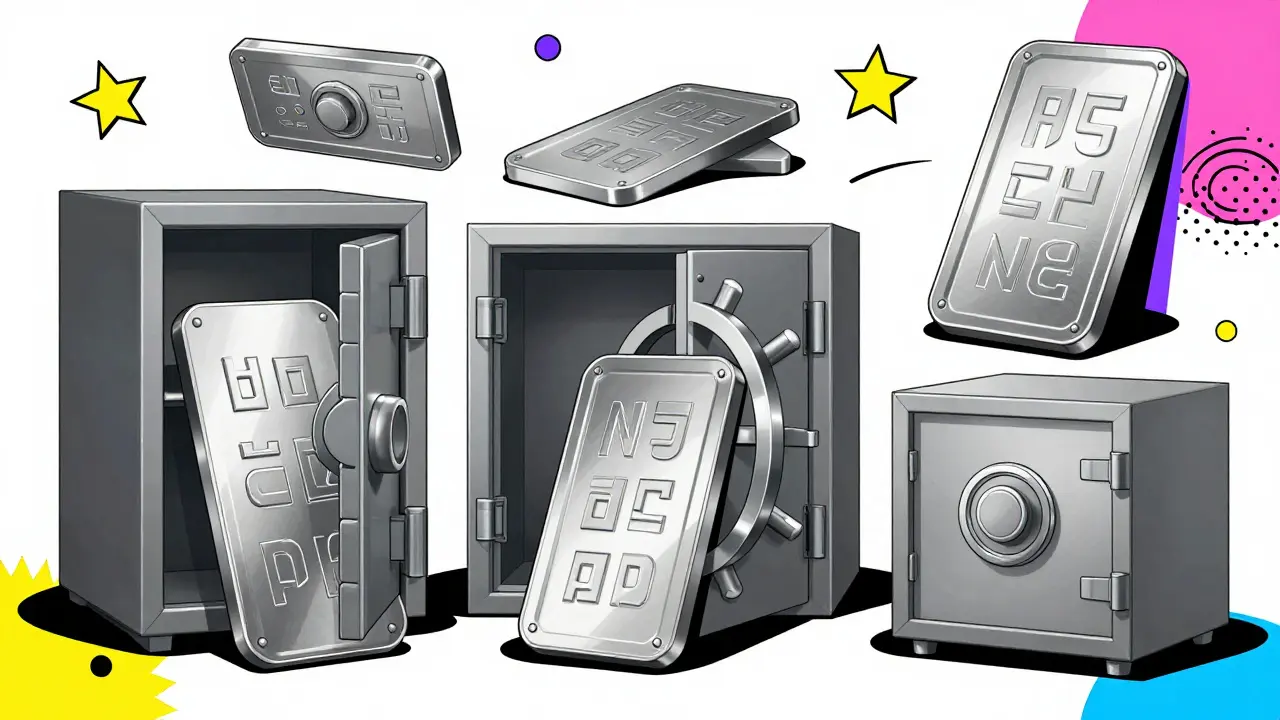
Once you have your digital shares, you need to store them physically. Paper is cheap but vulnerable to fire, water, and decay. This is why many serious holders turn to metal backups.
Companies like Cryptotag and Coinplate offer titanium or steel plates designed specifically for SLIP-39 word lists. Since each share is longer than a standard seed phrase, ensure your metal plate has enough space for 33 words if you choose that configuration. Engraving these shares onto metal ensures that even if your house burns down, your shares survive.
| Feature | Single Seed (BIP-39) | Shamir Backup (SLIP-39) |
|---|---|---|
| Protection against Loss | Low (requires multiple copies) | High (redundant shares) |
| Protection against Theft | None (one copy = full access) | High (needs threshold shares) |
| Complexity | Simple | Moderate (requires planning) |
| Share Format | 12-24 words | 20-33 words per share |
| Hardware Support | Universal | Limited (e.g., Trezor Model T) |
Common Mistakes to Avoid
Even with strong cryptography, human error can lead to lost funds. Here are the biggest pitfalls:
- Storing shares together: If you put all 5 shares in the same safe, you’ve gained nothing over a single seed. Spread them out geographically.
- Choosing a threshold too high: If you set a 5-of-5 threshold, you lose the ability to recover if even one share is damaged. Always leave room for error (e.g., 3-of-5).
- Using unverified software: Only use trusted, open-source hardware wallets to generate shares. Generating shares on a phone or PC exposes them to malware.
- Failing to test: Before moving significant funds, perform a dry run. Generate a small test wallet, split the shares, and try to recover it. This confirms you understand the process.
Shamir Backup vs. Multisig Wallets
You may hear about multisignature (multisig) wallets as an alternative. It’s important to distinguish between the two. Multisig distributes spending authority across multiple keys. Shamir Secret Sharing distributes backup knowledge of a single key.
They are not mutually exclusive. In fact, they work best together. You could have a 2-of-3 multisig wallet where each of the three keys is backed up using Shamir Secret Sharing. This adds layers of security, ensuring that neither a single compromised key nor a single lost backup can drain your account.
Who Should Use Shamir Secret Sharing?
If you hold long-term crypto investments, SSS is highly recommended. It solves the inheritance problem elegantly. You can give one share to your spouse, one to your lawyer, and keep one yourself. Neither party can access the funds alone, preventing accidental spending or unauthorized access, but together they can recover the assets if necessary.
For casual traders with small amounts, the complexity might not be worth it. Stick to a simple hardware wallet with a single seed stored in a fireproof box. But for anyone treating crypto as a significant asset class, Shamir Secret Sharing offers peace of mind that simple backups cannot match.
Is Shamir Secret Sharing safer than a normal seed phrase?
Yes, in terms of resilience. A normal seed phrase is vulnerable to total loss if destroyed and total theft if stolen. Shamir Secret Sharing protects against both by requiring multiple shares for recovery and rendering fewer-than-threshold shares useless to attackers.
Can I convert my existing BIP-39 seed to SLIP-39?
Generally, no. You should generate a new wallet using SLIP-39 from the start. Converting an existing seed requires trusting third-party tools, which introduces security risks. It is safer to create a new Shamir-backed wallet and move your funds to it.
What happens if I lose more shares than allowed?
If you lose more shares than the remaining threshold allows (e.g., you have a 3-of-5 setup and lose 3 shares), you cannot recover the wallet. This is why choosing a lower threshold relative to the total shares is crucial for redundancy.
Do I need the same device to recover my shares?
You need a device that supports SLIP-39 recovery. While the Trezor Model T generated the shares, other compatible devices or future standards-compliant wallets should also be able to recover them, provided they adhere to the SLIP-39 specification.
Are SLIP-39 shares backward compatible with BIP-39 wallets?
No. SLIP-39 uses a different word list and structure. You cannot enter a SLIP-39 share into a wallet that only accepts BIP-39 seeds. You must use a wallet that explicitly supports Shamir Backup/SLIP-39.