
Slashing Avoidance: Validator Best Practices and Monitoring for Proof-of-Stake Networks
 Dec, 10 2025
What Is Slashing-and Why Should You Care?
Slashing isn’t just a technical term-it’s a financial risk that can wipe out your staked cryptocurrency overnight. In proof-of-stake (PoS) blockchains like Ethereum, Cosmos, and Solana, validators earn rewards for helping secure the network. But if you make a mistake-like signing two different blocks at the same time or going offline too long-the network punishes you by burning part or all of your stake. This is slashing.
It’s not a bug. It’s a feature. Slashing exists to keep the network honest. If validators could act selfishly without consequence, the whole system would collapse. That’s why over 98.7% of major PoS networks use it. Ethereum alone protects more than $57.3 billion in staked ETH because of these penalties.
But here’s the truth: most slashing incidents aren’t malicious. They’re accidental. A power outage. A misconfigured server. A corrupted database. One small mistake, and you lose hundreds or thousands of dollars. That’s why knowing how to avoid slashing isn’t optional-it’s survival.
The Three Big Ways Validators Get Slashed
If you’re running a validator, you need to know exactly what triggers slashing. On Ethereum, the most common networks, there are three main offenses:
- Double-signing: Proposing or attesting to two different blocks at the same slot. This looks like cheating. The network treats it as malicious intent and responds harshly.
- Surround voting: Attaching attestations to conflicting checkpoints in a way that undermines finality. It’s complex, but essentially, you’re confusing the network about what’s real.
- Extended downtime: Missing more than 32 consecutive epochs (about 6.4 hours). This isn’t a minor glitch-it’s a failure to participate. The network assumes you’re offline on purpose.
Penalties vary. Double-signing on Ethereum can burn 5% of your stake and permanently remove you from the validator set (called tombstoning). Downtime penalties are smaller but add up fast. If you miss 32 epochs, you lose 0.5 ETH. Miss more, and the penalty grows.
Other networks handle it differently. Cosmos slashes 5% for double-signing but only 0.01% for downtime. Solana just started slashing in February 2025 and now burns 5% for malicious behavior. Near Protocol is more forgiving-minor penalties are temporary and recoverable after 36 hours. But Ethereum remains the strictest. And since it’s the largest PoS network, its rules set the standard.
How to Build a Slashing-Proof Validator Setup
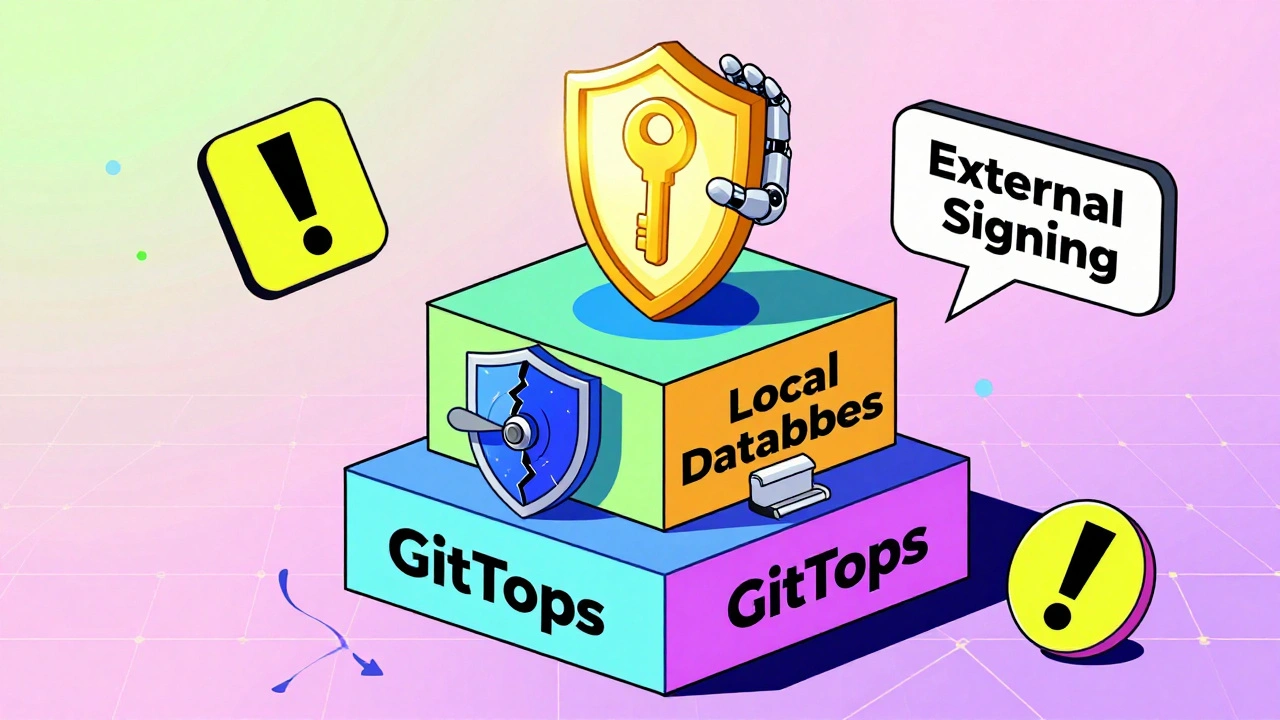
Avoiding slashing isn’t about luck. It’s about layers. The most successful validators use a three-tier defense system:
- GitOps Validation: This is automated code deployment. Instead of manually updating your validator software, you use version control (like Git) to push changes. If a new config might cause duplicate signing, the system blocks it before it ever runs. This stopped 99.2% of slashable errors in Kiln’s 2025 study across 12,500 validators.
- Local Anti-Slashing Database: Your validator client keeps a record of every block and attestation it signs. If it tries to sign the same slot twice, the database says, “Nope.” This is the first line of defense. But it’s fragile. If the database gets corrupted (which 22% of self-managed validators report), you’re vulnerable. That’s why daily automated backups are non-negotiable.
- External Signing Authority: This is the gold standard. Instead of letting your validator client sign directly, you use a separate, hardened system (like Lighthouse or Prysm with external signing) that manages keys and prevents duplicates across multiple machines. Validators using this setup saw slashable incidents drop to just 0.07%, compared to 4.3% for those relying only on local databases.
Enterprise validators-like those at Coinbase Cloud or Kiln-use all three. DIY validators often skip the third. That’s why independent operators have 32% more near-miss incidents, according to Stakefish’s 2025 report.
Monitoring: Your Early Warning System
Slashing doesn’t happen in a flash. It builds over hours. That’s why monitoring isn’t a nice-to-have-it’s your lifeline.
Every professional validator uses Prometheus and Grafana. These tools track real-time metrics like:
- Time since last attestation: If it hits 30 slots (about 6 minutes), you’re in danger.
- Missed attestations per epoch: More than 3 missed in one epoch? Time to check your connection.
- Validator balance changes: Any unexpected drop? That’s a red flag.
Sarah Chen, a validator operator in Manchester, cut her near-miss incidents from 3.2 to 0.4 per month just by setting alerts at 95% uptime. That’s the power of proactive monitoring.
Don’t rely on email. Use Discord, Telegram, or SMS alerts. One validator on r/ethstaker recovered from a storm-induced outage because his system alerted him at 99.5% uptime-he had 8 minutes to switch to his backup node before hitting the 32-epoch cutoff.
Hardware and Network Requirements
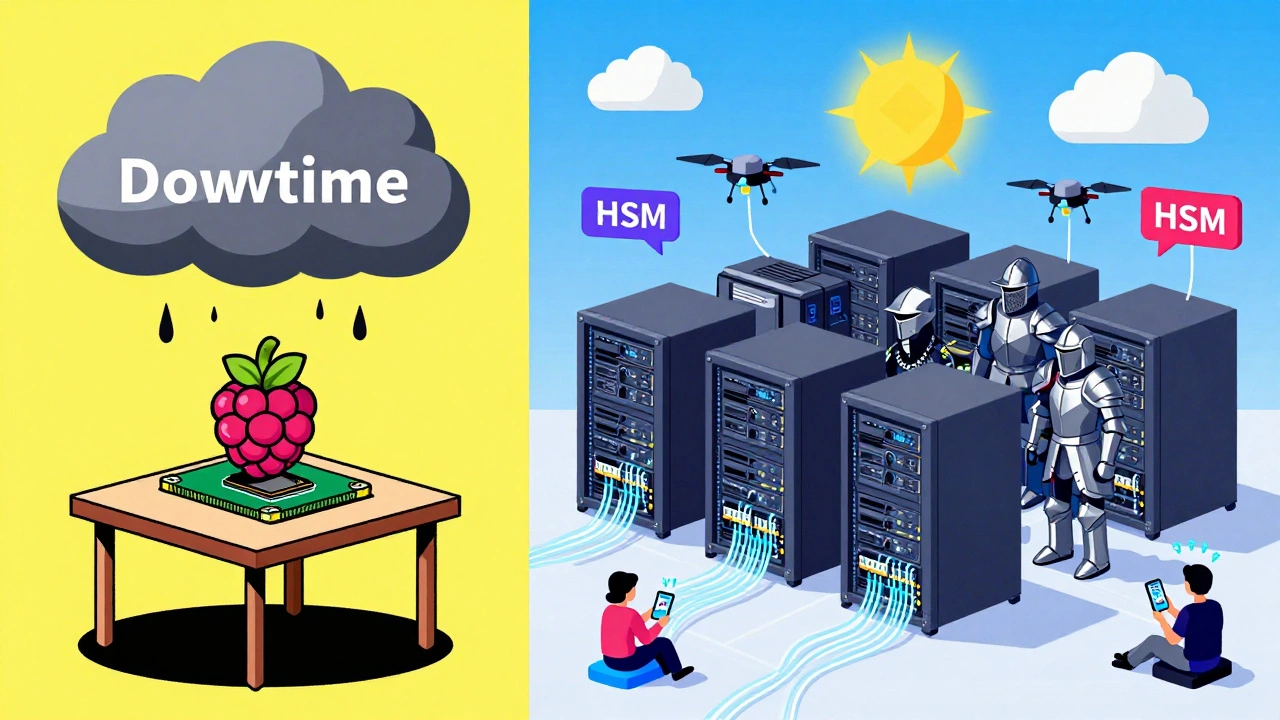
You can’t run a reliable validator on a Raspberry Pi. The Proof-of-Stake Alliance’s 2025 hardware guidelines are clear: minimum 8-core CPU, 32GB RAM, 1TB NVMe SSD. Why? Because your validator is constantly syncing, signing, and logging. If your disk slows down, your attestation misses.
Network uptime? Aim for 99.95%. That’s less than 22 minutes of downtime per month. To hit that, use sentry nodes. These are geographically separate machines that relay your validator’s traffic. If your main node loses internet, the sentry keeps it connected. 78% of professional validators use them.
And never store your validator keys on your main server. Use a Hardware Security Module (HSM). It’s a physical device that keeps your private keys isolated. Even if your server gets hacked, your keys stay safe.
What’s Next? The Future of Slashing Protection
The industry is moving fast. Ethereum’s upcoming “Slashing Protection as a Service” (SPaaS), launching in Q2 2026, will let any validator plug into a standardized network-level protection system. It could reduce accidental slashing by another 40%.
Chainlink’s new decentralized slashing protection network-using 1,024 oracle nodes to monitor validators-has already hit 99.8% detection accuracy in tests. That means even if your local system fails, someone else is watching.
But there’s a dark side. As slashing protection becomes more complex, only big players can afford it. Ethereum’s validator set saw a 17% rise in institutional participation after enterprise tools became standard. Smaller operators are getting squeezed. The World Economic Forum warns this could lead to centralization-the very thing PoS was meant to fix.
Common Pitfalls and How to Avoid Them
Here’s what goes wrong-and how to fix it:
- Database corruption: Happens to 22% of self-hosted validators. Fix: Daily encrypted backups. Test restores monthly.
- Network partitioning: Your validator loses connection but thinks it’s still online. Fix: Use sentry nodes and monitor peer count.
- Outdated software: Running old versions of Lighthouse or Prysm? You’re vulnerable. Fix: Automate updates with GitOps.
- Single point of failure: All your nodes in one data center. Fix: Use multiple cloud providers or geographically spread servers.
And never, ever share validator keys. Ever. Even with a friend. One copy of your key on another machine is enough to trigger a double-sign slash.
Should You Run Your Own Validator?
Running your own validator gives you full control. But it’s high-risk. If you’re not comfortable with Linux, networking, and automated monitoring, don’t do it.
Most people are better off using a trusted service. Coinbase Cloud, Kiln, and Figment offer enterprise-grade slashing protection, 24/7 monitoring, and recovery tools. Their clients report 89% satisfaction-mainly because they never had to worry about slashing.
But if you’re determined to go solo, start small. Stake 1 ETH. Learn the tools. Build your stack. Test your alerts. Then scale.
Final Thought: Slashing Is a Feature, Not a Bug
Slashing isn’t there to punish you. It’s there to protect the network-and by extension, your stake. The goal isn’t to avoid slashing at all costs. It’s to understand it, respect it, and build systems that work with it.
Use the right tools. Monitor constantly. Layer your defenses. And never assume you’re immune. The best validators aren’t the ones who never make mistakes. They’re the ones who never get slashed because they caught the mistake before it happened.
What happens if I get slashed on Ethereum?
If you’re slashed for double-signing, 5% of your staked ETH is burned, and you’re permanently removed from the validator set (tombstoned). For downtime, you lose 0.5 ETH for missing 32 epochs, with penalties increasing the longer you’re offline. You can’t recover from tombstoning-you’d need to deposit new ETH and rejoin as a new validator.
Can I get slashed for going offline during a power outage?
Yes, if you’re offline for more than 32 consecutive epochs (about 6.4 hours). That’s why professional validators use backup power (UPS) and sentry nodes. A 10-minute outage won’t slash you-but a 7-hour one will. Monitoring tools alert you before you hit that threshold.
Do I need a Hardware Security Module (HSM)?
If you’re staking more than 1 ETH, yes. HSMs keep your validator keys physically separate from your main server. Without one, a single hack can steal your keys and lead to double-signing-even if you didn’t mean to. Coinbase and Kiln require HSMs for institutional clients. It’s a small cost for massive protection.
Is it better to use a validator service or run my own?
For most people, using a service is safer and easier. Services like Coinbase Cloud, Kiln, and Figment handle monitoring, updates, and slashing protection for you. You still earn rewards, but you avoid the technical risk. Only run your own if you have the time, skills, and infrastructure. Self-stakers account for 73% of all slashing incidents, according to Blockchain Analytics Group.
What’s the cheapest way to avoid slashing?
The cheapest way is using open-source tools: DappNode for easy setup, Prometheus/Grafana for monitoring, and Lighthouse with external signing. You’ll need a decent server (8-core, 32GB RAM, NVMe) and reliable internet. Total cost: under $500 upfront. But time investment is high. If your time is worth more than $20/hour, a service is cheaper.
Will slashing ever be removed from PoS networks?
No. Slashing is fundamental to PoS security. Without it, validators have no economic reason to behave honestly. Even new networks like Avail and Celestia use slashing. The trend is toward smarter, more calibrated slashing-not removal. The goal is to punish only malicious or negligent behavior, not honest mistakes.