
Soulbound Tokens Explained: The Rise of Non-Transferable NFTs in Web3
 May, 12 2026
Imagine buying a rare digital trading card. You love it, but you can never sell it, trade it, or give it away. It is stuck to your wallet forever. That sounds like a nightmare for most crypto traders, right? But for the next generation of Soulbound Tokens (SBTs), this permanence is exactly the point.
We are used to thinking of NFTs as assets you buy, hold, and flip for profit. But what if a token wasn't about ownership of an asset, but proof of who you are? What if it represented your university degree, your work history, or your reputation in a decentralized community?
This is where Soulbound Tokens come in. They represent a massive shift in how we think about value on the blockchain. Instead of financial speculation, they focus on identity, credentials, and trust. If you have been hearing whispers about "Web3 identity" or "non-transferable badges," this guide will break down exactly what they are, how they work technically, and why they might change how you prove your skills online.
What Are Soulbound Tokens?
To understand SBTs, you first need to look at their origins. The concept was introduced in May 2022 by researchers E. Glen Weyl, Puja Ohlhaver, and Ethereum co-founder Vitalik Buterin. In their paper titled 'Decentralized Society: Finding Web3's Soul,' they proposed a new type of token that cannot be transferred between wallets.
The name itself comes from the popular game World of Warcraft. In the game, some items are "soulbound." Once you pick them up, they are bound to your character. You cannot mail them to a friend, sell them on the auction house, or drop them on the ground. They stay with you until you delete your character.
Soulbound Tokens (SBTs) are non-transferable digital tokens permanently bound to a specific wallet address, representing identity, credentials, or achievements rather than tradable assets.
In the world of blockchain, this means once an SBT is minted to your wallet, it stays there. You cannot send it to someone else. This simple restriction changes everything. It stops these tokens from being used for financial speculation and forces them to serve a different purpose: proving something about the holder.
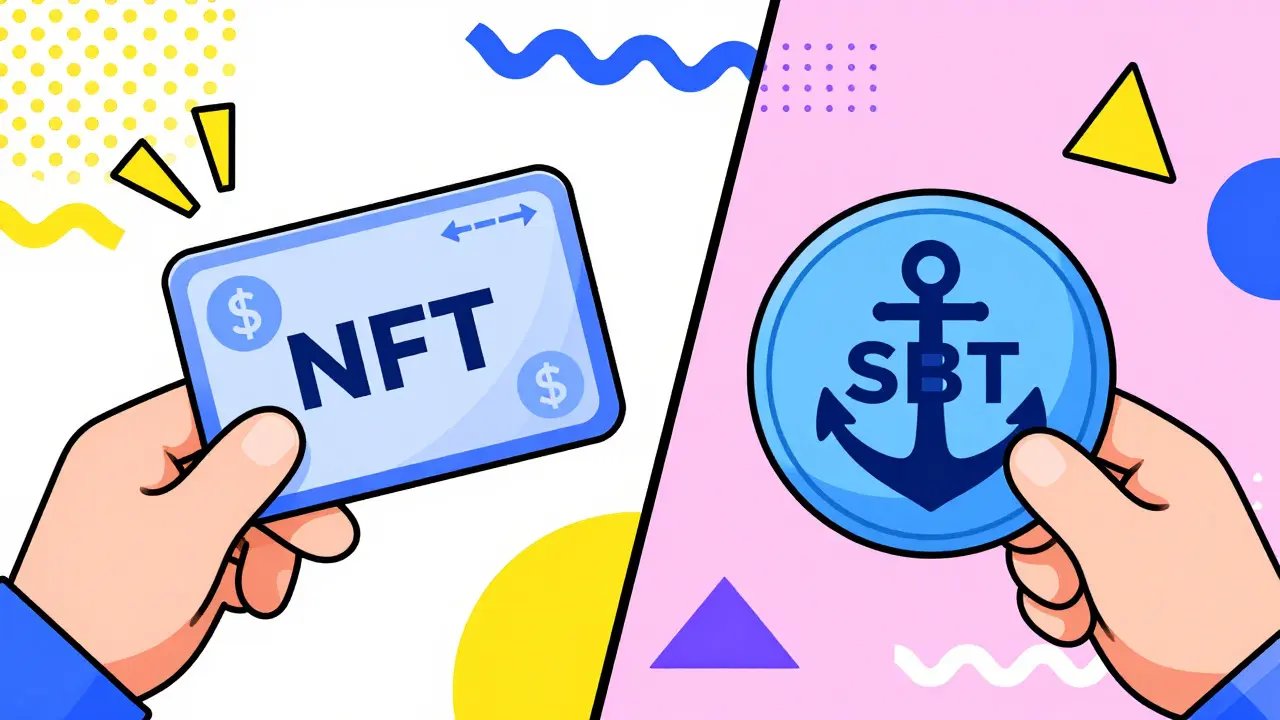
The Core Difference: SBTs vs. Traditional NFTs
Most people know NFTs as unique digital collectibles. You might buy a Bored Ape or a CryptoPunk because you hope its value goes up. The core feature of an NFT is transferability. You own it, and you can move it.
SBTs flip this model. Here is the breakdown:
- Transferability: NFTs can be sold and traded freely. SBTs cannot be transferred once minted.
- Purpose: NFTs are often financial assets or collectibles. SBTs are primarily for identity, reputation, and credentials.
- Value Source: NFT value comes from market demand and scarcity. SBT value comes from the credibility and utility of the information they represent.
- Liquidity: NFTs have liquidity; you can cash out. SBTs are illiquid by design.
Think of an NFT like a painting you hang in your living room. You can sell it if you want more money. Think of an SBT like a tattoo. It marks something about you-your loyalty, your experience, your status-and it doesn't go anywhere when you leave the room.
How Soulbound Tokens Work Technically
You might wonder, "Can't I just write code that blocks transfers?" Technically, yes. You could take a standard ERC-721 smart contract and remove the `transfer` function. But real-world use cases are messier than that. You need standards that handle revocation, expiration, and consent.
The Ethereum community has developed specific standards to handle this complexity. Two major ones are gaining traction:
| Standard | Key Feature | Best Use Case |
|---|---|---|
| ERC-5114 | Creates a "Soulbound Badge" permanently attached to an existing NFT. | Digital certifications linked to specific assets. |
| ERC-5484 | Requires mutual consent for issuance and defines immutable burn authorization. | Credentials requiring user permission before minting. |
ERC-5114 allows developers to attach a badge to an existing NFT, creating a persistent identifier for credentials that remains linked throughout the asset's lifecycle. This is useful if you want to prove that a specific digital art piece was created by a verified artist, without allowing that verification badge to be separated from the art.
ERC-5484 focuses on consent and revocation, ensuring that users agree to receive a credential and providing clear rules for how it can be burned or removed if necessary. This is critical for things like job references or medical records, where privacy and accuracy matter more than permanence.
Real-World Use Cases for SBTs
If you can't sell them, why would anyone want one? Because they solve huge problems in trust and verification. Here is where SBTs shine.
1. Education and Credentials
Imagine finishing your degree. Instead of getting a piece of paper that employers have to manually verify, you get an SBT. It lives in your wallet. When you apply for a job, the employer can instantly see that the token came directly from your university's official wallet. No fake diplomas, no paperwork delays. The token proves you did the work, and since it can't be transferred, you can't buy a degree from someone else.
2. Professional Reputation
In freelance markets, trust is hard to build. SBTs can act as reputation markers. If you complete five successful projects for a client, they might issue you an SBT acknowledging that partnership. Over time, your wallet becomes a portfolio of trusted relationships. These tokens aren't worth money directly, but they open doors to better opportunities.
3. Event Attendance and Community Membership
Have you ever attended a conference and wanted a permanent record of being there? An SBT can serve as a digital ticket stub that never leaves your wallet. It proves you were part of that community at that time. Some DAOs (Decentralized Autonomous Organizations) use SBTs to ensure that only active members can vote, preventing people from buying voting power on the secondary market.
4. Financial Identity
Traditional credit scores are opaque and controlled by big banks. In Web3, your transaction history is public. SBTs could summarize this data into a readable "credit score" token. If you have a history of repaying loans on time, a protocol could issue you an SBT reflecting that reliability. This helps you access loans without needing traditional bank documentation.

The Challenges: Revocation and Privacy
It sounds great, but there are serious hurdles. The biggest one is revocation. What happens if you lose your job? Or if a university discovers you cheated on your exams? If the SBT is truly permanent, you carry that false credential forever.
This is why standards like ERC-5484 are important. They allow for "burning" or revoking tokens under specific conditions. However, implementing this requires careful governance. Who decides when to revoke? How do you prevent abuse?
Privacy is another concern. If your wallet contains SBTs for your medical history, education, and political affiliations, anyone looking at your address sees everything. Developers are working on zero-knowledge proofs to allow you to prove you have a certain credential (like being over 18) without revealing the underlying data.
Are SBTs Ready for Mainstream Adoption?
As of 2026, SBTs are still largely experimental. While the technology exists, widespread adoption faces friction. Users are not yet comfortable linking their real-world identity so closely to a single wallet address. The risk of losing access to your "digital soul" if you lose your private keys is a significant barrier.
However, the trend is moving toward hybrid models. We are seeing more platforms integrate SBTs alongside traditional NFTs. For example, a gaming platform might let you trade your weapons (NFTs) but keep your achievement badges (SBTs) locked to your account. This balances the desire for liquidity with the need for reputation.
The infrastructure is maturing. Wallets are starting to display SBTs differently from NFTs, highlighting their role as identity markers rather than assets. As more institutions experiment with issuing digital credentials via blockchain, SBTs will likely become the standard for verifiable online identity.
Can I sell a Soulbound Token?
No. By definition, Soulbound Tokens are non-transferable. Once minted to your wallet, they cannot be sold, traded, or sent to another address. Their value lies in the identity or credential they represent, not in market speculation.
Who invented Soulbound Tokens?
The concept was introduced in May 2022 by E. Glen Weyl, Puja Ohlhaver, and Vitalik Buterin in their research paper 'Decentralized Society: Finding Web3's Soul.'
What is the difference between ERC-721 and ERC-5114?
ERC-721 is the standard for most NFTs, which are transferable. ERC-5114 is a standard specifically designed for Soulbound Badges, which are permanently attached to an existing NFT and cannot be transferred separately.
Can SBTs be revoked?
Yes, depending on the implementation. Standards like ERC-5484 include mechanisms for revocation or burning tokens. This is crucial for correcting errors or removing fraudulent credentials, though the specific rules depend on the issuer.
Why are SBTs called "Soulbound"?
The term is inspired by World of Warcraft, where "soulbound" items cannot be traded or mailed to other characters. Similarly, SBTs are bound to a specific wallet or "soul" and cannot be transferred.
Are SBTs safe from hacking?
SBTs are stored in your wallet, so they face the same security risks as any other crypto asset. If someone steals your private keys, they gain access to your SBTs. However, since SBTs cannot be transferred out of your wallet, a hacker cannot sell them for profit, reducing the incentive for theft compared to valuable NFTs.