
Stablecoin Adoption: Which Cryptocurrencies Are Winning in 2026
 Feb, 18 2026
By early 2026, stablecoins aren’t just another crypto asset-they’re the backbone of digital finance. If you’re still thinking of them as just a way to avoid Bitcoin’s rollercoaster, you’re missing the bigger picture. Today, stablecoins move more money than Visa. They pay workers overseas, settle B2B invoices, fuel DeFi loans, and help people in countries with collapsing currencies keep their savings intact. And two coins are pulling away from the pack: USD Coin (USDC) and Tether (USD₮).
Two Coins Dominate the Market
In 2026, USDC and USD₮ together control over 95% of the entire stablecoin market. It’s not even close. USDC, issued by Circle, saw its circulation grow 78% year-over-year in 2025. By November 2024, it was already hitting $1 trillion in monthly on-chain transactions. Total lifetime volume? Over $18 trillion. That’s not a typo. Tether, meanwhile, remains the workhorse of crypto trading. It’s the first thing traders turn to when moving in and out of Bitcoin or Ethereum. Together, these two have turned stablecoins into the most used digital currency on Earth.Why do they win? It’s not luck. It’s infrastructure. Both have deep ties to banks, exchanges, and payment networks. USDC is backed by fully audited U.S. dollars held in regulated institutions. Tether, despite past controversies, now operates with near-transparent reserves and has spent years building trust with institutional users. New stablecoins keep popping up-euro-pegged ones, gold-backed ones, even ones tied to corporate bonds-but none come close to matching their liquidity or global reach.
Payments Are the Biggest Growth Engine
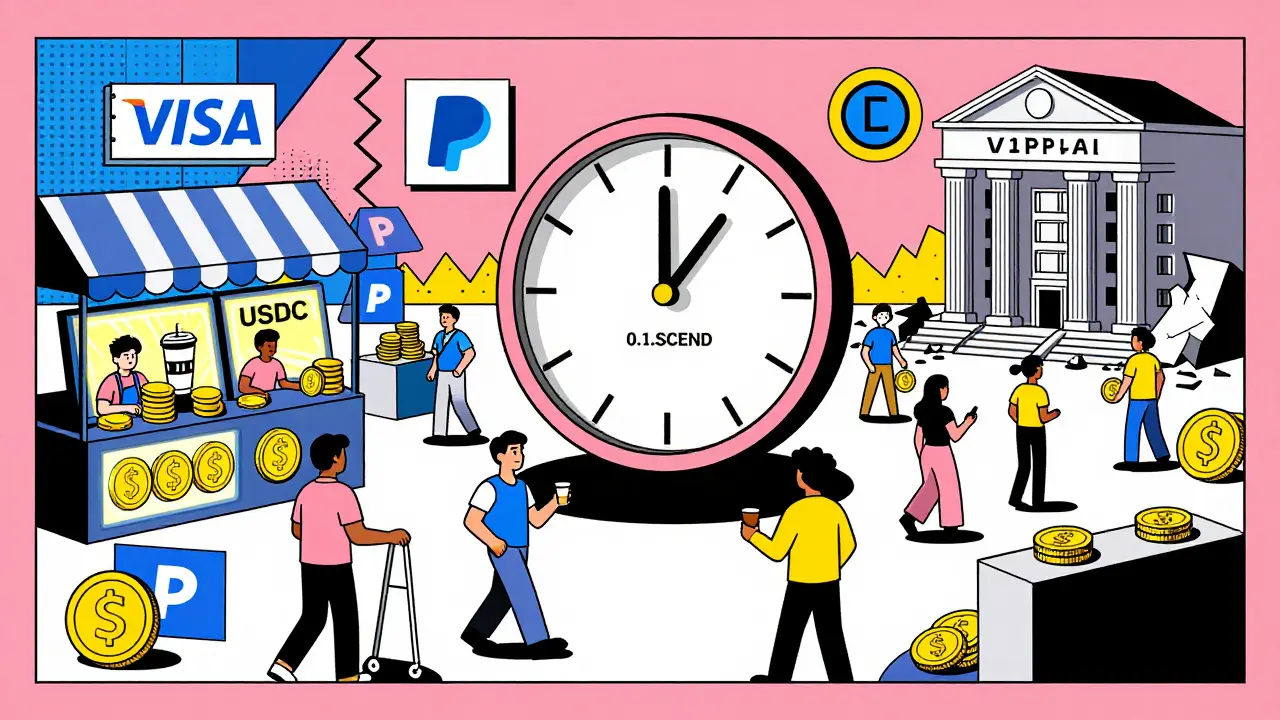
The biggest shift in 2026? Stablecoins are no longer just for traders. They’re for paying bills, payroll, and invoices.Visa’s stablecoin-linked cards alone hit a $3.5 billion annualized spend rate in Q4 2025. That’s up 460% from the year before. By January 2026, Visa was settling $4.5 billion in stablecoin payments annually. And that’s just one company. Total card-based stablecoin spending hit $18 billion annualized in early 2026. That means everyday people are using USDC and USD₮ to buy coffee, pay rent, or order groceries online-with instant settlement and near-zero fees.
B2B payments are exploding even faster. In 2023, companies were sending maybe $100 million a month in stablecoins. By mid-2025, that number jumped to $6 billion per month. That’s a 6,000% increase. Why? Because cross-border payments that used to take 3-5 days and cost 5-7% in fees now settle in under 10 seconds for less than 0.1%. Companies like Deel and Flywire now use USDC to pay freelancers in 80+ countries. BVNK, a stablecoin infrastructure provider, processed $30 billion in volume in 2025-$10 billion of it from U.S. businesses alone.
DeFi and Lending Run on These Two Coins
If you’re lending, borrowing, or earning interest in crypto, you’re almost certainly using USDC or USD₮.In August 2025, monthly on-chain stablecoin lending hit $51.7 billion. Total loan balances outstanding? $14.8 billion. And 89% of that activity happened on Aave and Compound-two platforms that only support USDC and USD₮ as primary collateral. Why? Because they’re the most trusted, most liquid, and most widely accepted. No one wants to lend against a new stablecoin with unknown reserves. But when you know the issuer has passed audits, has regulatory licenses, and is backed by real dollars, you sleep better at night.
Even tokenized real-world assets-like buildings, invoices, or bonds-are being issued as tokens pegged to USDC. The market for these assets hit $12.7 billion in 2025. Analysts project it could hit $1 trillion to $4 trillion by 2030. That’s not speculation. That’s institutional capital flowing into blockchain because stablecoins make it safe and predictable.
Emerging Markets Are Driving Real-World Use
You won’t find stablecoin adoption in the U.S. because it’s trendy. You’ll find it because people need it.In Argentina, where inflation hit 300% in 2024, people are converting their pesos into USDC to protect their savings. In Nigeria, remittances from the U.S. and Europe now flow through stablecoins instead of Western Union. Between January and July 2025, crypto inflows to South Asia jumped 80% to $300 billion. Indonesia, Vietnam, and the Philippines are leading the charge. Latin America received $1.5 trillion in crypto value between mid-2022 and mid-2025. Sub-Saharan Africa saw activity rise 52% year-over-year.
Why? Because traditional banking is slow, expensive, or inaccessible. Stablecoins let someone in Lagos send $500 to their family in Lagos in seconds for less than 50 cents. No middlemen. No delays. No hidden fees. That’s not innovation-that’s necessity. And USDC and USD₮ are the only coins that can scale to meet that demand.
Regulation Is Locking in the Winners
The U.S. and EU aren’t banning stablecoins-they’re regulating them. And that’s making it harder for newcomers to compete.The GENIUS Act in the U.S. now treats stablecoin transactions like wire transfers, requiring full KYC and AML checks. The EU’s MiCA framework, fully active in 2024, forces issuers to hold reserves in cash or cash equivalents and submit monthly audits. Circle and Tether spent millions building compliance teams, legal departments, and audit systems. A new stablecoin startup? They’d need to do the same-and they’d have to convince users they’re not going to disappear tomorrow.
That’s why 13% of corporations already use stablecoins for treasury management, and 54% of those who don’t plan to start within the next year. This isn’t a fad. It’s becoming a financial standard. And the only ones who can meet the bar are the ones already there.

Why Other Stablecoins Aren’t Winning
You’ve heard of DAI, FRAX, or even a new euro stablecoin hitting $500 million in market cap. But here’s the truth: size matters.A new stablecoin might offer a clever algorithm or a lower fee, but if it can’t move $10 billion in a single day, it’s useless for institutional users. If it doesn’t integrate with Visa, PayPal, or Coinbase, it’s irrelevant for retail. If it hasn’t been audited by a Big Four firm, no enterprise will touch it.
USDC and USD₮ aren’t winning because they’re perfect. They’re winning because they’re reliable, scalable, and embedded into every part of the financial system-from ATMs to payroll systems to DeFi protocols. No other stablecoin has that kind of network effect.
What’s Next? The $1 Trillion Milestone
By late 2026, total stablecoin circulation is expected to exceed $1 trillion. That’s more than the entire Bitcoin market cap just five years ago. And nearly all of that growth will go to USDC and USD₮.Platforms like Plasma are making transfers faster and cheaper. Banks are starting to issue their own stablecoins. But none of this threatens the leaders. Instead, they’re building on top of them. Plasma doesn’t replace USDC-it makes USDC easier to use. A bank-issued dollar coin? It’ll likely be pegged to the same reserves as USDC and integrate with the same rails.
The race isn’t about who invents the next stablecoin. It’s about who owns the infrastructure. And right now, USDC and USD₮ own it all.
Which stablecoin is the most widely used in 2026?
In 2026, USD Coin (USDC) and Tether (USD₮) are the two most widely used stablecoins, together accounting for over 95% of the entire market. USDC leads in institutional adoption, DeFi lending, and payment integrations, while USD₮ remains the most traded stablecoin on exchanges and is heavily used for liquidity in crypto markets. Both are backed by real-dollar reserves and integrated into global financial infrastructure.
Why are stablecoins used for cross-border payments instead of traditional banks?
Stablecoins settle transactions in under 10 seconds with fees under 0.1%, while traditional bank wires take 3-5 days and cost 5-7%. For businesses sending money internationally or individuals sending remittances, this speed and cost difference is game-changing. Stablecoins also bypass intermediaries like correspondent banks, reducing complexity and increasing transparency through blockchain ledgers.
Can stablecoins replace the U.S. dollar?
Not as a replacement, but as a digital extension. The U.S. dollar remains the world’s dominant reserve currency. Stablecoins like USDC and USD₮ are digital tokens that represent the dollar on blockchain networks. They don’t replace the dollar-they make it easier to move, use, and access globally. Think of them as digital cash for the internet age.
Are stablecoins safe to use?
USDC and USD₮ are among the safest because they’re fully backed by cash or short-term U.S. government securities, undergo regular audits, and operate under strict regulatory oversight. However, not all stablecoins are created equal. Algorithmic or unbacked stablecoins carry higher risk. Always check if a stablecoin is backed by real assets and audited by reputable firms before using it.
How are businesses using stablecoins in 2026?
Businesses use stablecoins for global payroll, cross-border supplier payments, treasury management, and instant settlement of invoices. Companies like Deel, Flywire, and BVNK use USDC to pay freelancers in over 80 countries, avoid currency conversion fees, and reduce settlement times from days to seconds. Many corporations now treat stablecoins as part of their cash management strategy, similar to holding U.S. Treasury bills.
Do central bank digital currencies (CBDCs) threaten stablecoins?
Not in the near term. While countries are testing CBDCs, they remain limited to pilot programs with little real-world use. Stablecoins are already live, integrated into apps, cards, and payment systems, and used by millions daily. CBDCs face political and privacy hurdles that stablecoins don’t, giving commercial stablecoins a significant head start in adoption and infrastructure.
What’s the difference between USDC and USD₮?
USDC is issued by Circle and is fully transparent, with daily audits and public reserve reports. It’s preferred by regulated institutions and DeFi platforms. USD₮, issued by Tether, is older, has higher trading volume, and is more commonly used on exchanges for liquidity. While both are backed by dollar reserves, USDC has stronger regulatory compliance and is more widely integrated into financial services like Visa and PayPal.
Is it better to hold USDC or USD₮?
For most users, USDC is the safer choice due to its transparency, regulatory compliance, and integration with major financial platforms. If you’re trading frequently on exchanges, USD₮ may be more convenient due to its deeper liquidity. But for payments, DeFi, or long-term holding, USDC’s audit trail and institutional backing make it the more reliable option.
Stablecoins have moved from crypto curiosity to financial necessity. And in 2026, the winners aren’t just leading-they’re defining the future of money.