
Stablecoin Pairs in Crypto Trading: How to Reduce Volatility Exposure
 Dec, 1 2025
When Bitcoin drops 15% in a single day, most traders panic. Sell too early? You miss the rebound. Hold on? Your account gets hammered. But there’s a quiet tool most successful crypto traders use every day to avoid this rollercoaster: stablecoin pairs.
Instead of trading BTC for USD through banks - which takes days and fees - traders swap Bitcoin for USDT or USDC. These are digital coins that stay pegged to $1. No wild swings. No sleepless nights. Just a safe harbor in the middle of a storm.
Why Stablecoin Pairs Are the Default Choice in Crypto Trading
Over 85% of all crypto trading volume happens on stablecoin pairs. That’s not a coincidence. It’s because they solve the biggest problem in crypto: volatility.
Imagine you bought Bitcoin at $40,000. It jumps to $60,000, then crashes to $45,000. You’re still up, but you’re anxious. You don’t want to sell and lock in gains, but you also don’t want to lose everything if it drops to $30,000. What do you do?
You sell your Bitcoin for USDT. Now you’re holding $45,000 worth of digital cash. No more fear. No more emotional trading. When the market stabilizes, you buy back in - often at a better price. This is called volatility shielding.
It’s not just for exits. Traders use stablecoin pairs to enter positions fast. On Binance, swapping BTC for USDT takes 15 seconds. Converting to USD through a bank? Three days. That’s why 92% of on-chain trading uses stablecoins as the base asset.
How Stablecoins Actually Stay Stable
Not all stablecoins are the same. There are two main types, and knowing the difference can save your portfolio.
- Fiat-collateralized: USDC, BUSD, TUSD. Each coin is backed by $1 in cash or short-term U.S. Treasuries held in regulated banks. Circle, the company behind USDC, publishes monthly audits showing exactly what’s in reserve. As of March 2023, they held $41.1 billion in assets.
- Algorithmic: DAI. No bank account. Instead, it’s backed by over-collateralized crypto - like ETH or BTC - locked in smart contracts. If you want $1 of DAI, you must lock up $1.50 worth of ETH. It’s decentralized, but riskier. If ETH crashes hard, the system can struggle to stay pegged.
USDT is the most traded, making up about 68% of the stablecoin market. But it’s also the most opaque. Tether doesn’t release full audits like Circle does. In 2021, they settled a $4.1 billion fine with the CFTC for misleading claims about reserves. That’s why smart traders don’t put all their money in USDT.
Top Stablecoin Pairs and Why They Matter
Not all pairs are created equal. Liquidity, fees, and reliability vary wildly.
Here are the most trusted pairs as of 2025:
- BTC/USDT: The most liquid pair on Earth. Over $500 million in daily volume on Coinbase Pro alone. Tight spreads. Fast execution. The default for most traders.
- BTC/USDC: Slightly less volume than USDT, but preferred by institutions. Hedge funds use USDC because of its transparency. It’s the go-to for regulated traders.
- ETH/USDT: Ethereum’s main trading pair. Used for DeFi entry/exit and staking positions.
- DAI/USDC: Used in DeFi lending and yield farming. Not for trading Bitcoin, but essential for crypto-native finance.
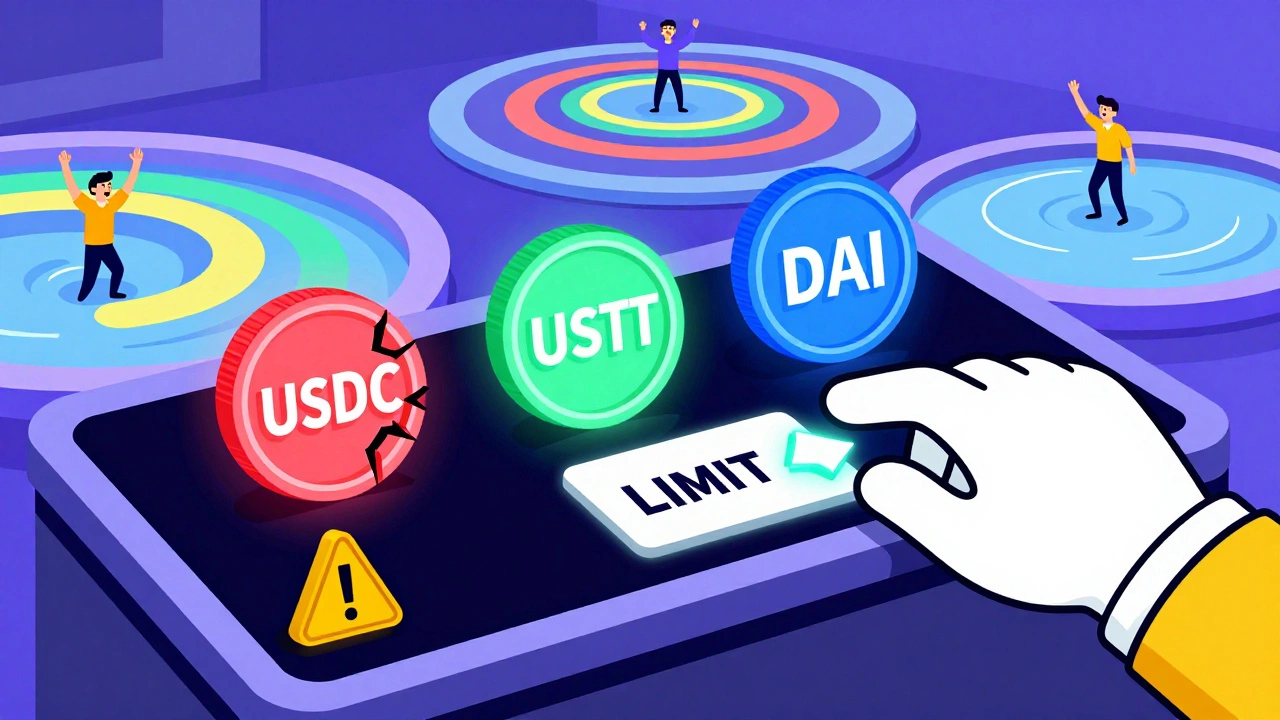
Avoid low-volume stablecoin pairs like USDP or FDUSD unless you’re doing arbitrage. If daily volume is under $5 million, you’ll get stuck with bad prices and high slippage.
How Stablecoin Pairs Reduce Slippage and Fees
Slippage is when your order fills at a worse price than you expected. In volatile pairs like BTC/ETH, slippage can be 2% or more during a spike. That’s $20 lost on a $1,000 trade.
With BTC/USDT, slippage drops to 0.05-0.15%. Why? Because there’s so much money on both sides. You’re not fighting a thin order book - you’re swimming in liquidity.
Fees matter too. On MEXC, maker fees for USDT pairs are 0.09%. On KuCoin, they’re 0.1%. On Coinbase Pro, spot trades are 0.5% for takers. That’s a 5x difference. Use limit orders to get maker fees. Always check the fee schedule before trading.
The Dark Side: When Stablecoins Fail
Stablecoins aren’t magic. They can break.
In May 2022, TerraUSD (UST) - an algorithmic stablecoin - collapsed. It wasn’t backed by cash. It was backed by a complicated algorithm and another crypto called LUNA. When confidence dropped, the peg broke. UST fell to 70 cents, then 10 cents. $40 billion vanished in days. Traders who held UST/BTC pairs lost everything.
Even USDC had problems. In March 2023, Silicon Valley Bank failed. USDC was partially backed by SVB deposits. Within hours, USDC dropped to $0.85. It took 72 hours for Circle to restore the peg. People couldn’t cash out. Some lost money.
These aren’t hypotheticals. They’re real events that wiped out portfolios. That’s why you never put all your money in one stablecoin. Use a mix: 50% USDC, 30% USDT, 20% DAI. That way, if one fails, you’re not ruined.

How Professional Traders Use Stablecoin Pairs
Most retail traders buy Bitcoin and hold. Professionals do something smarter: they use stablecoin pairs to time the market without leaving crypto.
Here’s a common strategy:
- Hold BTC/USDT. When BTC rises 20% in a week, sell half into USDT.
- Wait for a 10% pullback. Buy back BTC with USDT.
- Repeat. This is called volatility harvesting.
One trader on Reddit, u/CryptoSurvivor87, said USDC saved his portfolio during the Luna crash. He had 70% in BTC. When UST collapsed, BTC dropped 30%. He sold to USDC, waited three days, and bought back at 20% lower. He ended up with more BTC than before - and no panic.
Another trader, CryptoWolf, made 37% annual returns in 2022-2023 using USDT-based dollar-cost averaging. He bought $500 of BTC every time it dropped 10% from its high. He never sold. He just moved cash between BTC and USDT to avoid emotional decisions.
What You Should Do Right Now
If you’re trading crypto and not using stablecoin pairs, you’re working harder than you need to.
Here’s your action plan:
- Switch your main trading pair to BTC/USDT or BTC/USDC. Stop trading BTC/USD or ETH/EUR. Those are slow and expensive.
- Diversify your stablecoins. Keep at least two: USDC and USDT. Add DAI if you use DeFi.
- Check reserves. Go to Circle’s transparency dashboard (for USDC) or Tether’s reports. If you don’t know where the money is, don’t trust it.
- Set up alerts. Use TradingView to monitor if USDC or USDT drops below $0.98. If it does, move your funds immediately.
- Use limit orders. Never use market orders on crypto. They cost you money. Limit orders protect you.
Stablecoin pairs don’t make you rich. But they keep you in the game. And in crypto, staying in the game is half the battle.
Regulation Is Coming - And It’s Good
The EU’s MiCA law, effective June 2024, requires all stablecoins to be fully backed by cash or safe assets. The U.S. is moving the same way. By 2025, unbacked or poorly backed stablecoins will be banned from major exchanges.
This is good news. It means the bad actors - like Terraform Labs - won’t be able to fool people anymore. USDC and regulated USDT will become even more dominant.
By 2027, experts predict 95% of crypto trading will happen on stablecoin pairs. The days of trading crypto against fiat currencies are ending. The future is digital cash.
Are stablecoin pairs safe?
They’re safer than trading volatile crypto pairs, but not risk-free. USDC and USDT are backed by real assets, but they can still de-peg during bank failures or panic. Always diversify across multiple stablecoins and monitor reserve audits.
Which stablecoin is best for trading?
For most traders, USDT is the best because of its liquidity and low fees. But for safety and transparency, USDC is better. Use both. Keep 50-70% in USDC, the rest in USDT. Avoid new or low-volume stablecoins.
Can I lose money with stablecoin pairs?
Yes, if you use unstable stablecoins like UST (which collapsed in 2022). You can also lose money if you trade low-volume pairs with high slippage. But if you stick to USDT or USDC on major exchanges, your main risk is market movement - not the stablecoin itself.
Do I need to convert back to fiat?
No, not unless you want to cash out. Stablecoin pairs let you stay in crypto while avoiding volatility. You can move between BTC, ETH, and stablecoins without ever touching bank accounts. This saves time, fees, and delays.
How do I know if a stablecoin is trustworthy?
Check for monthly audits by reputable firms like Grant Thornton or PwC. USDC publishes real-time reserve data on Circle’s website. Tether’s reports are less frequent and less transparent. Avoid stablecoins without public audits or those that rely on complex algorithms without clear collateral.