
Tax Saving for Children: How to Reduce Your Tax Bill by Planning for Your Kids
When it comes to tax saving for children, strategic financial moves that lower your taxable income by investing in your child’s future. Also known as child-focused tax deductions, it’s not about fancy schemes—it’s about using rules already in place to keep more money in your pocket and your child’s future. Many parents think tax savings for kids means paying for private school or saving for college. But in India, the real power lies in Section 80C, a tax deduction limit of ₹1.5 lakh per year for specific investments, including those made for your child’s education or savings. You can use this to fund a Public Provident Fund (PPF) account in your child’s name, contribute to their Sukanya Samriddhi Yojana (SSY), or even pay their tuition fees under approved institutions—all of which count toward your ₹1.5 lakh limit.
But here’s what most people miss: Section 80C and Section 80D, the deduction for health insurance premiums. health insurance tax benefit can work together. You can claim up to ₹1.5 lakh under 80C for your child’s PPF or SSY, and another ₹25,000 (or ₹50,000 if your child is a senior citizen) under 80D for their health insurance. That’s nearly ₹2 lakh in deductions just by planning ahead. And yes, the money in SSY grows tax-free, withdrawals are tax-free, and even the interest is exempt. No other savings tool gives you this triple advantage.
It’s not just about the numbers—it’s about timing. The earlier you start, the more compound growth you get. A ₹10,000 annual investment in a girl child’s SSY account at age 5 can grow to over ₹12 lakh by age 21, all tax-free. And if you’re thinking about education loans, remember: the principal repayment on a loan taken for your child’s higher education also qualifies under 80C. But be careful—only the principal counts, not the interest. And only if the loan is from a recognized financial institution.
What about other expenses? Daycare, tuition, extracurriculars—none of those directly reduce your tax bill. But they do affect your budget. That’s why smart parents use 80C to free up cash flow. If you’re already putting ₹1 lakh into your own PPF, you still have ₹50,000 left to invest in your child’s SSY or their education fund. That’s enough to cover two years of school fees at a decent private institution.
You don’t need a financial advisor to do this. You just need to know where to look. The posts below break down exactly how to use Section 80C for your kids, what documents you need, how to avoid common mistakes, and which investments give you the best long-term return. Whether you’re setting up your first SSY account or wondering if your child’s tuition fees qualify, you’ll find clear, no-fluff answers here.
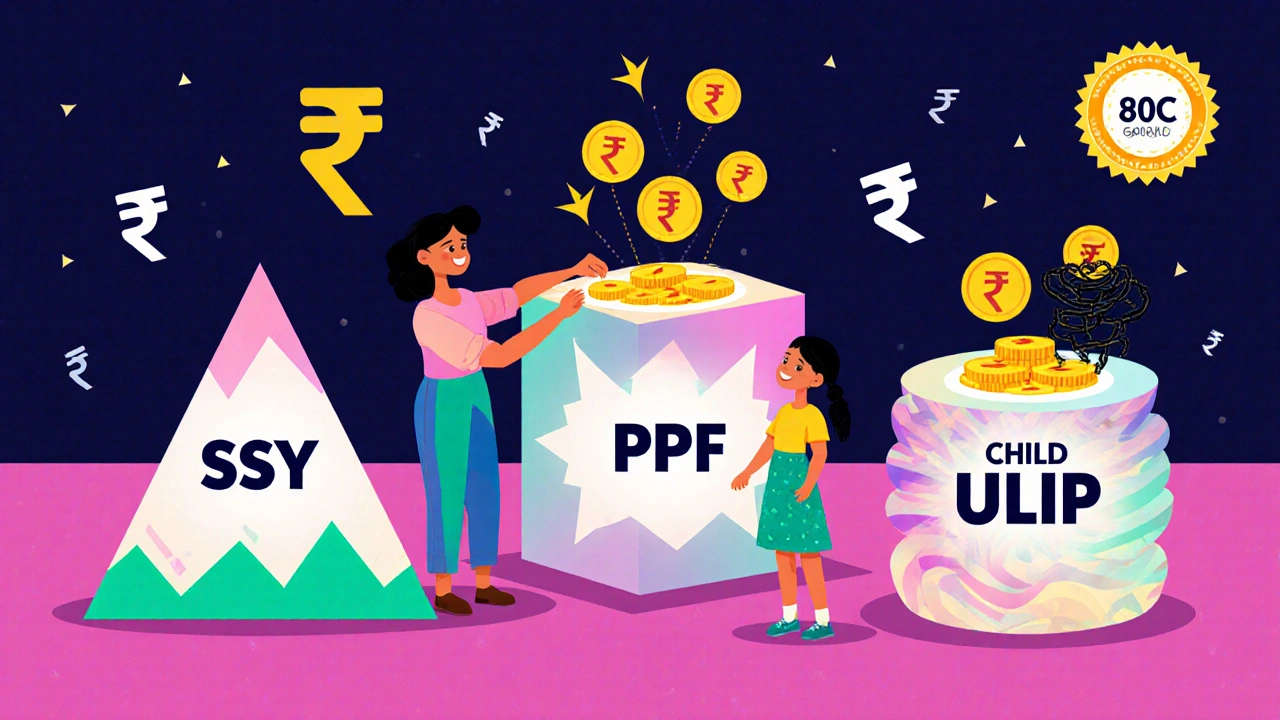
Section 80C and Children’s Plans in India: SSY vs Child ULIPs vs PPF
Compare SSY, PPF, and Child ULIPs under Section 80C to find the best tax-saving investment for your child's future in India. Learn which option offers higher returns, lower risk, and true financial security.
Categories
- Cryptocurrency
- Careers & Education
- Home & Living
- Technology
- Home & Lifestyle
- hire domestic help in Mumbai
- hire drivers in mumbai
- Personal Finance
- hire pet care in mumbai
- Travel & Transportation