
Token Supply Explained: Maximum, Circulating, and Total Supply in Crypto
 Dec, 19 2025
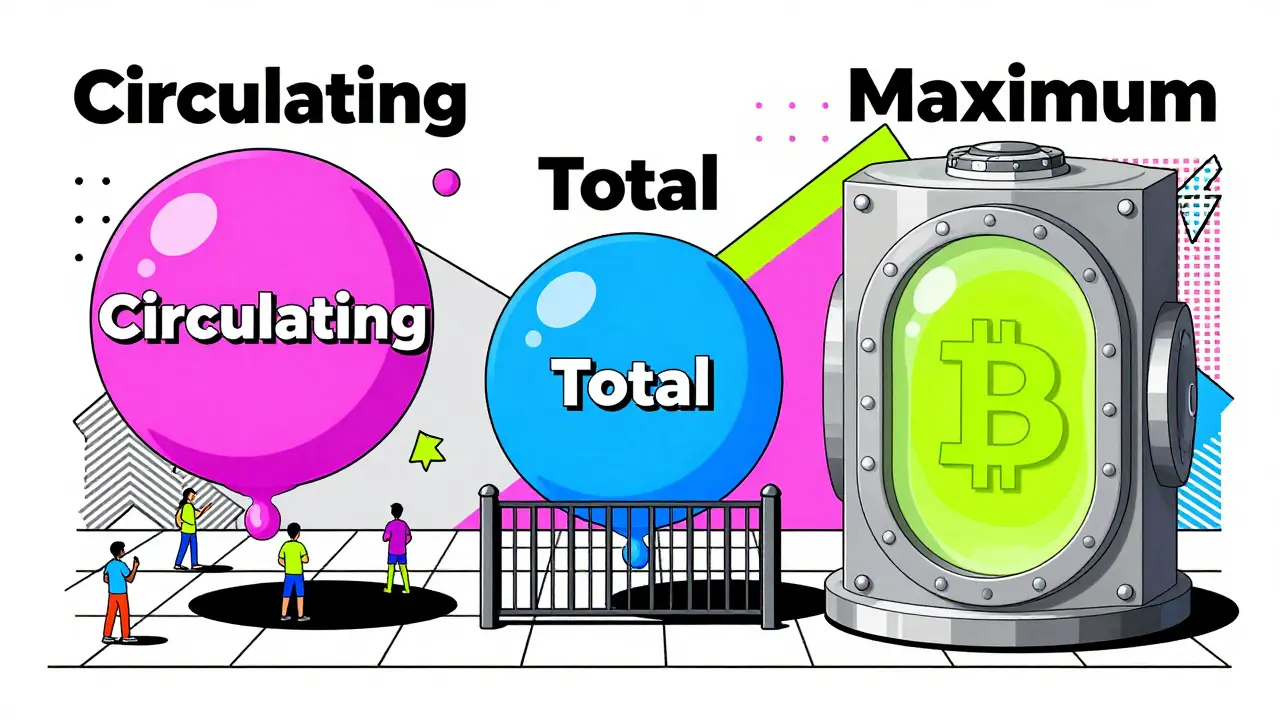
When you see a cryptocurrency listed with a $10 billion market cap, do you know what that number really means? Many investors think it’s just the price multiplied by the number of coins out there. But that’s only half the story. The real value of a token depends on three different types of supply: circulating supply, total supply, and maximum supply. Mixing them up can cost you money - or help you make smart moves if you understand them right.
What Is Circulating Supply?
Circulating supply is the number of tokens that are actually out in the open, being traded by the public. Think of it like shares of a company that are available on the stock market. These are the coins you can buy right now on exchanges like Binance, Coinbase, or Kraken.It doesn’t include tokens locked in team wallets, reserved for future development, or stuck in staking contracts. For example, as of December 1, 2025, Bitcoin had a circulating supply of 19,633,206 BTC. That’s about 93.5% of its total maximum supply. Ethereum, which doesn’t have a hard cap, had 121,438,752 ETH in circulation.
This number is what most platforms use to calculate market cap: circulating supply × current price. That’s why you see Bitcoin’s market cap listed as roughly $600 billion - it’s based on this number, not the full 21 million.
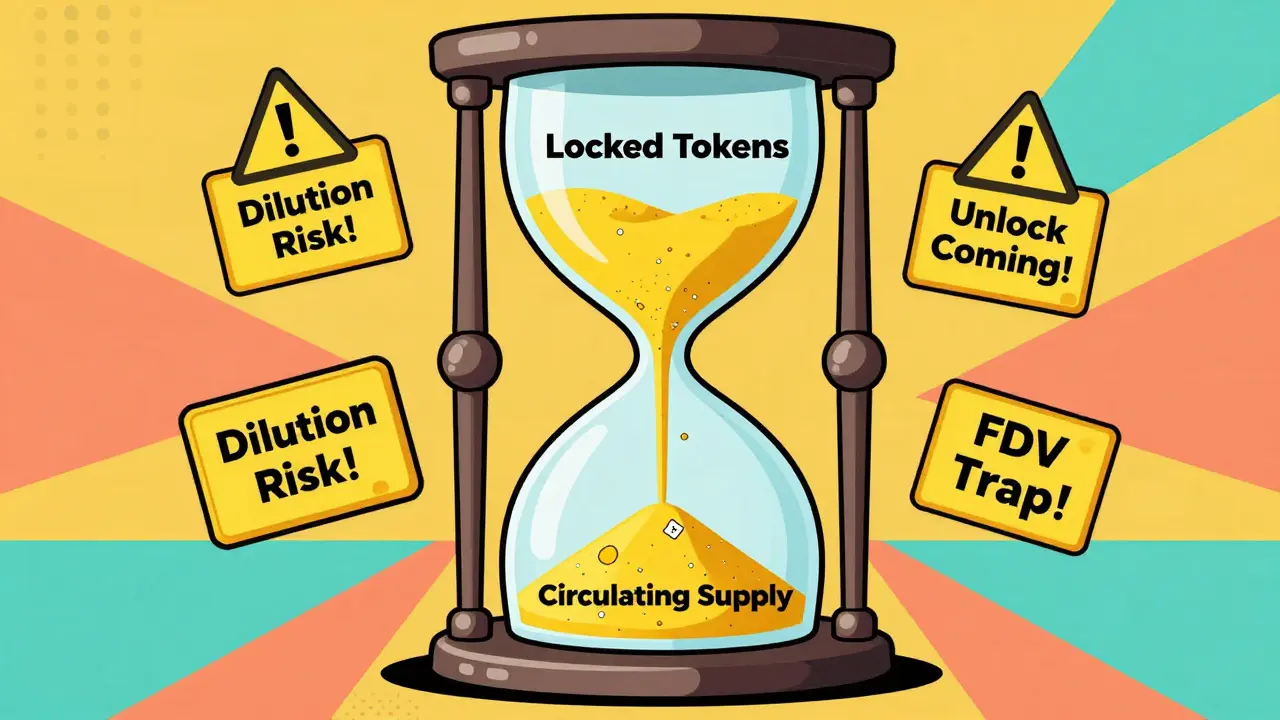
But here’s the catch: if a project has only 10% of its tokens in circulation, and the rest are locked up for release next year, your “$1 billion market cap” could become $10 billion overnight when those tokens unlock. That’s why many retail investors get burned. They see a low market cap and assume it’s undervalued - not realizing the flood of new supply is coming.
What Is Total Supply?
Total supply is everything that’s been created so far, minus any tokens that have been permanently burned. It includes circulating coins plus those held in reserve, locked in smart contracts, or sitting in team wallets.For Bitcoin, total supply equals maximum supply - 21 million - because no more can ever be created. But for other coins, it’s different. Take Shiba Inu: it started with 1 quadrillion SHIB, but over 400 trillion have been burned through verified transactions. As of December 10, 2025, its total supply was around 589 trillion SHIB.
Total supply matters because it shows you the full picture of how many tokens exist in the system. If a project has a total supply of 1 billion tokens but only 100 million are circulating, that means 90% are still locked up. That’s a red flag if those tokens are scheduled to unlock in the next 12 months. You’re not just buying a coin - you’re buying into a future supply explosion.
Some tokens, like BNB, reduce their total supply over time through quarterly burns. That’s a positive signal - fewer tokens mean higher scarcity. But not all burns are real. Some projects send tokens to dead addresses and call it a burn, even though those tokens could theoretically be recovered. Always check if the burn is verifiable on the blockchain.
What Is Maximum Supply?
Maximum supply is the absolute ceiling - the most tokens that will ever exist. It’s baked into the code at launch. Bitcoin’s maximum supply is 21 million. That’s not negotiable. It’s hardcoded into the Bitcoin Core software. No matter what happens, you won’t see 21.1 million BTC.That’s what makes Bitcoin unique. Most other cryptocurrencies don’t have a maximum supply. Ethereum, for example, has no cap. New ETH is created every time a validator confirms a block. As of August 2025, Ethereum’s annual issuance rate is about 0.45%, down from 4.3% before the Merge. That’s still inflationary - just much slower.
Maximum supply is critical for calculating fully diluted valuation (FDV). FDV = maximum supply × current price. It tells you what the market cap would be if every single token were in circulation right now. For Bitcoin, FDV is close to its actual market cap because almost all tokens are already out. For a new altcoin with only 5% circulating, FDV might be 20 times higher than the real market cap. That’s why FDV is useless for uncapped tokens like Ethereum. You can’t predict how many will exist in 10 years.
Some experts argue that maximum supply only matters for capped coins. Nic Carter, a well-known crypto analyst, says, “Ignoring the difference between circulating and total supply is the single most common valuation mistake among novice crypto investors.” He’s right. If you’re looking at a token with a $500 million FDV but only 10% circulating, you’re not seeing the real risk - you’re seeing a fantasy.
Why the Difference Matters for Investors
The gap between circulating and total supply tells you how much dilution risk exists. A token with 20% circulating supply and 80% locked up is like a company that just IPOed with 20% of its shares available - and the rest are locked up for employees and investors who will sell them next year.Take Aptos. As of December 15, 2025, it had 205 million APT in circulation, but a total supply of 1 billion. That’s just 20.5% circulating. If all those tokens unlock at once, and demand doesn’t keep up, the price could crash. According to Kanga Exchange’s analysis, tokens with less than 30% circulating supply saw an average price drop of 37.2% after major unlocks.
On the flip side, Bitcoin’s 93.5% circulating supply means almost all tokens are already out. That’s why it’s more stable. Fidelity’s data shows tokens with over 90% circulating supply have 42% less price volatility than those under 50%.
Professional traders watch unlock schedules like a clock. They use tools like TokenUnlocks.info or CoinGecko’s Supply Schedule API to track when large batches of tokens will hit the market. One trader on YouTube, Alex Becker, made 147% in Q1 2024 by betting on Ethereum’s price surge after its issuance rate dropped from 4.3% to 0.45% - a structural supply shock that most retail investors missed.
And it’s not just about price. Community sentiment follows supply transparency. LunarCrush found that projects with clear unlock schedules and gradual token releases get 3.2 times more positive social chatter than those hiding their plans.
Common Mistakes and How to Avoid Them
Most people make three big mistakes:- Using market cap based on circulating supply only - This makes new tokens look cheaper than they are. Always check FDV too.
- Assuming all burns are real - Some projects send tokens to “dead” addresses that aren’t truly inaccessible. Verify burns on Etherscan or similar explorers.
- Ignoring unlock schedules - If 80% of tokens unlock in six months, don’t buy just because the price is low today.
One Reddit user, u/TokenSavvy, saved $25,000 by walking away from a 2024 project with only 5% circulating supply. The team promised a 200% price increase. But they didn’t mention the 1,900% supply increase coming from unlocks. That’s not a scam - it’s just bad disclosure.
Another investor lost $8,000 on a token because an exchange only showed circulating supply. The token had a tiny market cap - until 70% of its tokens unlocked overnight. The price dropped 65% in a week.
Even big platforms make mistakes. Binance burns BNB every quarter, reducing total supply. But the effect on price isn’t immediate. It takes 12-18 months for the market to fully price in the reduced supply. Many investors sold too early, thinking the burn would spike the price right away.

Tools to Track Supply Metrics
You don’t need to guess. There are free tools that show you exactly what’s happening:- TokenUnlocks.info - Real-time tracking of upcoming token unlocks for hundreds of projects.
- CoinGecko Supply Schedule API - Updated hourly, includes circulating, total, and max supply.
- CryptoQuant Supply Dashboard - Used by over 287,000 users monthly, shows on-chain supply trends.
- Etherscan - Check burn transactions for Ethereum-based tokens.
- DeFiLlama - See how many tokens are locked in DeFi protocols, which affects circulating supply.
Learn how to read these tools. It takes 8-12 hours to get comfortable, but it’s one of the best investments you can make in crypto. Glassnode’s 2025 analysis found that tokens with low circulating supply and high network value-to-token supply (NVT) ratios outperformed the market by 23.7% from 2022 to 2025.
The Bigger Picture: Supply Mechanics Are the Future of Crypto Valuation
Institutional investors are already ahead of retail. Fidelity’s 2025 report says 78% of traditional asset managers now use total supply metrics in their models - up from just 32% in 2022. The SEC now requires all token issuers to disclose circulating, total, and maximum supply in registration filings.ARK Invest predicts that by 2030, tokens with well-designed supply mechanics will capture 68% of the $20.4 trillion crypto market. Bitcoin’s fixed cap gives it a premium. But Ethereum’s low, predictable issuance rate is becoming a model for others.
Meanwhile, new protocols are experimenting with dynamic supply. Sixty-three of the top 100 DeFi projects now adjust token issuance based on usage, revenue, or staking activity. That’s a shift from fixed supply to adaptive supply - a smarter way to balance incentives and scarcity.
But don’t get fooled by hype. As Bernstein’s 2025 outlook warns, “Overemphasizing maximum supply could become obsolete for proof-of-stake networks.” Why? Because staking removes tokens from circulation. A token with 1 billion max supply might have only 200 million actively trading. That’s the real circulating supply - not the one on the chart.
So ask yourself: Are you investing in a coin, or in its supply mechanics? The answer will determine whether you ride the wave or get swept away.
What’s the difference between circulating supply and total supply?
Circulating supply is the number of tokens currently available for trading by the public. Total supply includes all tokens that have been created, minus those that have been verifiably burned - even if they’re locked in wallets, staked, or reserved for future use. Circulating supply affects today’s price; total supply shows future dilution risk.
Why is maximum supply important for Bitcoin but not Ethereum?
Bitcoin has a hard-coded maximum supply of 21 million, making it deflationary and predictable - a key reason for its scarcity narrative. Ethereum has no maximum supply; new ETH is created with each block. While its issuance rate is low (0.45% annually), it’s still inflationary. Maximum supply only matters for capped tokens. For Ethereum, the issuance rate and staking behavior matter more than a theoretical cap.
Can total supply ever be higher than maximum supply?
No. Maximum supply is the absolute upper limit. Total supply can never exceed it. Total supply is always less than or equal to maximum supply. If a token has no maximum cap, then total supply is simply the number of tokens created minus burns.
How do token burns affect supply metrics?
Burns reduce total supply. When tokens are permanently destroyed (sent to an unspendable address), they’re subtracted from both total and maximum supply (if applicable). This increases scarcity. For example, BNB’s quarterly burns have reduced its total supply by over 40% since 2017. Always verify burns on-chain - some projects fake them by sending tokens to inactive addresses.
Should I use FDV to evaluate a crypto project?
Only if the project has a maximum supply cap. FDV (fully diluted valuation) = max supply × price. It’s useful for Bitcoin or other capped tokens to understand future value. But for uncapped tokens like Ethereum, FDV is meaningless because there’s no limit to how many tokens can be created. Rely on circulating supply and issuance rate instead.
What’s the best way to avoid losing money due to token unlocks?
Check unlock schedules before investing. Use tools like TokenUnlocks.info to see when large batches of tokens are set to enter circulation. Avoid tokens where less than 30% of total supply is circulating, especially if a big unlock is due in the next 6-12 months. Always compare circulating supply to total supply - a gap over 70% is a major red flag.