
Token Unlock Events: How Supply Shocks Impact Crypto Prices in 2026
 Jul, 2 2026
You buy a new altcoin because the tech looks solid and the community is buzzing. Two weeks later, the price drops 20% for no apparent reason. No bad news, no exchange hacks, just a quiet slide into the red. If this sounds familiar, you’ve likely run headfirst into a token unlock.
In the world of cryptocurrency, these events are scheduled moments when previously frozen tokens-held by teams, early investors, or treasuries-are released into the circulating supply. It’s not a mystery; it’s math. But understanding how that math translates to price action can save your portfolio from unnecessary pain.
The Mechanics of Vesting: Cliffs vs. Linear Unlocks
To understand why prices drop, you first need to understand how tokens get locked in the first place. When a project launches, it rarely gives all its tokens to the public immediately. Instead, they use a vesting schedule. This is a contract-based timeline that dictates when different groups get access to their coins.
There are two main ways this happens:
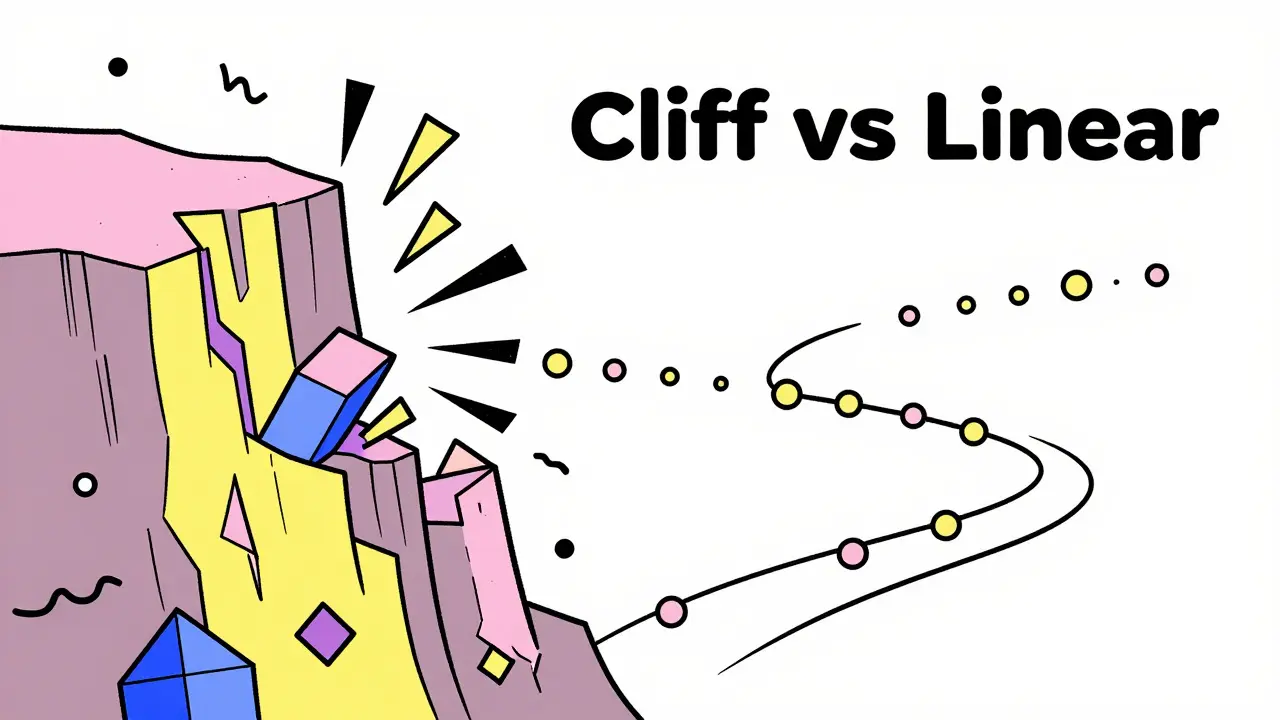
- Cliff Unlocks: Imagine a four-year plan where nothing unlocks for the first year. Then, on day one of year two, 25% of the allocation hits the market all at once. This creates a "supply cliff." If that 25% represents a chunk of the total supply and daily trading volume is low, the order book gets overwhelmed. Prices tend to spike downward as buyers retreat from the sudden flood of sell orders.
- Linear Unlocks: Here, tokens drip out slowly-daily, weekly, or monthly. This spreads the selling pressure over time. While less dramatic than a cliff, linear unlocks still add constant supply. If demand doesn’t grow to match that drip, the price slowly bleeds.
The key difference? Cliffs create sharp, short-term shocks. Linear unlocks create steady, long-term pressure. Most serious projects today use a mix: a long cliff followed by linear vesting to keep insiders committed while preventing massive dump days.
Why Do Prices Drop? The Psychology of Anticipation
It’s easy to blame the people holding the unlocked tokens for the price crash. They sell, so the price falls. Simple supply and demand, right? Not entirely. Research suggests the real damage often happens before the tokens even unlock.
A major study by Keyrock analyzed over 16,000 unlock events across 40 major tokens. They found that 90% of unlocks generated negative price pressure. But here’s the twist: the price impact usually starts about 30 days *before* the event. Traders see the calendar coming. They know millions of dollars worth of tokens are about to become liquidable. So, they front-run the event by selling or shorting early.
This creates a self-fulfilling prophecy. Fear drives the price down in anticipation. By the time the actual unlock date arrives, much of the selling has already happened. That’s why you’ll often see prices stabilize or even bounce slightly within two weeks after the unlock. The fear is gone, and the remaining holders decide to wait and see.
When Unlocks Don’t Crash Prices
Not every unlock is a death sentence for a token’s price. In fact, about 30% of major unlocks in recent datasets have been associated with price appreciation. What’s the difference?
It comes down to liquidity and purpose.
| Factor | Bearish Scenario (Price Drops) | Bullish/Neutral Scenario (Price Holds/Rises) |
|---|---|---|
| Liquidity Depth | Low daily volume; thin order books | High daily volume; deep institutional interest |
| Unlock Size | >20% of circulating supply or >2.5x daily volume | <5% of circulating supply |
| Recipient Type | Early VCs, private investors (profit-taking motive) | Ecosystem funds, treasury (re-investment motive) |
| Market Sentiment | Bear market or low interest in sector | Bull market or strong product adoption |
If a project has strong fundamentals-growing users, rising transaction fees, or clear utility for the token-the new supply can be absorbed by new buyers. For example, ecosystem development unlocks often lead to positive price action. Why? Because those tokens aren’t going into pockets to be sold; they’re going into grants, bounties, and marketing budgets that fuel growth. The market interprets this as a sign of future expansion, not immediate dumping.
Also, consider the size relative to the float. A $50 million unlock might crush a small-cap coin with only $10 million in daily volume. But for a giant like Ethereum or Solana, that same $50 million is a drop in the ocean. High-liquidity tokens often show no statistically significant abnormal returns around unlock dates because the market depth is simply too large to move easily.

How to Track and Trade Around Unlocks
You don’t need to guess when an unlock is happening. The data is public. Smart contracts enforce these schedules, making them highly predictable. By mid-2026, platforms like DefiLlama, CoinGecko, and Tokenomist offer detailed dashboards showing upcoming unlocks, amounts, and recipient categories.
Here is a practical checklist for evaluating risk:
- Check the Ratio: Look at the unlock amount as a percentage of the current circulating supply. If more than 5% unlocks in a single month, treat it as high risk.
- Compare to Volume: Is the unlock value larger than the average daily trading volume? If yes, expect slippage and volatility. KuCoin research indicates that unlocks exceeding 2.5 times daily volume almost always break order books.
- Identify the Recipient: Who gets the tokens? Team members and early VCs are statistically more likely to sell to realize profits. Ecosystem funds and treasuries are less likely to dump immediately.
- Watch the Timeline: Start monitoring price action 30 days before the event. If you see a slow drift downward despite good news, the market is pricing in the unlock.
For traders, a common strategy derived from historical patterns is to reduce exposure roughly 30 days before a major cliff unlock and re-enter about 14 days after, once the panic subsides and the price stabilizes. This isn’t financial advice, but it reflects how many professional desks manage risk during these predictable supply shocks.
The Future of Tokenomics Design
As the crypto market matures, we’re seeing a shift in how projects design their vesting schedules. Early ICOs often had weak structures, leading to massive crashes. Today, best practices emphasize gradual releases to align incentives.
Projects are moving away from large initial floats. Instead, they prefer longer cliffs and slower linear vesting. This protects retail investors from insider dumps and encourages teams to stay focused on building the product rather than cashing out quickly. However, this also means that total supply will continue to increase for years. Patience is required. You aren’t just buying a token; you’re betting on the project’s ability to generate enough demand to absorb that growing supply.
Understanding token unlocks removes the element of surprise. It turns a confusing price drop into a logical market event. By tracking these schedules and understanding the mechanics of supply and liquidity, you can navigate the crypto markets with more confidence and less fear.
What exactly is a token unlock?
A token unlock is a scheduled event where previously restricted cryptocurrency tokens held by teams, investors, or treasuries are released into the circulating supply according to a predefined vesting schedule. These tokens were locked via smart contracts to prevent early selling and align long-term incentives.
Do token unlocks always cause the price to drop?
No, but they often do in the short term. Studies show that about 90% of unlocks create negative price pressure, primarily due to psychological anticipation and front-running by traders. However, if the project has strong fundamentals, high liquidity, or if the tokens are allocated to ecosystem growth rather than profit-taking, the price may hold or even rise.
What is the difference between a cliff unlock and linear vesting?
A cliff unlock releases a large portion of tokens all at once after a specific period (e.g., 25% after one year), causing a sudden supply shock. Linear vesting releases tokens gradually over time (daily or monthly), spreading the selling pressure and reducing immediate volatility.
How far in advance does the price start reacting to an unlock?
Research indicates that price impacts often begin approximately 30 days before the unlock date. Traders anticipate the increased supply and sell or short positions in advance, causing the price to slip before the tokens are actually released.
Where can I find information about upcoming token unlocks?
You can track upcoming unlocks using specialized analytics platforms such as DefiLlama, CoinGecko, CoinMarketCap, Tokenomist, and DropsTab. These sites provide calendars detailing unlock dates, amounts, recipient types, and historical price impacts.