
Token Utility Design: How to Create Real Demand Beyond Speculation
 Aug, 21 2026
Most tokens fail because they solve a problem that doesn't exist. You launch a coin, people buy it hoping for a 10x return, and then... nothing happens. The price drops, volume dies, and the project fades into obscurity. The difference between a dead token and a thriving ecosystem comes down to one thing: token utility design. It is not about making the logo look cool or writing a whitepaper full of buzzwords. It is about engineering a system where users *need* the token to do something specific.
If you remove the token from your product, does anything break? If the answer is no, you don't have a token; you have a stock certificate with extra steps. True utility means the token acts as fuel, a key, or a vote in a machine that runs without it. Let’s look at how to build that necessity so your demand is driven by usage, not just hype.
The Necessity Test: Does Your Token Actually Matter?
Before you write a single line of code, you need to pass what experts call the "necessity test." This is a brutal but essential filter. Ask yourself four questions:
- What specific action requires this token? Is it paying a fee? Unlocking a feature? Voting on a parameter?
- Who must use it? Is it every user, or just a small group of validators?
- What happens if they avoid it? Can they pay in USDC instead? Can they skip the governance vote?
- How do you prove it's being used? Do you have an on-chain metric that tracks actual usage?
Many projects fail here because they offer "optional" utilities. For example, if a user can pay protocol fees in ETH or your native token, your token has weak utility. To create real demand, make the native token the primary or exclusive method for critical actions. If the system operates measurably worse without the token, you are on the right track.
Six Core Patterns of Token Utility
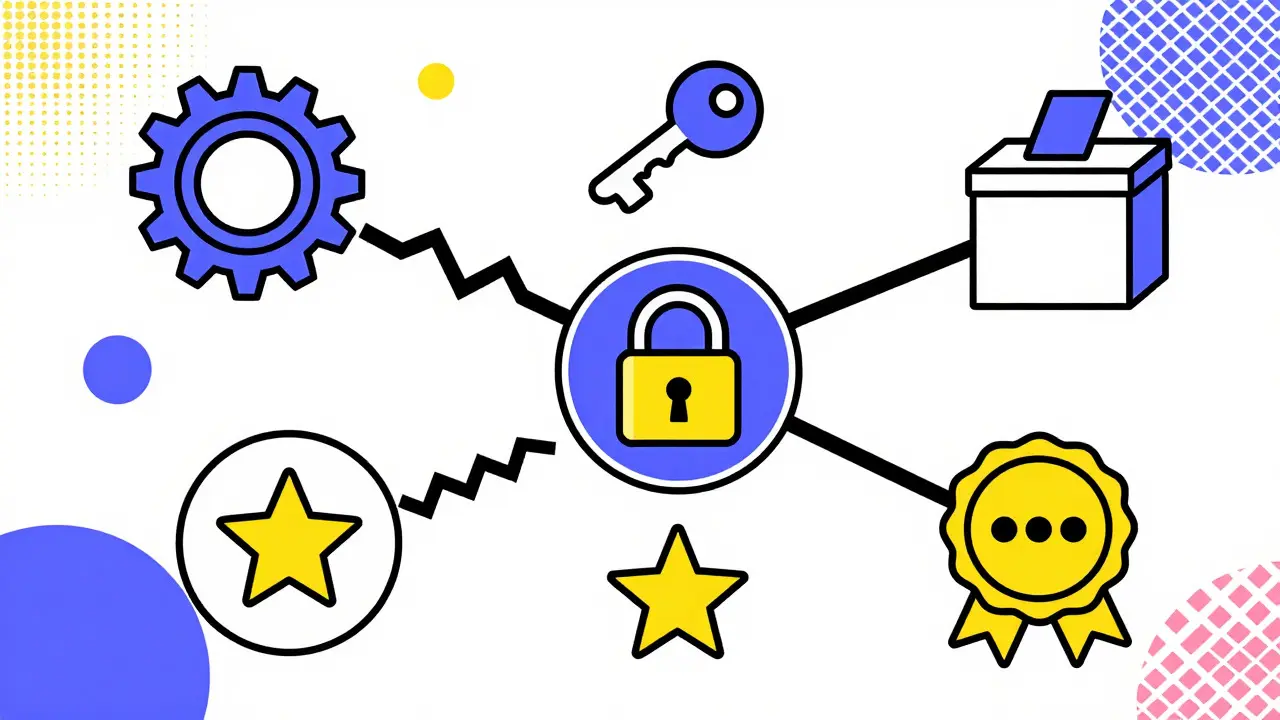
You don't need to invent a new wheel. Most successful tokens rely on one or more of these six established patterns. Mixing them creates a robust economy, but picking the wrong combination leads to confusion.
| Utility Type | Core Function | Demand Driver | Risk Factor |
|---|---|---|---|
| Payment/Fee Settlement | Paying for transactions or services | Usage volume | Substitution by stablecoins |
| Access/Gating | Unlocking premium features | Feature adoption rate | Low perceived value of gated content |
| Governance | Voting on protocol changes | Active voter turnout | Whale dominance/apathy |
| Staking/Security | Locking tokens for network security | Locked supply percentage | Yield farming speculation |
| Rewards/Loyalty | Incentivizing desired behaviors | Participation rates | Inflationary pressure |
| Reputation/Credentialing | Verifying trust/history | Trust-based interactions | Complexity for average users |
Payment Utility is the most direct route to non-speculative demand. If users must burn or spend the token to use your dApp, demand scales linearly with activity. However, be careful: if the fee is too low, users won't notice the burn. If it's too high, they'll leave. Access Utility works like a VIP club. Hold X amount of tokens, get Y benefit. This is powerful for creating a floor under the price, but only if the "VIP" benefits are actually desirable. A 5% discount isn't compelling enough to drive mass adoption; exclusive early access to new features might be.
Avoiding "Utility Washing" and Common Traps
"Utility washing" is when a team slaps a label on a token saying it has utility, but in reality, the function is trivial. For instance, offering a tiny fee discount (like 1-2%) is often considered utility washing because rational users will just pay in a stablecoin to save the gas cost of switching. Another major trap is misaligned incentives. Imagine you offer 20% APY for staking, but your protocol only generates 2% revenue. Who pays that 18% difference? New investors buying the token. This turns staking into a Ponzi-like yield farm rather than a security mechanism. Once the inflow slows, the price crashes. Always ensure that reward emissions are backed by real protocol revenue or sustainable inflation models.
Governance is another area where teams overpromise. Giving every token holder a vote on every minor detail leads to operational chaos. Instead, limit governance to high-level parameters: fee structures, treasury spending, or validator selection. Keep it simple so people actually want to vote.
Designing the User Journey and UX
Even the best economic model fails if the user interface is confusing. Users shouldn't need a PhD in blockchain to understand why they need to hold your token. Here is how to make utility visible:
- Show the Savings: If holding the token gives a discount, display the exact amount saved per transaction in real-time.
- Clarify the Action: Use clear UI cues. Don't just say "Stake Now." Say "Stake to Secure Network & Earn 4% Yield."
- Track Participation: Show users their voting power or loyalty tier progress. Gamification helps retention.
When users see tangible, immediate feedback-like a green checkmark confirming a discount was applied-they associate the token with value, not just a number going up and down.

Implementation Roadmap: From Concept to Launch
Building token utility is a process, not a one-off event. Here is a practical 5-step framework to guide your development:
- Define Core Value: Identify the #1 problem your product solves. What is the most critical action in that workflow?
- Map User Journeys: List 3-5 critical actions per user type. Which of these *must* involve the token?
- Design Incentive Loops: Create a flywheel. Users earn tokens for contributing -> spend them to access features -> increased usage raises protocol value -> more earning opportunities.
- Structure Supply: Align emission schedules with projected usage. Avoid dumping tokens on the market before demand exists.
- Plan Governance & Expansion: Start with 1-2 core utilities. Plan to add secondary utilities (like cross-platform integrations) in later phases based on data.
Start small. A token with one strong, necessary utility outperforms a token with ten weak, optional ones. Focus on making that first utility undeniable.
Measuring Success: Metrics That Matter
Don't just look at the token price. Price is a lagging indicator. Look at leading indicators of health:
- In-Protocol Transaction Volume: How much value is settled using your token vs. external assets?
- Staking Ratio: What percentage of circulating supply is locked? Higher ratios usually indicate long-term belief.
- Governance Turnout: Are people voting? Low turnout suggests apathy or lack of meaningful proposals.
- Retention Rate: Do users who spent tokens come back next month?
Set up dashboards to track these weekly. If in-protocol volume is dropping while exchange volume rises, you have a leakage problem. Users are trading the token rather than using it. Fix the utility friction immediately.
What is the difference between token utility and tokenomics?
Tokenomics is the broader study of a token's economic structure, including supply, distribution, and market mechanics. Token utility design is a specific subset focused on defining the concrete functions the token performs within the ecosystem, such as payment, access, or governance. Utility drives demand; tokenomics manages the supply side to match that demand.
Why do many utility tokens still feel speculative?
They often fail the "necessity test." If users can easily substitute the token with fiat or stablecoins, or if the utility provides minimal value compared to the potential profit from trading, behavior remains speculative. Strong utility requires that the token be the most efficient or exclusive way to perform a valuable action.
Is governance alone enough to sustain a token's value?
Rarely. Governance is a passive utility. Most holders will not vote unless stakes are high. While governance creates a reason to hold, it rarely drives active daily demand. It works best when combined with active utilities like fee payment or staking rewards.
How do I prevent my staking rewards from becoming inflationary?
Align emissions with protocol revenue. Ideally, rewards should come from fees generated by the network. If you must use inflationary emissions, cap the annual issuance rate and adjust it dynamically based on participation levels to prevent runaway inflation.
Can a token have multiple utilities simultaneously?
Yes, and complex ecosystems often do. However, prioritize clarity. Define 1-2 core utilities that drive the majority of value, and treat others as secondary features. Too many overlapping utilities can confuse users and dilute the message of why the token is needed.