
Trading Account vs Demat Account in India: Key Differences Explained
 Aug, 23 2026
Imagine trying to buy a car without owning a garage. You can drive it around, but you don't actually own the asset in a way that lets you store or sell it easily. In the Indian stock market, this is exactly what happens if you confuse your trading account with your demat account. One handles the transaction; the other holds the asset. Mixing them up leads to confusion about where your money goes and how you actually take possession of shares.
Most beginners think they need two separate banks or brokers to get started. They don't. A trading account is merely the interface where you place orders-buying or selling stocks. A demat account is the digital locker where those stocks live after the trade settles. Understanding this distinction is the first real step toward navigating the National Stock Exchange (NSE) or Bombay Stock Exchange (BSE) with confidence.
The Core Function: Execution vs Custody
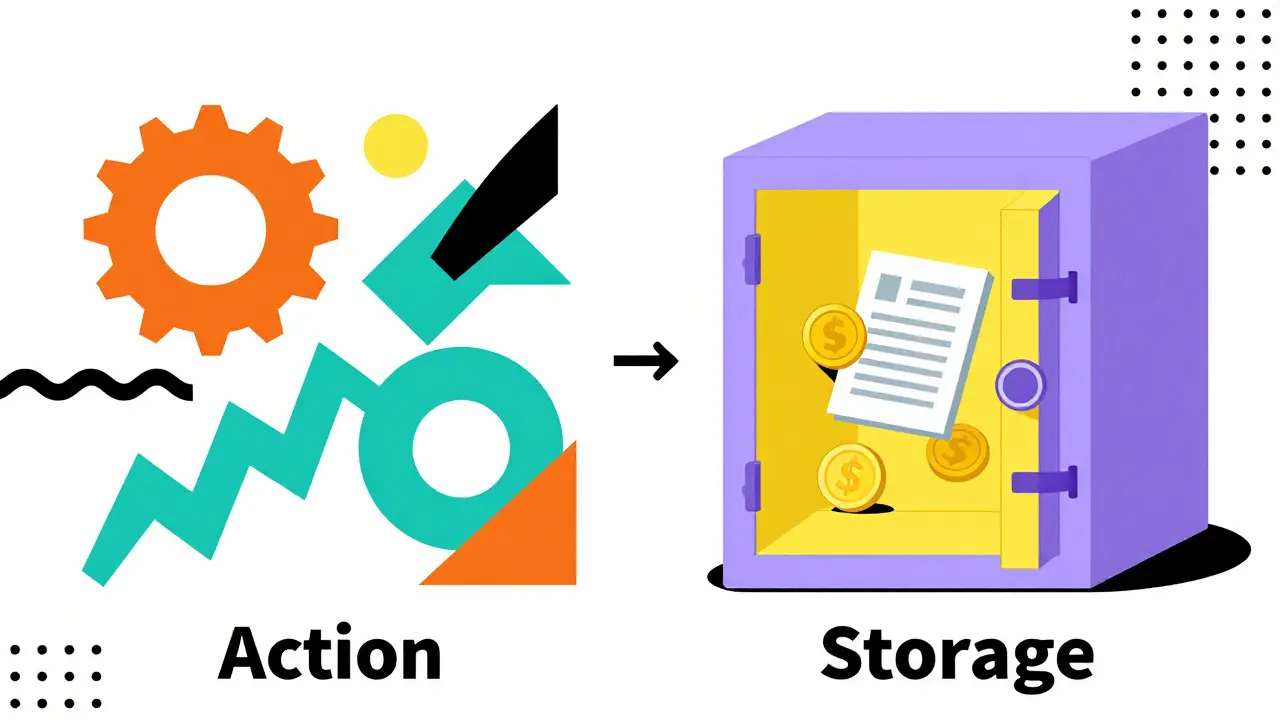
To understand the difference, look at what each entity does mechanically. A Trading Account is a brokerage account used to execute buy and sell orders on stock exchanges. It acts as the bridge between you and the exchange. When you click "Buy" on an app like Zerodha Kite or Groww, that command travels through your trading account to the exchange's matching engine. Without it, you cannot participate in the market. However, it does not hold your assets. It only processes the deal.
A Demat Account, short for Dematerialized Account, is an electronic wallet that holds financial securities in digital form. Think of it as your bank account, but instead of cash, it stores shares, mutual funds, bonds, and ETFs. If you buy 10 shares of Reliance Industries, those 10 shares appear in your demat account within T+2 days (the settlement cycle). The trading account just facilitated the handshake; the demat account now owns the result.
| Feature | Trading Account | Demat Account |
|---|---|---|
| Primary Purpose | Execute buy/sell orders | Hold securities electronically |
| Asset Holding | No (Cash balance only) | Yes (Shares, Bonds, MFs) |
| Regulator | SEBI (via Brokers) | SEBI (via Depositories) |
| Provider | Stock Brokers (e.g., Zerodha, ICICI) | Depositories (CDSL, NSDL) |
| Cost Structure | Brokerage fees per trade | Annual Maintenance Charge (AMC) |
Who Manages What? Brokers vs Depositories
This is where most people get tripped up. Who do you call when something goes wrong? For your trading account, you talk to your Stock Broker. This is the company that gives you the app or website. Examples include Zerodha, Angel One, or HDFC Securities. They are registered with SEBI to facilitate trades. Their job is to provide the platform, charge brokerage, and ensure your order reaches the exchange quickly.
For your demat account, you interact with a Depository. In India, there are only two authorized depositories: CDSL (Central Depository Services Limited) and NSDL (National Securities Depository Limited). Your broker acts as a "Depository Participant" (DP), meaning they open the demat account for you under the umbrella of either CDSL or NSDL. So, while you might log in via your broker's app, the actual custody of your shares lies with CDSL or NSDL. This separation ensures that even if your broker goes bankrupt, your shares are safe because they are held by the depository, not the broker.
The Money Flow: How Settlement Works
Let’s walk through a specific scenario to see how these accounts interact. Suppose you want to buy 5 shares of Tata Motors at ₹800 each. Total cost: ₹4,000 plus taxes and charges.
- Fund Transfer: You transfer ₹4,200 from your bank account to your trading account linked bank account. This money sits in your trading account balance, ready for use.
- Order Placement: You place a buy order in your trading app. The broker sends this to the NSE/BSE.
- Trade Execution: The exchange matches your buy order with a seller. The trade is confirmed.
- Settlement (T+2): Two business days later, the money leaves your trading account and goes to the seller. Simultaneously, the 5 shares move from the seller’s demat account to your demat account.
- Final State: Your trading account shows a reduced cash balance. Your demat account shows +5 Tata Motors shares.
If you sold those shares, the process reverses. The shares leave your demat account, and the cash lands in your trading account. You can then withdraw that cash to your bank. Notice that the demat account never sees cash, and the trading account never sees physical share certificates. They work in tandem but handle different types of value.

Costs and Fees: What You Actually Pay
Understanding the fee structure helps avoid surprises. These two accounts have distinct cost models.
- Trading Account Costs: You pay brokerage every time you trade. Discount brokers like Zerodha charge a flat fee (e.g., ₹20 or 0.03% of turnover, whichever is lower) for equity delivery trades. Full-service brokers may charge higher percentages. There is usually no monthly fee just for keeping the trading account open.
- Demat Account Costs: You pay an Annual Maintenance Charge (AMC). This typically ranges from ₹300 to ₹700 per year, depending on the broker/depository combo. Additionally, there is a one-time opening charge (often waived during promotions) and stamp duty on purchases (0.1% of transaction value).
A common pitfall is forgetting the AMC. If you rarely trade but keep a large portfolio, the fixed AMC is negligible. But if you are a day trader making 50 trades a month, the brokerage costs will dwarf the AMC. Conversely, if you are a long-term investor buying once a year, the AMC becomes a significant recurring cost relative to your activity.
Why Do You Need Both?
Can you have a demat account without a trading account? Technically, yes, if you invest directly in mutual funds or SIPs, which often bypass the trading execution layer. But for direct stock investing, you need both. Why? Because the exchange requires a verified identity for trading (trading account) and a verified custody location for assets (demat account). They serve different regulatory and operational purposes.
Many brokers offer a combined service called a "Combined Account." When you sign up, they open both simultaneously. You get one login ID, one bank linkage, and one dashboard. This simplifies the user experience. You don’t manage two separate entities; you manage one relationship with the broker, who handles the backend split between the trading execution and the depository custody.

Common Mistakes Beginners Make
Even with clear definitions, errors happen. Here are three frequent issues:
- Confusing Balance Types: Seeing money in your trading account doesn't mean you own shares. It means you have purchasing power. Seeing shares in your demat account doesn't mean you have cash. You must sell them to convert back to liquid funds in your trading account.
- Ignoring Settlement Cycles: New investors often think shares appear instantly. Remember the T+2 rule. If you buy on Monday, shares arrive Wednesday. If you sell on Monday, cash arrives Wednesday. Planning liquidity around this cycle prevents failed trades due to insufficient funds or shares.
- Choosing the Wrong Depository: While CDSL and NSDL are functionally identical for most users, some brokers have better integration with one than the other. Check if your preferred broker offers lower AMC for CDSL or NSDL before signing up. Once opened, switching depositories is possible but involves paperwork and potential downtime.
FAQ
Can I have a demat account without a trading account?
Yes, but it is limited. You can open a standalone demat account to hold mutual funds, bonds, or IPO applications. However, to buy and sell individual stocks on the exchange, you need the trading account component to execute those orders. Most retail investors open both together.
Which is better: CDSL or NSDL?
There is no functional difference for the average investor. Both are SEBI-registered and secure. The choice often depends on which depository your preferred broker partners with for lower fees. CDSL has a slightly larger market share in retail demat accounts, while NSDL has a strong institutional presence. Check your broker's AMC rates for each.
What happens to my shares if my broker goes bankrupt?
Your shares are safe. They are held in your name at the depository (CDSL or NSDL), not at the broker. The broker is just a participant. In a bankruptcy scenario, your demat account would be transferred to another DP (Depository Participant) without losing ownership. Your cash in the trading account, however, should be kept in a separate bank account linked to the broker to minimize risk.
Do I need a PAN card to open these accounts?
Yes. A valid PAN card is mandatory for both trading and demat accounts in India. It serves as your primary tax identification. You also need a KYC-compliant address proof and a bank account with IFSC code for fund transfers.
How long does it take to open a trading and demat account?
With online KYC, the process is instant. Upload your documents, complete video verification, and sign digitally. You can start trading the same day. If using offline methods, it may take 3-5 business days for physical document verification and account activation.